
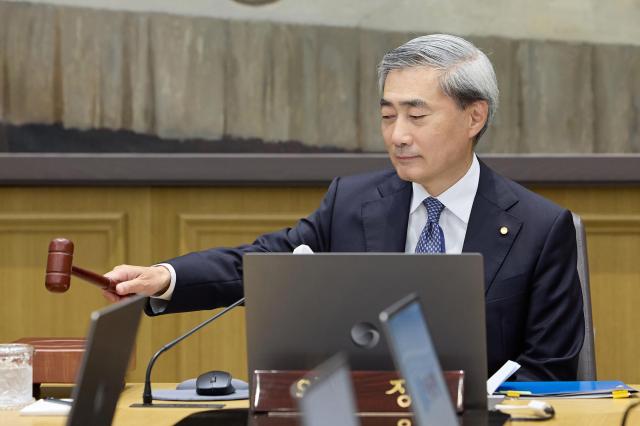
Bank of Korea Governor Shin Hyun-sung strikes the gavel. [Photo=Bank of Korea]
The Bank of Korea's Monetary Policy Committee decided on May 28 to keep the benchmark interest rate at 2.50% for the eighth consecutive time. However, for the first time, the committee's policy statement indicated a potential timeline for future rate hikes, suggesting a shift towards tightening monetary policy.
In the statement, the committee noted, "Future monetary policy will be determined by assessing the extent of inflationary pressures, the trajectory of economic improvement, and financial stability conditions, including the timing of interest rate increases."
The committee projected that domestic inflation rates would exceed target levels for an extended period, stating, "Despite the impact of the Middle East conflict, growth is expected to continue improving, supported by a strong semiconductor market."
During the decision-making process, five committee members voted to maintain the current rate, while members Jang Yong-seong and Yoo Sang-dae expressed a minority opinion favoring an increase to 2.75%.
Full text of the monetary policy statement:
The Monetary Policy Committee has decided to maintain the Bank of Korea's benchmark interest rate at the current level of 2.50% until the next policy direction decision. While inflationary pressures have increased due to the Middle East conflict, growth has expanded more than expected, driven by strong exports, particularly in semiconductors. Financial stability risks persist, but given the high uncertainty surrounding the developments in the Middle East and their potential impacts, it is deemed appropriate to maintain the current rate while closely monitoring the situation and its effects on growth and inflation.
The global economy is expected to slow due to rising energy and commodity prices and supply disruptions stemming from the Middle East conflict, despite increased investments in artificial intelligence. Inflationary pressures are anticipated to rise significantly. In international financial markets, U.S.-Iran negotiation delays and potential shifts in major countries' monetary policies have led to a sharp increase in government bond yields, while the U.S. dollar has strengthened. Stock prices have surged, reflecting expectations of increased AI investment demand and strong corporate earnings. Going forward, the global economy and international financial markets are expected to be influenced by the developments in the Middle East, trends in AI investment, and changes in major countries' monetary, fiscal policies, and trade environments.
Domestically, the economy has seen significant growth driven by strong exports and investment, particularly in semiconductors, along with healthy consumer spending. Employment has continued to rise, although the pace of increase has slowed, particularly in the service sector. While the domestic economy may face some pressures from rising commodity prices and supply chain disruptions, it is expected to continue improving, supported by the semiconductor market and supplementary budgets. As a result, this year's growth rate is projected to exceed the February forecast of 2.0%, reaching 2.6%. This growth trajectory carries substantial upside and downside risks related to the semiconductor market's expansion, domestic demand impacts, developments in the Middle East, and changes in the trade environment.
In terms of domestic prices, the consumer price inflation rate rose significantly to 2.6% in April, driven by a sharp increase in oil prices, while the core inflation rate (excluding food and energy) remained at 2.2%. Short-term inflation expectations among the public are in the high 2% range. Price increases are expected to continue, influenced by rising international oil prices and increasing demand pressures from income growth. Consequently, this year's consumer price and core inflation rates are projected to significantly exceed the February forecasts of 2.2% and 2.1%, respectively, reaching 2.7% and 2.4%. Future price trajectories are subject to high uncertainty regarding international oil prices, exchange rate movements, the extent of cost increases, and the effectiveness of government price stabilization measures.
In the financial and foreign exchange markets, high volatility in key price variables has persisted. Government bond yields have risen sharply due to concerns over domestic and international inflation and changing expectations regarding monetary policy. The won-dollar exchange rate, which had slightly decreased, has risen again to around 1,500 won due to the strengthening of the U.S. dollar and continued foreign selling of stocks. Stock prices have experienced significant fluctuations influenced by the developments in the Middle East, but have maintained a steep upward trend due to improved corporate earnings expectations. Housing prices in the metropolitan area have resumed their upward trend, with increased expectations for further rises, while household loans have shown limited growth, although the increase in housing-related loans has slightly expanded.
The Monetary Policy Committee will continue to monitor growth trends while ensuring that inflation rates stabilize at target levels over the medium term, paying attention to financial stability. The domestic economy is expected to see inflation rates exceed target levels for an extended period, and growth is anticipated to remain robust, supported by the semiconductor market despite the impact of the Middle East conflict. In terms of financial stability, there are ongoing concerns regarding high exchange rate volatility and the housing market and household debt situation in the metropolitan area. Therefore, future monetary policy will be determined by assessing the extent of inflationary pressures, the trajectory of economic improvement, and financial stability conditions, including the timing of interest rate increases.
In this interest rate decision, five members of the Monetary Policy Committee voted in favor, while Jang Yong-seong and Yoo Sang-dae expressed the opinion that an increase to 2.75% would be appropriate.
* This article has been translated by AI.
Copyright ⓒ Aju Press All rights reserved.