
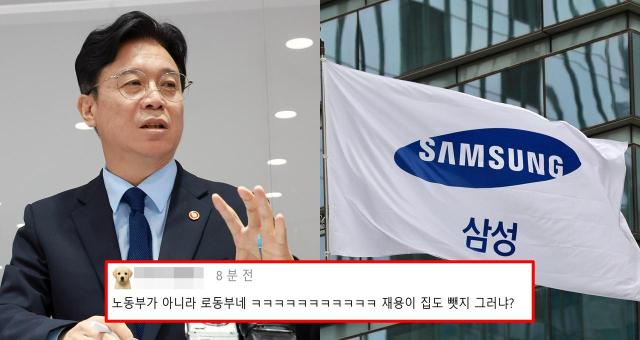
Labor Minister Kim Young-hoon announced plans to hold an urgent discussion on how to redistribute the "astronomical excess profits" of large corporations amid the ongoing Samsung strike. The announcement has sparked reactions from netizens.
During a press briefing at the Government Sejong Center, Minister Kim stated, "I would like to open a discussion on how to socially redistribute the excess profits of large companies and explore the possibilities of a Korean-style social solidarity wage policy." He revealed that the urgent discussion is scheduled for June 1.
Kim explained that the discussion aims to set the agenda and initiate dialogue before formal labor-management negotiations. He referred to the event as a "tentative discussion on the possibilities of a Korean-style social solidarity wage policy."
The social solidarity wage policy is a labor initiative aimed at reducing wage disparities between large and small businesses, as well as between regular and non-regular workers. It involves using the funds saved from restraining wage increases for high-income workers to boost the wages or welfare of vulnerable workers. The Rehn-Meidner Model from Sweden is a notable example.
While acknowledging that applying Sweden's social solidarity fund model directly to Korea is nearly impossible, Kim emphasized the importance of upholding its spirit. He expressed a desire to foster social dialogue aimed at collective well-being.
"We must reflect deeply and rationally on this issue, and the solution ultimately lies in social dialogue," Kim said. He added, "The success of Samsung Electronics is not only due to the dedication of its labor and management but also the contributions of all communities and society. If we agree that this success should be redistributed socially, then the solution is social dialogue."
He further clarified, "We need to discuss how to share the pure profits remaining after excluding taxes, interest, depreciation, and other financial costs. This is not about the government collecting more taxes or directly intervening in distribution, but rather about labor and management autonomously seeking ways to achieve mutual growth and reduce disparities in the labor market alongside the primary distribution of taxes."
However, netizens have expressed criticism in response to the report.
Comments included, "What excess profits does a private company have?" and "If there are losses, the government won't take responsibility, so why discuss sharing profits?" Others questioned, "Why is the government discussing the distribution of corporate profits? Isn't that a communist idea?" Some suggested, "If you want to share profits, buy stocks," and remarked, "Only Lee Jae-yong suffers in this structure."
Some commenters acknowledged the issue of disparities between subcontractors and non-regular workers but argued that it is excessive for the government to address profit distribution in private companies.
Meanwhile, Samsung Electronics' labor and management recently reached a dramatic agreement after mediation by the Central Labor Relations Commission, averting a total strike. However, discussions surrounding the bonus system and excess profit distribution are expected to continue in the political and labor sectors for the foreseeable future.
* This article has been translated by AI.
Copyright ⓒ Aju Press All rights reserved.