
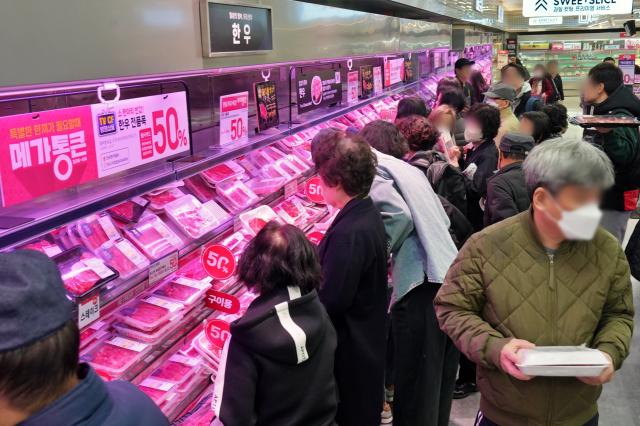
In the first quarter of this year, household consumption showed signs of recovery, but income growth lagged behind, leaving many low-income families feeling significant financial strain. Notably, the trend of 'deficit spending' is deepening among lower-income households, where expenditures exceed income.
According to the National Data Agency's "2026 Q1 Household Trend Survey" released on May 28, the average monthly income per household reached 5.481 million won, a 2.4% increase compared to the same period last year. However, the real income growth rate, adjusted for inflation, was only 0.4%.
Household spending rose to 3.105 million won, marking a 5.3% increase that significantly outpaced income growth. Consequently, the average household surplus decreased by 3.1% to 1.239 million won, while the average consumption propensity rose by 1.7 percentage points to 71.5%. This consumption propensity indicates the proportion of disposable income spent, suggesting that households are left with less disposable income.
The recovery in consumer spending, which began in the previous quarter, has become more pronounced. Notably, expenditures on transportation and logistics surged by 12.1%, while spending on entertainment and culture increased by 12.0%, and health expenditures rose by 10.4%. This reflects a simultaneous increase in car purchases, a rebound in overseas travel demand, and rising medical costs. Analysts suggest that the recovery in consumer sentiment, stock market rebounds, and rising asset prices since late last year have contributed to some increase in spending capacity.
However, the benefits of this recovery are not evenly distributed across income levels. Households in the lowest income quintile saw their average monthly income rise by only 2.7% to 1.17 million won, while their spending increased by 7.3%. Their average consumption propensity stood at 155.3%, indicating that their spending exceeds their disposable income. This suggests that many households are relying on debt or depleting existing assets to cover living expenses.
In contrast, households in the highest income quintile experienced a 4.2% increase in average monthly income to 12.378 million won, with disposable income rising by 5.1%. Their spending also increased by 6.9%, but their average consumption propensity remained at a stable 57.7%. This indicates that higher-income households are seeing faster income growth and relatively stable spending capacity.
The income gap continues to widen, with the income quintile ratio based on equalized disposable income rising to 5.91 times, up from 5.82 times a year earlier. Equalized disposable income accounts for differences in household size, serving as a measure of actual living standards. A higher ratio indicates a deepening income polarization. Despite increases in government transfer income, the widening gap in market income remains a concern.
Notably, the growth rate of earned income has slowed. In the first quarter of this year, earned income rose by only 0.3% to 3.422 million won. This reflects a base effect from last year's significant increases due to improvements in the semiconductor industry and expanded bonuses, as well as a slowdown in employment in manufacturing and construction.
Conversely, transfer income increased by 9.7%, driving overall income growth. This rise is attributed to increases in public transfer income, such as national pensions and basic pensions, as well as expanded government support. In fact, a similar trend of rising transfer income was observed in the fourth quarter of last year, which helped sustain overall household income.
* This article has been translated by AI.
Copyright ⓒ Aju Press All rights reserved.