
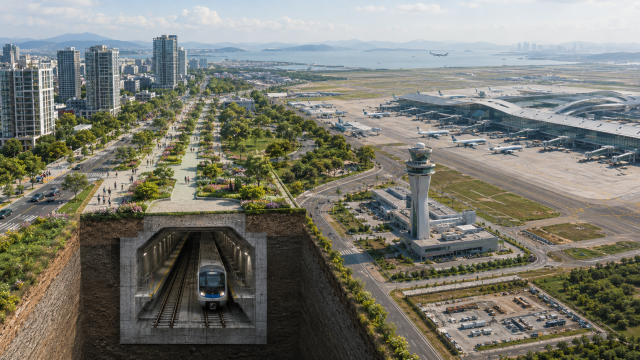
As the June 3 local elections approach, promises surrounding major social overhead capital (SOC) projects, including the underground Gyeongbu Line and new airport construction, have become a focal point. Candidates for key metropolitan mayoral positions in Busan, Gyeonggi, and Daegu are unveiling ambitious development plans that integrate airport facilities, rail systems, and industrial complexes as part of their regional growth strategies. However, concerns have been raised regarding the funding structure and feasibility of these long-term projects, particularly as the underground rail relies on profits from above-ground development and the new airport is contingent on the development of residual land after relocation.
According to the construction and real estate sectors on May 28, Busan is the fastest among the regions proposing the underground Gyeongbu Line as a common pledge. The city was included in the Ministry of Land, Infrastructure and Transport's first pilot project for integrated underground rail development last year, marking its entry into national project status.
The basic planning phase has begun for the section between Gaya and Busanjin, with a target construction start date set for 2030. Discussions are also underway regarding the development of the above-ground rail land to finance the project, which has led to a relatively optimistic assessment of its feasibility.
In addition, Jeon Jae-soo, the Democratic Party's candidate for Busan mayor, has proposed creating a green pedestrian corridor connecting a public park on the above-ground site to the North Port. The People Power Party's candidates, including Park Hyung-jun for Busan mayor and Park Min-sik for the Busan Buk-gap National Assembly by-election, have pledged to include the 8.7 km section of the Gyeongbu Line from Gupo to Gaya in the underground rail project.
In Incheon, Democratic Party candidate Park Chan-dae has suggested the undergrounding of the Gyeongin Line connecting Incheon and Guro in Seoul, but is currently awaiting inclusion in the national comprehensive plan. People Power Party candidate Yoo Jeong-bok has emphasized expanding Incheon’s subway lines 1, 2, and 3, as well as linking the metropolitan express train (GTX) and KTX services from Incheon, stating, "We will make all of Incheon a transit-oriented development area."
Seoul has presented its own underground rail plan, but it is also waiting for inclusion in the national comprehensive plan. The proposal aims to finance the project through development profits estimated at 25.6 trillion won, generated from above-ground developments around Seoul Station and Yongsan Station. However, these profits may fluctuate based on real estate market conditions and the extent of high-density development permitted. The section from Cheonan Station to Dujeong is not included in the first pilot project, leading to a low likelihood of short-term progress.
The new airport promises have emerged as key issues in various regions. In Busan, the focus is on the Gadeokdo New Airport, which is central to the vision of an "aeronautical logistics hub."
Candidate Jeon Jae-soo has proposed accelerating the airport's opening and establishing an integrated logistics hub connecting the North Port and Busan Port, along with relocating maritime institutions and establishing a maritime court, to form an economic zone in the southern region.
Candidate Park Hyung-jun has emphasized the goal of early airport opening by 2032, proposing the creation of an "Air City" as a complex city behind the airport, along with relocating the Industrial Bank and enacting special laws to consolidate aviation, industry, and tourism functions.
In Daegu, the Daegu-Gyeongbuk Integrated New Airport is the top priority, with total project costs estimated at 15 trillion won. While there are differences in funding methods, the overarching goal remains to establish a new economic zone centered around the airport.
Democratic Party candidate Kim Boo-kyum has stated that alongside the early promotion of the new airport, he aims to develop a "Digital Transformation Valley" that combines advanced industries, knowledge services, and youth entrepreneurship on the land remaining after the airport's relocation. People Power Party candidate Choo Kyung-ho has stressed the need to promote the airport construction as a national project and has proposed simultaneous development of an Air City in the Gunwi and Uiseong areas and a global complex city on the residual land.
The challenge remains that most of these pledges require substantial funding and long-term financial planning. While the underground Gyeongbu Line is proposed to be financed through above-ground development profits, its profitability may be affected by fluctuations in the real estate market. Similarly, the new airport project must navigate complex procedures, including national plan inclusion, preliminary feasibility studies, and private investment eligibility assessments, making it difficult to expect visible results in the short term.
The Busan Economic Justice Coalition has also criticized the pledges from both parties, stating, "The financial planning lacks specificity and the funding structure is weak." They pointed out that all candidates exhibit instability in financial planning, a lack of quantitative performance targets, dependence on the central government, and insufficient mechanisms for resident participation, raising significant concerns about the feasibility of fulfilling these promises.
An industry insider noted, "While the underground rail and new airport can serve as long-term growth strategies for the region, when presented as election pledges, it is essential to consider the funding methods, construction timelines, and the basis for estimating development profits. Although they appear to be transportation promises, they are fundamentally real estate development projects contingent on above-ground and residual land development."
* This article has been translated by AI.
Copyright ⓒ Aju Press All rights reserved.