
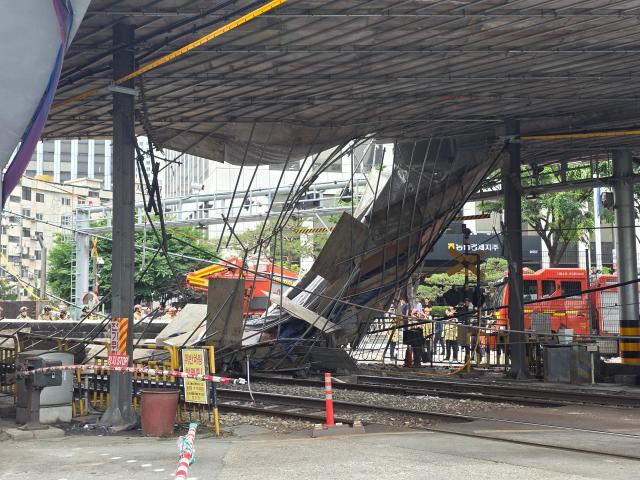
The recent collapse at the Seosomun Overpass demolition site and the missing rebar issue at the Samsung Station GTX construction site may appear to be separate incidents, but they share a common root: a persistent culture that prioritizes cost and speed over safety.
On May 28, President Lee Jae-myung stated, "Money cannot be more valuable than life," calling for thorough investigations and accountability from relevant agencies. He criticized the "distorted practices" that place money and efficiency above safety, underscoring the seriousness of accidents in the public sector.
These incidents are particularly alarming because they occurred in public domains responsible for citizen safety and large infrastructure projects. The Seosomun Overpass accident was a major safety incident in the heart of the city, while the missing rebar issue has raised significant public anxiety. The absence of rebar is not merely a construction error; it raises doubts about whether the entire system of design, supervision, construction, and management is functioning properly.
Korean society has repeatedly vowed that such large-scale disasters must never happen again. However, over time, vigilance wanes, and the logic of cost-cutting and expedited timelines resurfaces, often at the expense of safety. On-site, resources and personnel are reduced, and within the layers of subcontracting, accountability becomes blurred. In many cases, when accidents occur, only a few workers face consequences.
May 28 also marks the 10th anniversary of the Guui Station tragedy, where a 19-year-old worker was killed by a train while repairing a screen door. At that time, society strongly criticized the outsourcing of risk and inadequate safety management. Yet, a decade later, workers continue to lose their lives in industrial settings, and issues of substandard construction and safety violations persist.
There is growing concern that the temptation to cut safety costs is increasing amid economic downturns and profitability pressures. This trend is not limited to construction and civil engineering; it is also intensifying across manufacturing, logistics, and platform industries, where competition prioritizes "efficiency" and "speed." However, viewing safety as a cost inevitably leads to predictable disasters.
Both corporations and public institutions must fundamentally change their mindset. Safety should be seen as an investment, not an expense. Adhering to safety regulations is not optional; it is a minimum obligation. Relying solely on post-accident measures and punishing responsible parties will not prevent recurrence. Safety standards must be reinforced throughout the entire process, from design to construction, operation, and supervision, with clear accountability for violations, regardless of rank.
The political sphere must also move away from using safety issues as fodder for partisan conflict. Each time a major accident occurs, the focus on blaming the opposing side has prevented the resolution of structural problems on the ground. What the public desires is not political bickering but effective measures to prevent recurrence.
A nation's status is not determined solely by its skyscrapers or advanced technology. More importantly, it is about whether citizens can live, work, and move about safely. A society where safety is compromised cannot be considered advanced. It is time to reaffirm the fundamental principle that "life takes precedence over money."
On May 28, President Lee Jae-myung stated, "Money cannot be more valuable than life," calling for thorough investigations and accountability from relevant agencies. He criticized the "distorted practices" that place money and efficiency above safety, underscoring the seriousness of accidents in the public sector.
These incidents are particularly alarming because they occurred in public domains responsible for citizen safety and large infrastructure projects. The Seosomun Overpass accident was a major safety incident in the heart of the city, while the missing rebar issue has raised significant public anxiety. The absence of rebar is not merely a construction error; it raises doubts about whether the entire system of design, supervision, construction, and management is functioning properly.
Korean society has repeatedly vowed that such large-scale disasters must never happen again. However, over time, vigilance wanes, and the logic of cost-cutting and expedited timelines resurfaces, often at the expense of safety. On-site, resources and personnel are reduced, and within the layers of subcontracting, accountability becomes blurred. In many cases, when accidents occur, only a few workers face consequences.
May 28 also marks the 10th anniversary of the Guui Station tragedy, where a 19-year-old worker was killed by a train while repairing a screen door. At that time, society strongly criticized the outsourcing of risk and inadequate safety management. Yet, a decade later, workers continue to lose their lives in industrial settings, and issues of substandard construction and safety violations persist.
There is growing concern that the temptation to cut safety costs is increasing amid economic downturns and profitability pressures. This trend is not limited to construction and civil engineering; it is also intensifying across manufacturing, logistics, and platform industries, where competition prioritizes "efficiency" and "speed." However, viewing safety as a cost inevitably leads to predictable disasters.
Both corporations and public institutions must fundamentally change their mindset. Safety should be seen as an investment, not an expense. Adhering to safety regulations is not optional; it is a minimum obligation. Relying solely on post-accident measures and punishing responsible parties will not prevent recurrence. Safety standards must be reinforced throughout the entire process, from design to construction, operation, and supervision, with clear accountability for violations, regardless of rank.
The political sphere must also move away from using safety issues as fodder for partisan conflict. Each time a major accident occurs, the focus on blaming the opposing side has prevented the resolution of structural problems on the ground. What the public desires is not political bickering but effective measures to prevent recurrence.
A nation's status is not determined solely by its skyscrapers or advanced technology. More importantly, it is about whether citizens can live, work, and move about safely. A society where safety is compromised cannot be considered advanced. It is time to reaffirm the fundamental principle that "life takes precedence over money."
* This article has been translated by AI.
Copyright ⓒ Aju Press All rights reserved.