
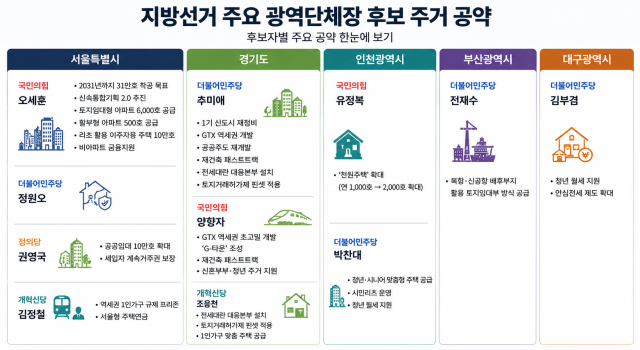
As the June 3 local elections approach, candidates for regional leadership positions are unveiling various housing models, including 1,000-won housing, citizen REITs, installment apartments, and land lease housing. These policies target young people, newlyweds, and those displaced by redevelopment projects. However, an analysis of the official five-point pledges submitted to the National Election Commission on May 28 reveals that few candidates have provided specific details regarding supply volume, funding, pricing conditions, or implementation pathways.
The analysis categorized the new housing models proposed by candidates into land lease, installment, REITs, 1,000-won housing, and social housing. This review focused on the extent to which the official pledges outlined the supply entities, funding sources, volume, pricing conditions, and execution methods, rather than ranking the merits or effectiveness of the policies.
In Seoul, Oh Se-hoon, the candidate from the People Power Party, proposed land lease apartments, installment apartments, and housing for migrants utilizing REITs, along with financial support for non-apartment construction. Oh aims to initiate the construction of 310,000 units by 2031 through the Rapid Integrated Planning 2.0 initiative, with plans to supply 6,000 land lease apartments and 500 installment apartments. His proposal also includes 100,000 units of REITs-based housing for migrants and financial support for non-apartment construction.
While the official pledge document provides relatively detailed information on supply volume and business methods, actual occupancy may take time due to the construction timeline. Additionally, the land lease housing model's success depends on land acquisition methods and consumer preferences. The installment apartments also require further clarification on repayment structures and the timing of ownership transfer in subsequent plans.
In the Incheon mayoral race, Yoo Jeong-bok from the People Power Party stands out with his pledge for 1,000-won housing, aiming to expand the current program, which operates at 1,000 units annually, to 2,000 units. While this expansion is based on an existing policy, the official pledge document does not sufficiently clarify land acquisition strategies, target demographics, locations, or selection criteria.
Park Chan-dae, the Democratic Party candidate for Incheon mayor, has promised housing tailored for youth and seniors, citizen REITs, Incheon-style social housing, and rental support for young people. However, the operational structure of the citizen REITs, supply volume, and profit-sharing methods are not clearly outlined in the official pledge document. Similarly, details regarding the supply areas, methods, and volume for Incheon-style social housing require further explanation.
In Busan, Jeon Jae-soo from the Democratic Party proposed public SPC land lease supply utilizing the North Port and the area behind the new airport. However, this proposal is intertwined with other development projects, making it difficult to assess the timing and volume of housing supply separately.
In Sejong, candidate Jo Sang-ho proposed supplying 1,000 units of basic housing for youth, while Choi Min-ho proposed 3,000 units of rental housing exclusively for civil servants. Yet, the official pledge documents still need additional details on supply methods, pricing conditions, funding structures, and land acquisition plans.
Experts emphasize the importance of evaluating supply volume, funding, and execution pathways rather than merely focusing on the new housing models. The supply shortage in Seoul and the surrounding metropolitan area is linked to a lack of new construction in urban centers, suggesting that small-scale models targeting specific demographics may not sufficiently alleviate overall market instability.
Song Seung-hyun, CEO of Urban and Economy, stated, "Seoul's supply expansion pledges must also address business viability and regulatory easing. The level of detail in execution plans will influence the credibility of the pledges."
Seo Jin-hyung, a professor at Kwangwoon University, noted that while recent housing welfare policies are shifting from selective to universal welfare, the critical issue remains securing funding. He added, "While redevelopment projects can increase supply, they may also trigger price hikes, necessitating complementary policies."
Kim Je-kyung, head of Tumi Real Estate Consulting, remarked, "Among local election pledges, policies related to redevelopment projects can have the most direct impact on the market, as they are linked to the Seoul city's permitting authority. It is essential to assess the candidates' genuine commitment and sincerity in their proposals."
* This article has been translated by AI.
Copyright ⓒ Aju Press All rights reserved.