
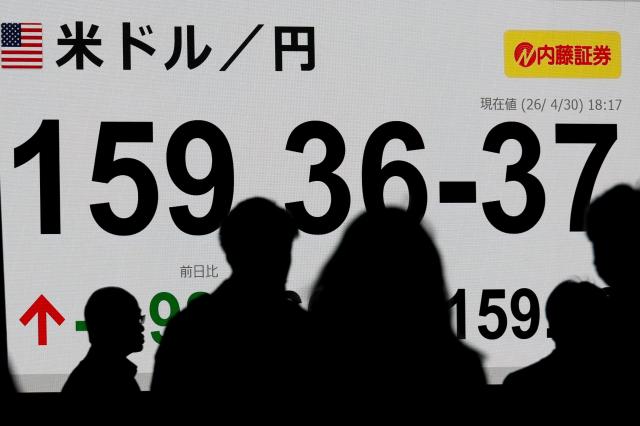
The Japanese yen is once again nearing the 160 mark against the dollar. Following a market intervention by Japanese authorities at the end of April that temporarily pushed the yen back to the mid-155 range, it has slipped back to the mid-159 range within a month. The 160 yen defense line, which was barely maintained, is now being tested again.
According to the Nihon Keizai Shimbun (Nikkei), the yen was trading at 159.57 to 159.58 yen per dollar in the Tokyo foreign exchange market on the afternoon of May 28. This represents a 0.22 yen increase (indicating a decline in yen value) compared to the previous day. At one point in the morning, the yen rose to around 159.60, marking its highest level since April 30. Reports of renewed tensions between the U.S. and Iran during negotiations have driven up oil futures prices, contributing to concerns about Japan's trade balance, which continues to weigh on the yen, according to Nikkei.
However, attributing the yen's return to the 160 level solely to Middle Eastern factors is insufficient. During this period, Japan has seen rising long-term interest rates and a record current account surplus, while concerns about market intervention remain. All three factors typically support a stronger yen, yet the currency has weakened. Market attention has shifted to why these factors are failing to support the yen.
The most notable aspect is the divergence between long-term interest rates and the yen's performance. Generally, rising government bond yields enhance the attractiveness of a currency. However, in Japan, despite rising long-term interest rates, there has not been a corresponding increase in yen buying. Nikkei reported that the gap between U.S. and Japanese long-term interest rates has narrowed over the past year, yet the yen's weakness persists. The market interprets the rise in Japanese long-term rates not as a sign of economic recovery or normalization of monetary policy, but rather as a reflection of fiscal risks and concerns that the Bank of Japan is lagging in addressing inflation.
The impact of interest rate changes on exchange rates varies based on market interpretation. If rising rates signal that the Japanese economy is normalizing, it could lead to yen buying. Conversely, if they signal that higher returns are needed to hold Japanese government bonds, it could indicate anxiety about Japanese assets. Currently, the latter interpretation is gaining traction, making it difficult for foreign capital to actively purchase Japanese government bonds and the yen, even as yields rise.
Another complicating factor for the yen's weakness is Japan's external balance. Daisuke Karakama, chief market economist at Mizuho Bank, recently noted that Japan's current account surplus for 2025 is projected to reach 34.52 trillion yen, marking a record high for three consecutive years, while the trade balance has returned to surplus for the first time in five years. On the surface, these statistics suggest little reason for the yen to weaken.
However, in the foreign exchange market, what matters is not just the statistical surplus but the actual flow of money leading to yen purchases. If dollars earned overseas do not convert to yen upon entering Japan but are reinvested locally or remain in foreign asset forms, the current account surplus does not increase yen demand. Karakama pointed out that while Japan's current account surplus for January to March was 9.54 trillion yen, the actual cash flow surplus, excluding overseas reinvestment income that does not lead to yen purchases, was only about 1.6 trillion yen.
The concern is what will happen if oil prices rise again. With the yen unable to escape its weakness despite a record current account surplus, an increase in oil prices could jeopardize the trade surplus that has been supporting the external balance. Karakama analyzed that the decline in oil prices last year was a key factor in Japan's return to a trade surplus. If geopolitical instability in the Middle East leads to higher oil import costs, the trade balance could deteriorate over time, increasing selling pressure on the yen.
The remaining safety net is the possibility of market intervention by authorities. As the yen approaches 160 again, there are growing concerns that Japanese authorities may intervene in the market, similar to April. However, even if intervention temporarily boosts the yen, it does not eliminate the underlying pressure for a weaker yen.
The yen still has a low funding cost compared to major currencies. With major overseas stock markets rising, investor sentiment for risk assets is also reviving. In this environment, even if intervention temporarily strengthens the yen, the yen carry trade—where investors borrow yen to invest in higher-yielding assets like dollars—could resurface, renewing selling pressure on the yen. Nikkei noted that if intervention leads to a rebound in the yen, long-term selling pressure from carry trades could quickly reemerge, further pushing the yen down. Therefore, the market suggests that even if the Bank of Japan raises rates in June, without a clear commitment to further increases, it will be difficult to curb carry trades, and the effect on yen appreciation will be limited.
Ultimately, all three trends converge on one point: rising long-term interest rates, a record current account surplus, and the potential for market intervention are not being interpreted as compelling reasons to buy the yen. Concerns about fiscal and inflation instability accompany interest rates, while the current account surplus is hindered by a lack of actual yen buying demand, and intervention faces limitations due to carry trades.
To prevent further yen depreciation, the Bank of Japan must demonstrate a willingness to raise rates, but its options are not straightforward. Raising rates could trigger instability in the long-term bond market and increase long-term interest rates. According to Nikkei, Japan's 10-year government bond yield recently reached 2.8%, the highest level in 29 and a half years, indicating an already unstable situation.
The Bank of Japan will discuss the possibility of further rate hikes and plans to reduce government bond purchases at its monetary policy meeting next month. Slowing the pace of bond purchase reductions could stabilize the bond market, but it may also delay the withdrawal of liquidity from the market, increasing pressure for a weaker yen. The strategies to prevent yen depreciation and stabilize the bond market are in conflict. The market is closely watching the next move of the Bank of Japan, which finds itself in a difficult position.
* This article has been translated by AI.
Copyright ⓒ Aju Press All rights reserved.