
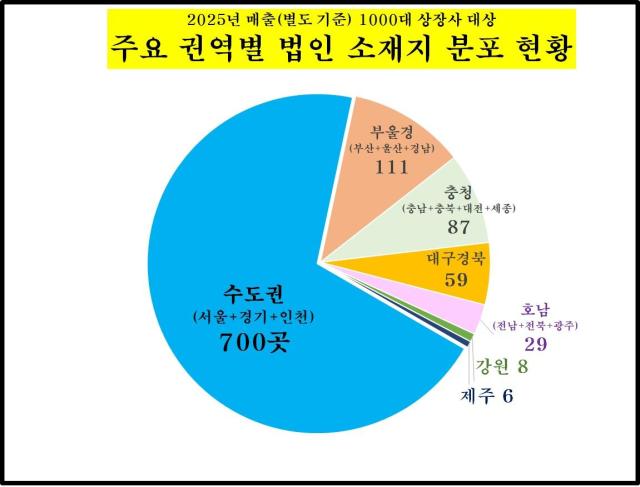
A recent report reveals that 70% of South Korea's top 1,000 listed companies are headquartered in the capital region. Despite discussions about relocating public institutions and businesses to provincial areas since the launch of the Lee Jae-myung administration, the concentration of corporate headquarters in Seoul and Gyeonggi Province remains strong. Notably, larger companies tend to be more concentrated in Seoul, while the Busan-Ulsan-Gyeongnam (BULG) area shows relative strength among non-capital regions.
According to the Korea CXO Research Institute's analysis of the locations of the top 1,000 listed companies by revenue in 2025, 700 of these companies are based in the capital region, which includes Seoul, Gyeonggi, and Incheon.
The analysis focused on the top 1,000 listed companies based on individual and separate revenue figures from last year, using the corporate addresses listed in their business reports.
Within the capital region, the concentration in Seoul is particularly pronounced. Of the top 1,000 companies, 405 are headquartered in Seoul, while 263 are in Gyeonggi Province and 32 in Incheon. This means that nearly 40% of South Korea's major companies are based in the capital.
The trend of larger companies being more concentrated in Seoul is evident. Among the 40 companies in the '10 trillion club,' which reported revenues exceeding 10 trillion won last year, 30 are headquartered in Seoul. Hyundai Motor and Kia are based in the Seocho district of Seoul, while Posco International and Hyundai Mobis are located in the Gangnam area.
However, some of the country's leading manufacturing firms are headquartered in Gyeonggi and Incheon. Samsung Electronics, the top company by revenue and market capitalization, is based in Suwon, Gyeonggi Province, while SK Hynix is located in Icheon, Gyeonggi. Hyundai Steel is also headquartered in Incheon. This reflects the characteristics of the manufacturing sector, which often aligns with production sites despite the overall trend of concentration in the capital region.
In non-capital regions, the BULG area shows the strongest presence, with 111 of the top 1,000 companies headquartered there, accounting for about 11% of the total. Among the metropolitan areas, Gyeongnam has the third-highest number of companies, with 50.
In Gyeongnam, companies in the shipbuilding, defense, and machinery industries play a central role. Hanwha Ocean is based in Geoje, while Changwon is home to major defense and heavy industry firms such as Hanwha Aerospace, Hyundai Wia, Doosan Enerbility, and Hyundai Rotem. Changwon has the highest number of top 1,000 company headquarters among non-capital cities, with 25.
Busan has 37 companies headquartered there, including HJ Heavy Industries, Seongwoo Hightech, and Hwasung Industry. Recently, HMM, one of the largest shipping companies in the country, officially announced its relocation to Busan, raising the possibility of further corporate clustering in the city. Busan is accelerating its strategy to attract businesses in the maritime and logistics sectors.
In Ulsan, companies such as HD Hyundai Heavy Industries, Lotte Fine Chemical, and Gyeongdong City Gas are located, reflecting the city's traditional manufacturing base.
In the Chungcheong region, a total of 87 companies are headquartered, with 35 in South Chungcheong, 31 in North Chungcheong, 14 in Daejeon, and 7 in Sejong. Notable companies in South Chungcheong include Coway, Dongwon Systems, and Hanamicron, while North Chungcheong is home to Hyundai Elevator, HK InnoN, and Simtech. Daejeon features KT&G and Hanon Systems among its leading companies.
The Daegu-Gyeongbuk region has 59 companies headquartered there, with 33 in North Gyeongsang and 26 in Daegu. Pohang is home to Posco Holdings and Posco Future M, while Hanwha Systems is located in Gumi. In Daegu, Korea Gas Corporation, L&F, and SL are leading companies driving the local economy.
The Honam region has relatively fewer company headquarters, totaling 29, including 13 in North Jeolla, 9 in South Jeolla, and 7 in Gwangju. However, the presence of Korea Electric Power Corporation in Naju, South Jeolla, is significant. Other companies such as KEPCO KPS and Kumho Construction are also based in Naju.
Gangwon and Jeju regions have 8 and 6 companies headquartered, respectively. Gangwon Land is the largest revenue-generating company in Gangwon, while Kakao and Jeju Air are notable firms in Jeju.
At the municipal level, Gangnam District in Seoul has the highest number of headquarters, with 89 companies. It is followed by Seongnam City in Gyeonggi Province and Jung-gu in Seoul, each with 63. Seocho District in Seoul has 47, Yeongdeungpo District has 46, and Hwaseong City in Gyeonggi has 41, all identified as areas with a high concentration of corporate headquarters.
Gangnam District is home to Hyundai Mobis, Posco International, DB Insurance, and GS Retail, while Seongnam City hosts KT, Naver, Samsung Heavy Industries, and SK Gas. Yeongdeungpo District houses major LG Group affiliates, including LG Electronics, LG Display, and LG Chem.
Despite recent government initiatives aimed at balanced regional development and discussions about relocating businesses, analysts suggest that the preference for the capital region among companies is unlikely to change easily. Factors such as access to top talent, transportation and business infrastructure, supplier networks, and financial accessibility remain concentrated in the capital.
As large corporations increasingly rely on connections to investment, finance, legal, and consulting services, the preference for Seoul is particularly pronounced. In contrast, provincial areas often serve primarily as manufacturing sites, limiting incentives for relocating headquarters.
Oh Il-seon, head of the Korea CXO Research Institute, stated, "The ongoing concentration of major corporations in the capital region continues to widen the socio-economic gap with non-capital regions across various indicators. When companies relocate to provincial areas, there needs to be a premium and long-term support strategy in terms of taxation, location, and talent acquisition that can be practically felt."
* This article has been translated by AI.
Copyright ⓒ Aju Press All rights reserved.