
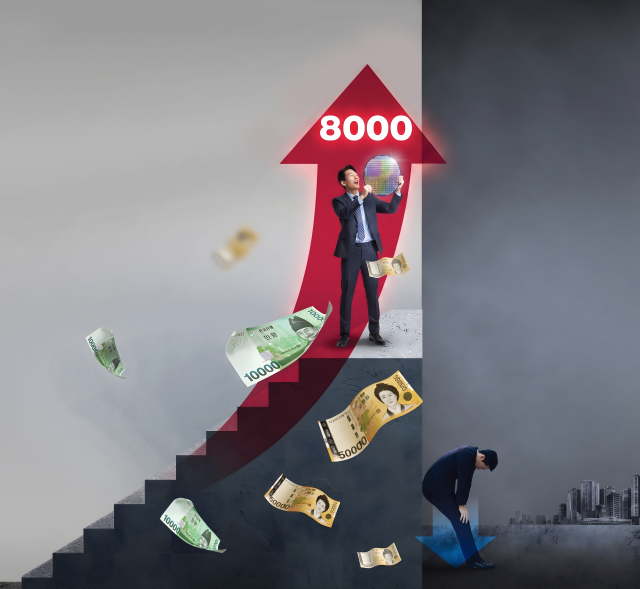
On May 27, the KOSPI index reached a record high of 8,228.70. Despite this unprecedented bull market, only 75 stocks saw gains that day, while 826 stocks either fell or remained unchanged. This means that 92% of the listed companies on the KOSDAQ were left behind, leading to complaints from investors like, "The KOSPI is at 8,000, but my stocks aren't rising."
Since last year, there has been a noticeable concentration of funds in specific stocks, creating distortions and illusions in the market. While the index continues to set new records, many investors do not feel the upward momentum. This concentration also leads to a 'bandwagon' effect, where funds rapidly flow into certain stocks, such as semiconductors, exacerbating market volatility.
"Index at 8,000, My Stocks in the Red"
According to the Korea Exchange, the KOSPI surpassed the 8,200 mark on May 28, setting a new all-time high. Just earlier this month, the index was below 7,000, but it surged over 1,600 points in just a month, driven by gains in semiconductor and artificial intelligence (AI) stocks. However, the overall performance of the market remained lackluster.
Statistics reveal the disparity. On May 27, when the KOSPI hit its peak, only 75 stocks recorded gains. This indicates that a small number of stocks were responsible for the index's rise. The increase in prices of major stocks like Samsung Electronics and SK Hynix gave the illusion of a booming market.
Expanding the timeframe, from May 4 to May 27, the KOSPI rose from 6,598.87 to 8,228.70, yet only 140 stocks increased in value, while 778 stocks declined. The average gain for the rising stocks was 21.7%, while the average loss for the declining stocks was 13.87%. Since the outbreak of the Middle East conflict in March until May 27, only 171 stocks had increased in value.
The trend of concentration is evident when examining the KOSPI index's performance across different sectors. Among 24 sectors, only six recorded gains: electrical and electronics (44.69%), manufacturing (30.63%), insurance (25.42%), retail (12.40%), IT services (10.09%), and finance (10.02%).
Notably, the electrical and electronics sector's growth rate was 1.8 times higher than the KOSPI's overall increase of 24.70%. In contrast, 18 sectors, including construction (-18.06%), paper and wood (-16.67%), and machinery and equipment (-13.29%), experienced declines.
Additionally, the KOSPI 50 (36.58%), KOSPI 100 (33.04%), and KOSPI 200 (30.91%) showed higher growth rates, indicating that the upward trend is primarily concentrated in large-cap stocks.
Market analysts suggest that excessive capital concentration in leading stocks, such as Samsung Electronics and SK Hynix, particularly in AI semiconductors and power infrastructure, is distorting the overall market. The recent surge in global AI investments and expectations for increased demand for high-bandwidth memory (HBM) have led to a concentration of investor funds in large-cap semiconductor stocks.
Since the outbreak of the Middle East conflict in March, funds have increasingly flowed into globally competitive large technology stocks, while small and mid-cap growth stocks and domestic stocks have been relatively neglected, widening the gap between perceived market conditions and the index.
"Concentration is a Typical Phenomenon in the Later Stages of a Bubble"
Interpretations of this concentration phenomenon vary. Some analysts believe that the surge in AI-related semiconductors will last for 2 to 3 years, making the concentration of funds in specific sectors a natural occurrence. A securities industry insider explained, "Since half of the KOSPI market capitalization is made up of large-cap semiconductor stocks, it is natural for their prices to rise and for funds to follow."
However, others argue that the current concentration resembles typical patterns seen in the later stages of a bubble. Lee Eun-taek, a researcher at KB Securities, recently noted in a report that the current semiconductor-driven market is showing trends similar to past bubble phases.
According to the report, during the 1929 U.S. stock market bubble, funds were concentrated in new technology consumer goods companies like aviation, telephony, and radio. Similar concentration was observed in the early 1970s with the 'Nifty Fifty' and during the 2000 dot-com bubble, where a few key growth stocks accounted for most of the market returns.
Particularly, just before the collapse of the dot-com bubble in 1999, the U.S. stock market exhibited extreme polarization, with funds heavily concentrated in the information technology (IT) sector. The researcher stated, "In the later stages of a bubble rally, the concentration of leading stocks tends to strengthen, and a reduction in concentration may signal not a 'welcome spread' but rather a precursor to a bubble collapse."
Applying this analysis to the second quarter of this year, concerns about the Korean stock market are growing. An analysis of relative returns compared to the KOSPI revealed that the IT sector has surged 31 percentage points above the market average, solidifying its dominance. In contrast, most other industries, excluding IT, remained in negative territory. The healthcare sector recorded a -61 percentage point performance compared to the KOSPI average, while utilities (-57 percentage points), telecommunications services (-54 percentage points), and consumer staples (-46 percentage points) also faced significant declines.
* This article has been translated by AI.
Copyright ⓒ Aju Press All rights reserved.