
The 19th-century industrial revolution produced steel magnate Andrew Carnegie, while the 20th-century automotive revolution gave rise to Ford and Toyota. The internet revolution birthed Bill Gates and Steve Jobs. Today, the world stands at the forefront of yet another industrial revolution, with Jensen Huang, CEO of NVIDIA, at its center.
On the 29th, an intriguing scene unfolded in the South Korean stock market. As rumors circulated about Huang's visit to meet with Koo Kwang-mo, chairman of LG Group, LG Electronics' stock surged. No contracts have been signed, nor have specific business plans been announced; the mere prospect of the meeting was enough to move the market.
This may sound exaggerated, but it reflects the reality of the AI era.
Today, NVIDIA is more than just a semiconductor company. It serves as the power grid and operating system of the AI era, essentially forming the backbone of the digital economy. Major companies like Microsoft, Google, Meta, and Amazon, along with countless AI firms worldwide, rely on NVIDIA chips. If NVIDIA is the engine driving the AI vehicle, Huang is its designer.
Thus, Huang's visit to South Korea signifies more than just a corporate visit; it represents a pivotal moment in determining whether Korea will remain a supplier in the AI era or emerge as a key player in shaping a new industrial order.
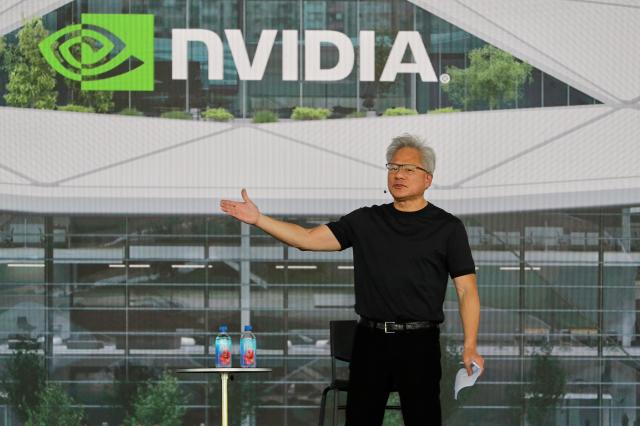
Beyond HBM to Physical AI
For the past two years, the relationship between South Korea and NVIDIA can be summed up in one term: HBM (High Bandwidth Memory).
SK Hynix has emerged as the biggest beneficiary in the AI semiconductor market, while Samsung Electronics is fiercely competing to enter NVIDIA's supply chain. The buzz surrounding the meeting between Chey Tae-won and Huang was ultimately driven by HBM.
However, this time, the conversation is different.
The business community is paying close attention because the key topic of this meeting is not merely memory supply but rather Physical AI.
Physical AI represents the next stage of generative AI.
While ChatGPT generates text and images, Physical AI refers to AI that interacts with the real world. It envisions a future where cars make autonomous decisions, robots move objects, and factories optimize production independently.
Huang has repeatedly emphasized this year that "the next wave of AI is Physical AI." In fact, NVIDIA is making substantial investments in robotics, autonomous driving, digital twins, and smart factories.
This is where South Korea's competitive edge becomes evident.
Hyundai Motor owns Boston Dynamics, a company with world-class humanoid robot technology.
LG possesses expertise in home appliances, robotics, smart factories, and industrial automation systems.
Naver has capabilities in digital twin and AI platform technology.
SK controls AI semiconductors and data center infrastructure.
In other words, South Korea is one of the few countries that possesses both the brain of AI—semiconductors—and the body of AI—manufacturing.
While the U.S. excels in AI software, South Korea has a robust industrial foundation that moves the real world.
This is likely why Huang is visiting Seoul.
The Real Competitor is China, Not the U.S.
One misconception to discard when considering this meeting is that meeting Huang guarantees success.
Corporate history is filled with glamorous meetings, but not all have led to fruitful outcomes.
What matters is not who you meet, but what you create.
Recently, the movements of Chinese AI companies have been significant.
Companies like DeepMind have begun offering AI services at one-tenth the price of their American counterparts. While performance may lag slightly, their price competitiveness is overwhelming.
History shows that the best technology does not always win.
There were companies that made better PCs than IBM and better mobile phones than Nokia.
However, the market ultimately sided with the companies that dominated the ecosystem.
The same applies to the AI competition.
If the U.S. pursues top performance, China is pushing forward with a low-cost strategy.
Where should South Korea position itself?
The answer is clear.
It should become a powerhouse in Physical AI that combines semiconductors and manufacturing.
South Korea manufactures cars, ships, and robots. It also possesses world-class semiconductors and batteries.
As AI begins to move into the real world, South Korea's strengths can only grow.
Winners in the AI Era are Companies that Change Reality
Looking back at history, industrial revolutions have always been won by technologies that changed reality.
The steam engine transformed factories, electricity changed cities, and the internet altered human communication.
AI is no different.
The era of people being astonished by ChatGPT's responses may pass more quickly than expected.
True change begins when AI enters factories, cars, hospitals, and warehouses.
At that moment, AI becomes not just a technology but an industry.
Huang's visit to South Korea symbolizes this turning point.
For Chey Tae-won, it is an opportunity to contemplate the future beyond AI semiconductors.
For Chung Eui-sun, it is a chance to design the future of robotics and mobility.
For Koo Kwang-mo, it is an opportunity to connect LG's manufacturing competitiveness with AI.
For Lee Hae-jin, it is a stage to explore new possibilities for software and platforms.
Of course, expectations may currently outpace reality.
Even if the meeting materializes, it does not guarantee immediate contracts worth trillions of won.
However, one fact is clear.
The weight of global industry is shifting toward AI.
And the focus of AI is moving from generative AI to Physical AI.
This meeting is not just a meal between business leaders.
It symbolizes the direction of South Korea's manufacturing and AI industries.
Winners in the AI era will not be those who possess technology.
They will be the companies that connect technology to reality.
This is why Huang's trip to Seoul is significant.
South Korean companies now stand at a crossroads: will they be mere spectators in the AI era, or will they become architects of a new industrial revolution?
Industrial revolutions have always favored the prepared. This time will be no exception.
* This article has been translated by AI.
Copyright ⓒ Aju Press All rights reserved.