
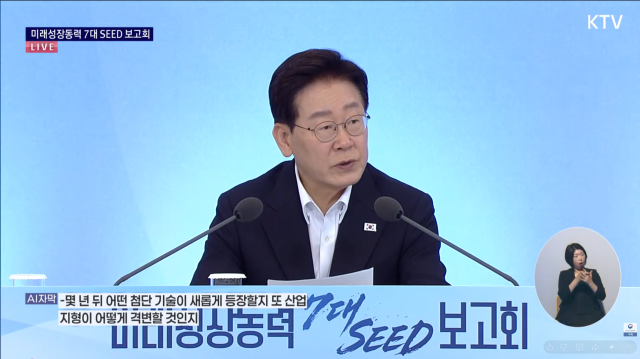
Lee said South Korea must use the opportunity created by its semiconductor industry to prepare for the technologies and industries that will follow the current artificial intelligence boom.
“The seven advanced technologies and seven SEED projects we are discussing today will become the next-generation growth engines of our economy as well as core strategic assets of the country,” Lee said, adding that the projects could eventually grow into new national mega-projects.
The seven areas are small modular reactors, nuclear fusion, renewable energy, quantum technology, space and aerospace, advanced biotechnology and advanced supply chains.
Under the roadmap, South Korea aims to commercialize light-water small modular reactors (SMRs) by 2035 and begin construction of multipurpose non-light-water reactors in the 2030s. A Korean-designed fusion demonstration reactor is also targeted for completion by 2035, with electricity generation planned for the late 2030s.
It will seek partnerships with countries including the United States to address uncertainties surrounding enriched uranium supplies while pursuing technologies related to spent nuclear fuel recycling.
Beyond individual technologies, Wednesday's meeting highlighted a broader shift in how the government intends to finance high-risk research and development.
Science Minister and Deputy Prime Minister Bae Kyung-hoon said the government plans to introduce an investment-based R&D model in which the public sector shares risks with private companies rather than relying only on traditional grants and loans.
Supply-chain security was another major pillar of the strategy.
Industry Minister Kim Jung-kwan warned that South Korea remains highly dependent on foreign suppliers for critical minerals, advanced materials, components and equipment despite its strength in manufacturing finished products such as semiconductors and batteries.
More than 10 trillion won will be invested in critical materials, parts and equipment technologies over five years, while another 5 trillion won will be jointly invested with the private sector in projects linking major companies with domestic suppliers.
The discussion also repeatedly returned to a less tangible challenge: people.
Researchers and university leaders warned that ambitious targets in SMRs, fusion, quantum technology and biotechnology would be difficult to achieve without a larger and more stable pool of scientists and engineers. Participants called for stronger basic research funding, long-term career paths for researchers and greater support for science and engineering students.
Closing the nearly two-hour discussion, Lee said South Korea's goal should be to become a technology leader rather than remain a fast follower.
“Traditional manufacturing remains important, but on that foundation, we have to move ahead of other countries in future advanced industries,” Lee said. “We have to become a leader, not a follower.”
He added that achieving that goal would require substantially greater national investment in education and R&D.
“If those working in the field show us the way, the government will actively support you and work together with you,” Lee said.
AJP Takeaways
△ South Korea unveiled seven “SEED” future growth projects on Aug. 12, 2026.
△ Key targets include SMRs, quantum computing, space, biotechnology and advanced supply chains.
△ The government plans to expand public-private investment in high-risk technologies.

Copyright ⓒ Aju Press All rights reserved.
