
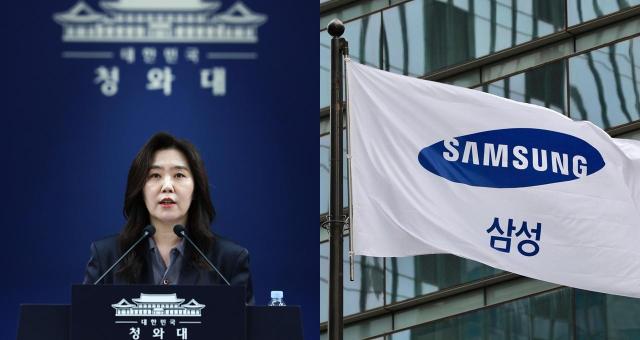
The Blue House has expressed support for public discussions regarding the distribution of excess profits by Samsung Electronics, following comments made by Minister of Employment and Labor Kim Young-hoon. On May 28, Kang Yoo-jung, the Blue House spokesperson, stated during a briefing that it would be beneficial to have opportunities for public discourse through future discussions.
Kang noted, "The Minister of Labor can mention the necessity of sharing achievements from his perspective, while the Minister of Industry can provide insights from his department's viewpoint. Given the various social issues and challenges raised by the labor disputes at Samsung Electronics, it is essential for our society to engage in open dialogue."
Earlier, on May 27, Minister Kim announced at a press conference held at the Government Sejong Center that social dialogue is the only solution and that an urgent discussion would be held on June 1. The discussion is titled "Exploring the Possibility of a Korean-style Social Solidarity Wage Policy."
Kim emphasized the need to discuss how to socially redistribute excess profits from large corporations, citing the labor disputes at Samsung Electronics as a catalyst for addressing issues such as the growth of partner companies, community contributions, and labor market polarization.
The social solidarity wage policy aims to reduce wage disparities between large and small businesses and between regular and non-regular workers. It involves adjusting wage increases for high-wage workers to allocate resources for supporting vulnerable workers and expanding welfare. The Rehn-Meidner Model from Sweden is often cited as a representative example.
However, the Blue House's call for public discourse has intensified criticism online. Negative reactions have emerged from some progressive communities and female-dominated forums.
Netizens expressed concerns, stating, "I thought the minister's comments would set boundaries, but it seems they are pushing forward anyway," and questioned, "Why should the government intervene in private enterprise profits?" Others remarked, "Defining a company's earnings as excess profits is itself dangerous," and expressed disappointment in the Democratic Party, saying, "If there are losses, will they not take responsibility, yet want society to share in the profits?"
Some pointed out that while the disparity between large corporations and subcontractors is a valid concern, the government's public discussion of private profit distribution could conflict with market economy principles.
Meanwhile, Samsung Electronics and its labor union recently reached a tentative agreement on wage and performance bonus negotiations following mediation by the Central Labor Relations Commission, averting a total strike. However, the ongoing debate surrounding the performance bonus system and excess profit redistribution is expected to continue for the foreseeable future.
* This article has been translated by AI.
Copyright ⓒ Aju Press All rights reserved.