Record High Early Voting Rate Signals Hope in South Korean Democracy
by Lim, Kwu JinPosted : May 30, 2026, 07:42Updated : May 30, 2026, 07:42
On May 29, the first day of early voting for the 9th nationwide local elections recorded a turnout of 11.6%. According to the National Election Commission, this marks the highest first-day turnout for early voting in local elections to date. This figure surpasses the first-day turnout of 10.18% from the 8th local elections in 2022 by 1.42 percentage points and more than doubles the 4.75% recorded during the first early voting in the 6th local elections in 2014.
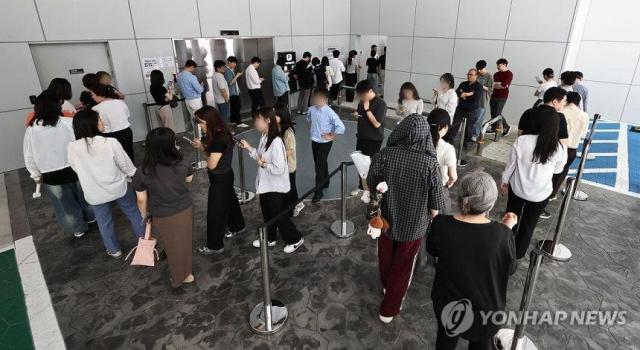
Workers line up to vote during lunch hour on the first day of early voting for the 9th nationwide local elections at the Seoul Jung-gu Administrative Complex on May 29. [Photo: Yonhap]
Interpreting this turnout as a direct reflection of public interest in politics requires caution. The Election Commission noted that the relatively low enthusiasm during the 2022 local elections was due to their timing shortly after the presidential election. Nevertheless, the significance of this record should not be underestimated. Even in an era marked by deep political distrust, citizens continue to express their will through voting, demonstrating a desire for a better future.
The public's view of politics remains critical. The National Assembly is mired in conflict, and political parties are trapped in partisan logic, with trust in the political sphere slow to recover. Yet, citizens consistently turn out to vote during elections, not necessarily out of satisfaction with politics, but because they recognize that politics is the most practical and peaceful means to change their lives.
Democracy is realized through voting. A democracy without citizen participation is merely a shell. In contrast, an actively participating democracy can correct its own mistakes and evolve. High voter turnout is one of the most important indicators of a healthy democracy. It is evidence that citizens are not indifferent to politics but are demanding better governance.
Local elections have traditionally been viewed as less significant than presidential or general elections. However, local governments and councils have the most direct impact on citizens' lives. Many policies regarding transportation, welfare, education, urban planning, environment, and local economies are determined by local authorities. The quality of administrative services that residents experience daily also varies based on the capabilities of local administrations.
In this context, the enthusiasm for early voting can be interpreted as a sign that local governance is maturing. Residents are actively showing their commitment to deciding the future of their communities.
Political leaders must take the message conveyed by this voter turnout seriously. Citizens are not apathetic toward politics; rather, they are disappointed by the current political system's failure to meet expectations. An increase in voter turnout may not signify support for the political establishment but rather a demand for improvement. After the elections, political leaders should not forget this message.
Today marks the last day of early voting. Voting is not an act for a specific party or candidate; it is a civic responsibility to determine the future of one's community and to uphold democracy in South Korea. "What difference does my one vote make?" some may wonder. However, history has always been shaped by each individual vote. Presidents, lawmakers, and local leaders are ultimately elected by the people's votes. Democracy begins not with grand slogans but at the ballot box.
Winston Churchill once said, "Democracy is the worst form of government, except for all the others that have been tried." Democracy functions because citizens monitor and evaluate power through their votes. The moment one gives up voting, the right to criticize politics weakens as well.
The record high early voting turnout for this local election clearly shows one fact: the public still believes in democracy. Despite significant disappointment in politics, citizens have not abandoned hope in voting. This is the strength of democracy in South Korea.
Voting is both a right and a responsibility, and it is the most powerful force driving democracy. The meaning of the highest early voting rate is fulfilled not by numbers but by participation. Each citizen's vote shapes the future of their community and determines the future of South Korea. This is the essence, principle, and common sense of democracy.