
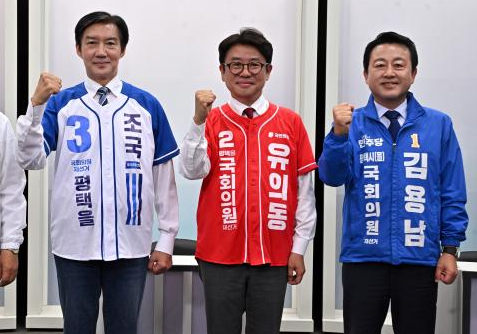
The Pyeongtaek constituency is considered the most competitive district in the upcoming by-election, which coincides with the June 3 local elections. The race features Kim Yong-nam of the Democratic Party, Cho Kuk of the Justice Party, and Yoo Yi-dong of the People Power Party, along with candidates Kim Jae-yeon from the Progressive Party and Hwang Kyo-ahn from the Liberty and Innovation Party. Although there were discussions about potential unification among candidates from the progressive and conservative camps, these efforts have effectively collapsed, leading to a multi-candidate race.
The significance of the Pyeongtaek election extends beyond a local contest, reflecting a power struggle within the progressive camp. The Democratic Party and the Justice Party are in direct conflict over who represents the progressive movement, while the People Power Party aims to capitalize on the divisions.
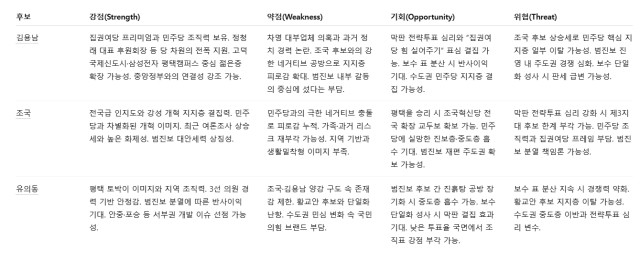
Kim Yong-nam's strengths include the advantages of being the ruling party candidate and the organizational support of his party. The Democratic Party views Pyeongtaek as a strategic stronghold in the metropolitan area and is providing extensive support. Party leader Jeong Cheong-rae has even taken on the role of Kim's campaign chair, demonstrating strong party commitment. Kim is focusing on appealing to voters by emphasizing his connections with the central government and the stability of the current administration. His support base is also bolstered by the presence of Samsung Electronics' Pyeongtaek campus and the new city development in Godeok, which align with the party's metropolitan expansion strategy.
However, Kim faces significant challenges. The conflict over unification with the Justice Party has intensified internal divisions within the progressive camp, and allegations regarding a shadow loan business and past political issues have sparked controversy throughout the campaign. Negative exchanges with Cho's camp are also contributing to voter fatigue among Democratic supporters. As a result, recent trends show a rise in support for Cho and a decline for Kim.
Nonetheless, as the election approaches, there remains an opportunity for voter sentiment to coalesce around the idea of supporting the ruling party candidate. At the same time, Cho's ability to attract reform-minded supporters and some moderate voters poses a potential threat to Kim's base.
Cho's strengths lie in his symbolic leadership of the Justice Party, national recognition, and ability to rally strong reformist support. By presenting a reform image distinct from the Democratic Party, he is appealing to progressive voters disillusioned with the current party. If Cho can attract voters dissatisfied with both major parties, he could not only secure a local victory but also demonstrate the Justice Party's potential for national expansion.
Conversely, if strategic voting trends toward supporting the candidate perceived as most likely to win gain traction, Cho's third-party status could become a liability. Additionally, Cho's inability to establish a commanding lead despite his national recognition remains a concern.
In this multi-candidate landscape, there is an opportunity for Cho to emerge as a central figure in the reorganization of the progressive camp by attracting voters disillusioned with the existing two-party system.
Yoo Yi-dong, who has served three terms in Pyeongtaek, emphasizes his local roots and organizational strength. He also stands to benefit from the fragmentation within the progressive camp. Recent assessments suggest that while the Democratic Party and the Justice Party engage in fierce competition, Yoo has maintained a relatively stable campaign trajectory. In the older urban areas of Anjung-eup, Poseung-eup, and Cheongbuk-eup, there are expectations that he is the right candidate to address issues such as the development of Pyeongtaek Port, transportation network expansion, and industrial complex challenges. Some political analysts predict that the longer the progressive candidates inflict damage on each other, the more favorable the situation will become for Yoo.
However, the failure to unify with conservative candidate Hwang poses a challenge. Recently, Yoo and Hwang have publicly clashed, effectively sidelining any discussions of unification.
In the Pyeongtaek election, the distribution of votes and turnout rates across different regions will be crucial factors. The sentiment in the eastern region, centered around Samsung Electronics' Pyeongtaek campus and the Godeok new city, may differ significantly from that in the western areas of Anjung and Poseung. Additionally, the nature of the by-election may lead to lower overall turnout, prompting all campaigns to focus on encouraging early voting and consolidating their support bases.
* This article has been translated by AI.
Copyright ⓒ Aju Press All rights reserved.