
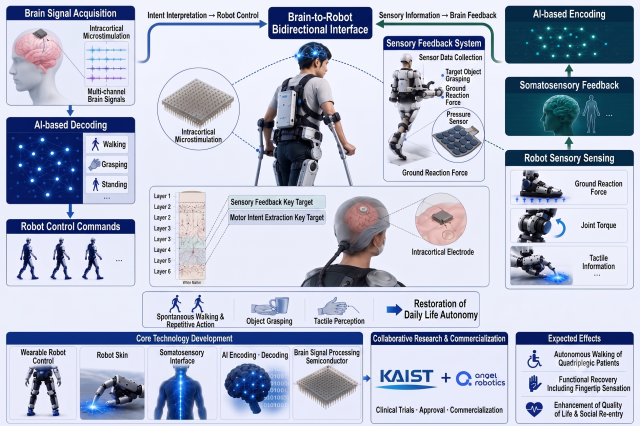
SEOUL, June 25 (AJP) - People with quadriplegia currently depend on clinical settings and human assistance to carry out basic physical tasks. A South Korean research consortium has begun developing a system intended to connect the human brain directly to a full-body robotic exoskeleton and route sensations captured by the robot back to the user's nervous system, the Korea Advanced Institute of Science and Technology said Thursday.
Brain-computer interface technology has already reached human clinical trials, with companies including Neuralink and Synchron demonstrating systems that allow users to control cursors or smartphones through neural signals. But those platforms share a critical limitation: development has focused on decoding brain signals without clearly defining what the signals should control or what sensory information should return to the user. The system now in development targets that gap directly, assigning a full-body exoskeleton as the designated control target and establishing simultaneous pathways to relay ground-reaction force, joint torque, and tactile data from the robot back into the user's brain, a fully closed loop that has not been demonstrated anywhere in the world.
The project is a flagship initiative under South Korea's multi-ministry advanced medical device research and development program, running from April 2026 to December 2032. It is led by professors Kong Kyoung-chul and Kim Jung at the Korea Advanced Institute of Science and Technology (KAIST) Department of Mechanical Engineering, in consortium with Angel Robotics, a wearable robotics firm founded by Professor Kong. KAIST is designated as the lead research institution for AI signal processing within the consortium.
Professor Kong, who led Angel Robotics to back-to-back gold medals at Cybathlon, an international assistive technology competition, will direct the development of the wearable robot control systems and AI-based movement-intent interpretation. His team will also design a somatosensory interface to relay sensory data from the robot to a brain-signal-processing chip. Professor Kim, whose robotic skin research earned him South Korea's Scientist of the Month award, will lead the development of robotic skin capable of registering physical sensations on behalf of a user with paralysis, alongside AI-based systems to decode that sensory information.
The core engineering challenge is the development of AI-based encoding and decoding algorithms that translate cortical signals from hundreds of channels into robot commands in real time while simultaneously converting sensory data from the robot back into signals the brain can interpret. This process is all carried out within a closed-loop control structure that must sustain extremely low latency to function reliably.
Commercialization will be handled by Angel Robotics, which plans a full-cycle path to market, including regulatory approval from South Korea's Ministry of Food and Drug Safety through to broad distribution.
The research team noted that the project's complexity requires safety validation, clinical testing, and regulatory framework development to advance in parallel with core research and that global market entry will additionally require accumulated clinical evidence, risk management systems, neural data protection, and ethical review.
"If this technology succeeds, a new rehabilitation paradigm will open where people with quadriplegia can walk on their own in daily life beyond hospitals, pick up objects, and even feel the touch of their fingertips," said KAIST professor Kong.

Copyright ⓒ Aju Press All rights reserved.
