
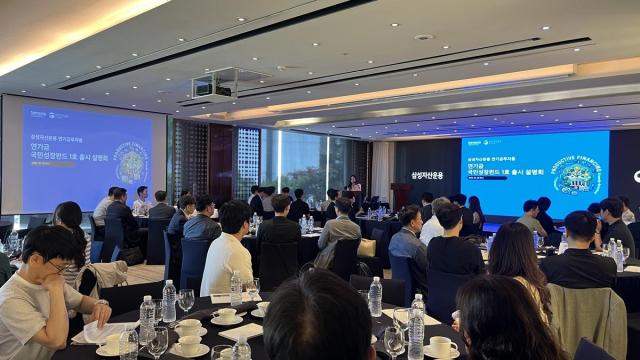
The National Growth Fund, designed for public participation, sold out its entire 600 billion won allocation within just five days of its launch. The number of subscribers surpassed 30,000, with approximately 39% classified as low-income based on annual income. The average subscription amount per person reached about 20 million won. In a financial market still marked by uncertainty, the fact that many citizens entrusted their funds to the growth fund carries significant implications.
What stands out most is the choice made by investors. In recent years, market funds have tended to concentrate on real estate, deposits, and short-term financial products. As the low-growth phase has prolonged, there has been a strong preference for stability over risk-taking in future industries. However, the success of the growth fund suggests that at least some funds may shift back toward productive investment.
Economic growth stems not from consumption but from investment—more specifically, investment that enhances future productivity. New companies must emerge, technologies must be developed, and innovative industries must grow to increase jobs and income. If funds remain tied up in real estate and short-term financial products, the overall growth potential of the economy will inevitably decline.
In fact, developed countries have long established various systems to connect citizens' assets to productive investments.
A prime example is the United States. A significant portion of American household assets is invested in companies and capital markets through pensions, mutual funds, and ETFs. The 401(k) retirement plan has served as a crucial source of funding for innovative companies for decades. The assets held by American households ultimately contribute to the growth of companies like Apple, Nvidia, and Microsoft.
Japan is following a similar path. The Japanese government has expanded the NISA (Nippon Individual Savings Account) program to encourage household financial assets, which have long been tied up in long-term deposits, to flow into capital markets. This is part of a broader 'from savings to investment' policy. While more than half of Japanese household assets were previously locked in cash and deposits, the proportion of investments in stocks and funds has been gradually increasing.
Singapore also utilizes its sovereign wealth fund and pension system to channel national and citizen assets into long-term investments, prioritizing national competitiveness and the development of future industries over short-term gains.
South Korea faces similar challenges. A high proportion of household financial assets in the country remains in deposits and real estate. While maintaining stable assets is important, there are ongoing concerns about the lack of long-term funds available for investment in future industries. Sectors such as artificial intelligence (AI), semiconductors, biotechnology, space industry, and energy transition require substantial capital to grow.
In this context, the complete sell-out of the growth fund can be seen as a positive signal. It demonstrates the potential for citizens' assets to be linked to future growth industries. Notably, the participation rate of low-income individuals approaching 40% indicates that citizens are eager to share in the long-term benefits of growth beyond simple deposit interest.
However, success should not be judged solely by initial popularity. The real test begins now.
In the past, various funds with policy objectives have garnered interest at launch but often failed to deliver expected results. Poor selection of investment targets or political interference can lead to deteriorating returns. Investment failures undermine public trust and negatively impact the development of capital markets.
It is crucial to clarify that the growth fund is an investment product, not a policy finance tool. Investment always carries risks. While profits can be gained, there is also the possibility of losses. If the government is perceived as guaranteeing principal or if the fund is used for political gain, market principles could be compromised.
Independence and professionalism in management are also vital. Investment decisions should be based on market logic, not political considerations. Support for specific industries or companies should not be the goal. When funds are allocated based on growth potential and profitability, both the fund and the industry can thrive.
Transparency is essential. Investors should be able to regularly verify where their money is invested and what returns are being generated. The disclosure of asset management reports and information is not merely an administrative procedure but a key mechanism for maintaining trust.
The significance of the growth fund lies not just in raising 600 billion won. Its true meaning is in connecting citizens' assets to future industries and creating a new financial ecosystem that encourages productive investment.
Economist Joseph Schumpeter defined innovation as a "new combination." The growth fund should serve as a new combination that links citizens' funds with corporate innovation. This way, investors can earn returns, companies can grow, and the nation can enhance its competitiveness.
The sell-out is just the beginning. What matters now is how well it is managed. There is hope that the growth fund will not be a short-term success but will establish itself as a new successful model for South Korea's capital markets. Creating a virtuous cycle where market funds flow into productive investments and the benefits return to the citizens is the most pressing task for the South Korean economy today.
* This article has been translated by AI.
Copyright ⓒ Aju Press All rights reserved.