
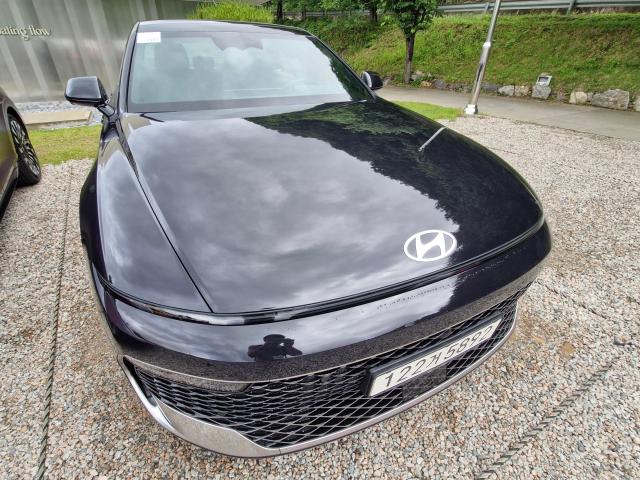
On May 28, I took a round trip of about 140 kilometers from the Godeok Business Valley in Gangdong-gu, Seoul, to Floating Flow in Chuncheon, Gangwon Province, with a passenger in the New Grandeur.
The most striking feature from the driver's seat was the 17-inch display that filled the center of the dashboard. The interface has been simplified compared to previous models, replacing complicated buttons with an intuitive layout that mimics the experience of using smart devices.
The traditional instrument cluster has been virtually eliminated, replaced by a box-shaped monitor that naturally comes into view beyond the steering wheel. A 'multi-function switch' that integrates turn signal and wiper functions has been added to either side of the steering wheel. The electronic gear shift lever has been moved to the right side of the steering wheel for easier shifting without taking hands off the wheel.
As I exited the parking lot, I was pleasantly surprised by the expansive forward visibility. Although it is a sedan, it felt almost like an SUV in terms of openness. The larger side mirrors and the low dashboard design contributed to this improved sightline.
In the urban section of Seoul, the quietness was impressive. Even at low speeds, road vibrations and external noise were minimal. The vehicle's body movements were also well-controlled.
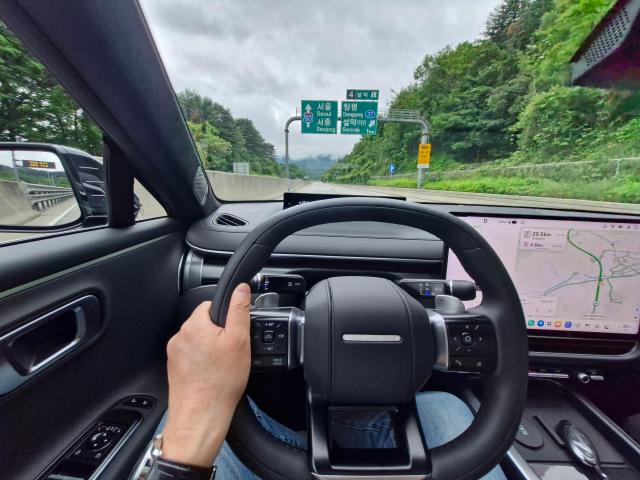
Switching to sport mode transformed the vehicle's character. Acceleration response became sharper, and the exhaust sound was more pronounced. The engine's RPM and the sound transmitted into the cabin felt more dynamic compared to the previous Grandeur.
On the highway and through curves, the driving stability was particularly notable. The steering response was relatively immediate in cornering situations. The lane-keeping assist system operated reliably, helping to maintain the vehicle's center.
Hyundai has implemented optimizations such as a cowl crossbar structure, enhanced front strut rigidity, and hydraulic rebound stoppers in the New Grandeur. These measures aim to reduce road impacts and improve ride comfort.
A key feature of this model is the transformation of the vehicle's software experience. Hyundai has introduced its first next-generation infotainment platform, Pleos Connect.
I tested the generative AI-based voice assistant, Gleo AI, within the vehicle. When I asked, "Play the latest news," it provided updates on domestic political news. It also responded immediately to the command, "Turn off the air conditioning."
Gleo AI is based on a large language model (LLM) system. It supports not only basic vehicle control but also knowledge searches, schedule recommendations, and natural conversation capabilities.
Hyundai developed Pleos Connect based on the Android Automotive Operating System (AAOS) and is working to expand the in-car app ecosystem. Currently, 11 third-party apps, including video and music streaming and gaming, are available.
A Hyundai representative stated, "As we aim for an open ecosystem, the current apps are just the beginning," adding that the goal is to add more than ten new apps by the end of the year.
The Smart Vision Roof, a first for Hyundai, also caught attention. It features polymer-dispersed liquid crystal (PDLC) film that allows for adjustable transparency of the roof. The market response to the New Grandeur has been enthusiastic, with over 10,000 units contracted on the first day of its launch.
* This article has been translated by AI.
Copyright ⓒ Aju Press All rights reserved.