
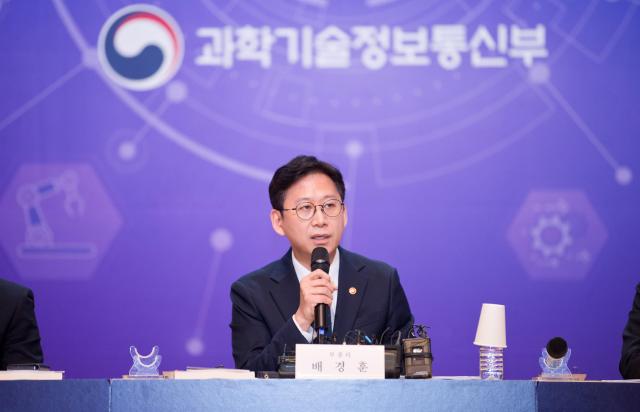
"It is time for us to challenge frontier models that can compete with the U.S. and China, moving beyond industry-specific artificial intelligence (AI)."
Baek Kyung-hoon, Deputy Prime Minister and Minister of Science and ICT, made this statement during a press conference on May 29 at the Central Post Office in Seoul, marking his first anniversary in office. He reviewed the past year's achievements in AI infrastructure development, research and development normalization, and reducing communication costs, while emphasizing the need for a focus on frontier models and general artificial intelligence (AGI) in future AI policies.
The Ministry of Science and ICT highlighted key accomplishments over the past year, including establishing a foundation for South Korea to become one of the top three AI nations, revitalizing a challenging research and development ecosystem, and ensuring basic communication rights while alleviating public burdens.
In the AI sector, the ministry pointed to the promotion of the independent AI foundation model project and the expansion of national AI infrastructure as major achievements. Currently, South Korea has secured 260,000 graphics processing units (GPUs) and is expanding its collaboration with global companies such as OpenAI, NVIDIA, and Google DeepMind.
Baek noted, "The most significant change over the past year has been the full-scale establishment of GPU-centered AI infrastructure, ensuring that researchers do not struggle to achieve results due to a lack of GPUs."
He assessed that the focus of AI competition is shifting from infrastructure development to securing frontier models. "Until now, we have pursued AI transformation strategies centered on strong industries like semiconductors and manufacturing, concentrating on developing suitable independent AI models," he explained. However, he added that the rapid advancement of frontier models necessitates a reassessment of national strategies.
Baek emphasized that to implement AI services accessible to all citizens, industry-specific models alone are insufficient. "South Korea must aim for AI capabilities on par with the U.S. and China," he stated.
He also mentioned that securing infrastructure investments is essential for achieving competitiveness in frontier AI. "While we cannot directly compare our AI budget with those of the U.S. and China, it is crucial for South Korea to efficiently expand investments in technology, GPUs, data, and talent across the board," he said.
During the conference, the ministry also unveiled plans for AGI and agentic AI. Baek remarked, "In the past, we questioned whether AGI was necessary, but that concern has disappeared. We must prepare for AGI-level frontier models." He added, "Soon, we will enter an era where AI will develop AI models on its own, and we must prepare for the accelerated pace of technological advancement starting now."
Regarding the government's 'AI for All' policy, Baek explained that the focus is on expanding AI agents beyond simple chatbot services. "A time will come when citizens, businesses, and government agencies utilize AI agents to enhance productivity," he said, aiming to create an environment where AI provides practical assistance in daily life, including administrative services and financial tasks.
On cybersecurity, he stressed the importance of both global cooperation and developing domestic capabilities. "It doesn't matter what rank we hold in cybersecurity; while short-term responses through global collaboration are important, it is even more crucial for South Korea to have the capacity to respond independently," he noted.
Finally, Baek reflected on his past year in office, expressing initial concerns about what could be achieved in a rigid organization upon his appointment. "Fortunately, flexible communication, which is central to our culture, has become well established, and communication among staff has improved," he reported.
He concluded by stating, "It is important to focus on the basics rather than inter-departmental power struggles, as many ministries rely on the Ministry of Science and ICT. We will concentrate on creating a system that can apply AI in the field."
* This article has been translated by AI.
Copyright ⓒ Aju Press All rights reserved.