
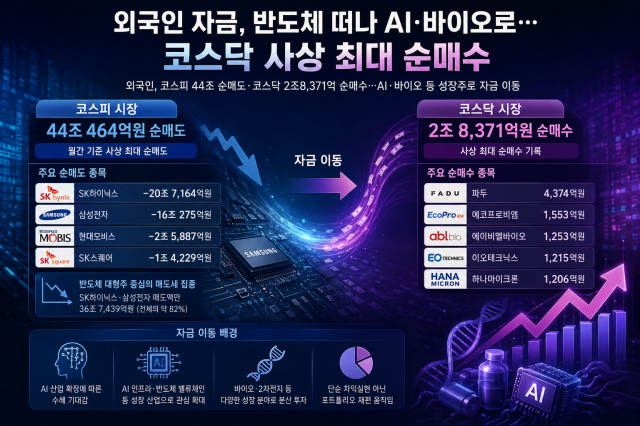
Foreign investors have engaged in significant net selling in the KOSPI while achieving record net buying in the KOSDAQ. They have shifted their funds from large-cap semiconductor stocks to growth sectors such as AI and biotechnology.
According to the Korea Exchange on May 31, foreign investors sold a net 44.46 trillion won ($39.5 billion) in the KOSPI market in May, marking the largest monthly outflow on record, surpassing the previous high of 35.75 trillion won set in March.
The selling trend persisted throughout the month, with foreign investors recording net sales for 16 consecutive trading days from May 7 to 29, the longest streak since the global financial crisis in 2009.
The sell-off was concentrated in large-cap semiconductor stocks. Foreign investors sold a net 20.72 trillion won in SK Hynix and 16.07 trillion won in Samsung Electronics. Other notable sell-offs included Hyundai Mobis at 2.59 trillion won and SK Square at 1.42 trillion won.
The combined net selling of SK Hynix and Samsung Electronics reached 36.74 trillion won, accounting for approximately 82% of the total net selling in the KOSPI.
The funds withdrawn from semiconductor stocks were redirected to the KOSDAQ market, where foreign investors recorded a net purchase of 2.84 trillion won, the highest on record. This trend contrasts sharply with the KOSPI, highlighting a strong buying interest in growth stocks.
In the KOSDAQ, investments flowed into companies involved in AI infrastructure, semiconductor value chains, biotechnology, and secondary batteries. Analysts suggest that foreign buying is particularly focused on companies expected to benefit from the expansion of the AI industry.
Among the top net purchases, Pado led with 437.4 billion won, followed by EcoPro BM at 155.3 billion won, ABL Bio at 125.3 billion won, IOTech at 121.5 billion won, and Hana Micron at 120.6 billion won.
These companies span various sectors, including storage devices for AI data centers, semiconductor equipment and post-processing, biotechnology, and secondary batteries, but they share the commonality of being in growth industries. Market analysts indicate that the recent changes in foreign investment reflect a shift in investment portfolios beyond mere profit-taking, suggesting a broader strategy that includes equipment, components, and biotechnology as beneficiaries of the AI industry's expansion.
* This article has been translated by AI.
Copyright ⓒ Aju Press All rights reserved.