
Over three days, more than 1,000 publishers, editors, and CEOs from over 60 countries are expected to attend. Following last year's congress in Krakow, Poland, this event is anticipated to be a major international platform for discussing strategies, technologies, and revenue models that will shape the future of the global media industry.
This year, AI has been elevated to a central theme of the event. For the first time, WAN-IFRA has organized an independent track titled "AI in Media," positioning it alongside two other key topics: "Future of Journalism" and "Revenue & Growth."
Industry experts believe that generative AI has moved beyond being a mere productivity tool and is now reshaping the entire news production process, from content creation and distribution to revenue generation and audience engagement.
The rise of AI as a focal point in the news industry can be traced back to the release of OpenAI's ChatGPT in late 2022, which marked a turning point. Since then, generative AI has quickly become a disruptive force across the entire media ecosystem, affecting everything from news production to search and consumption environments.
One of the most immediate impacts has been a decline in search traffic. According to digital analytics firm Similarweb, global traffic to major news sites dropped by approximately 26% in the year following Google's introduction of its AI search summary feature, "AI Overviews." Some media outlets have reported search traffic declines of over 90%, shaking the digital advertising revenue models that heavily rely on search.
The conflict between media companies and big tech over content acquisition has also intensified. In December 2023, The New York Times filed a copyright infringement lawsuit against OpenAI and Microsoft, prompting similar legal disputes in Canada, India, and Denmark. Conversely, organizations like the Associated Press, Axel Springer, and News Corp have opted for collaborative models by signing content licensing agreements with OpenAI.
In its recent annual report, WAN-IFRA defined AI as a "defining pillar" of its activities. The "Newsroom AI Catalyst" program, co-managed with OpenAI, currently involves 145 newsrooms worldwide.
This shift in focus marks a departure from previous congress themes. Last year's Krakow congress addressed AI as part of broader discussions on data strategy, trust restoration, and digital transformation under the theme "Mastering Media's New Playbook." The upcoming 2024 congress in Copenhagen will also focus on the future of news media in the AI era but will approach AI as one element of digital innovation.
In contrast, this year's congress emphasizes AI as an independent strategic agenda, signaling a significant transition for the news industry into the generative AI era.
At this congress, Aju Media will showcase innovations in newsrooms and global expansion strategies utilizing AI. The company is redesigning the entire news production process, including article generation, translation, video production, and multilingual platform management, based on AI. Drawing from its experience in providing services in five languages, including Korean and English, Aju Media plans to share its strategies for newsroom innovation and revenue growth in the AI era.
The congress theme is "Rising Voices, Emerging Risks, Inspiring Futures." WAN-IFRA explained that this reflects the search for new opportunities and a sustainable future amid simultaneous industry transformations, including the spread of AI, increasing platform dependency, declining news credibility, and changes in business models.
The choice of Marseille as the host city also carries symbolic significance. Founded around 600 B.C., Marseille is France's oldest city and the largest port city in the Mediterranean, serving as a gateway connecting Europe, Africa, and the Middle East.
WAN-IFRA described the selection of Marseille as a choice to highlight new voices emerging outside traditional centers of power.
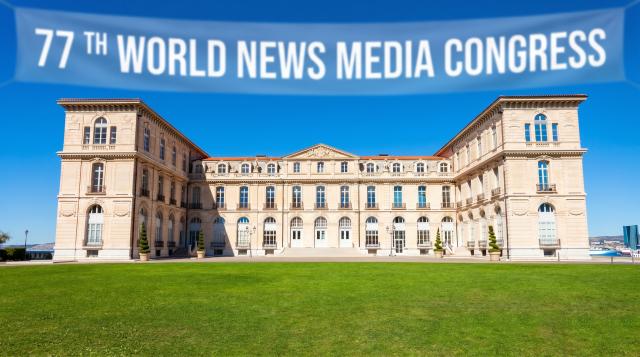
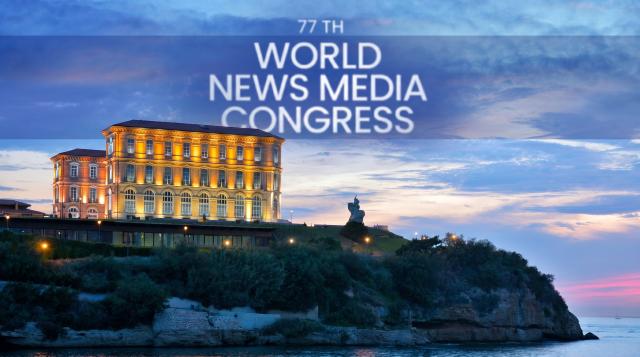
The congress is being held at the Palais du Pharo, a 19th-century palace built by Napoleon III. Co-hosts include BFM TV, RMC Radio, and the regional daily newspaper La Provence, all part of the French media group CMA Media.
The World News Media Congress, which began in 1948, originated from the founding congress of FIEJ, WAN-IFRA's predecessor. The delegation was invited to the Élysée Palace in Paris and has since been held in major cities worldwide, including Seoul, Cape Town, Taipei, Istanbul, Moscow, and Hong Kong.
Currently, WAN-IFRA represents over 3,000 news organizations and 60 publisher associations across 120 countries, making it the largest association of news publishers globally, representing approximately 18,000 media outlets.
In addition to the main sessions, the congress will feature pre-congress deep dives into technology, business, content, and innovation, as well as table talks on media sustainability, revenue diversification, the future of print newspapers, and the news creator ecosystem.
All sessions will be conducted in English, with real-time translation services available in over 50 languages powered by AI.
During the event, WAN-IFRA will also hold the prestigious "Golden Pen of Freedom" awards ceremony and the "Digital Media Awards Worldwide." Notably, the Digital Media Awards have recently introduced categories for "Best Use of AI in Newsrooms" and "Best Use of AI in Revenue Strategies," reflecting the growing importance of AI competitiveness as a key evaluation criterion.
Following the congress, a post-training program will be offered on June 4-5, allowing participants to visit major media outlets in Paris.
* This article has been translated by AI.

Copyright ⓒ Aju Press All rights reserved.