
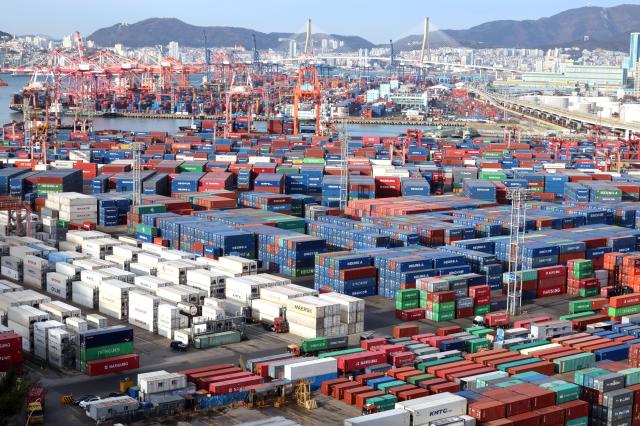
South Korea's exports surged over 50% year-on-year in May, reaching a record high. Despite uncertainties stemming from the Middle East conflict, semiconductor exports more than doubled, significantly contributing to the overall increase. The average daily export value also surpassed $4 billion for the first time, with the surplus from January to May exceeding annual records.
According to the Ministry of Trade, Industry and Energy and the Korea Customs Service, May's export value totaled $87.747 billion, marking a 53.2% increase compared to the previous year. This achievement represents the highest monthly figure on record, with exports exceeding $80 billion for three consecutive months. South Korea has maintained a positive export trend for 12 consecutive months since June of last year.
The average daily export value, adjusted for working days, reached $4.28 billion, the highest ever recorded, surpassing the previous peak of $3.79 billion in March.
The robust performance of semiconductor exports played a crucial role in this growth. In May, semiconductor exports soared to $37.16 billion, a staggering 169.4% increase from the previous year, setting a new record. This surge is attributed to rising fixed prices for memory chips, driven by increased investments in artificial intelligence (AI) by major U.S. tech companies, with exports exceeding $30 billion for three consecutive months.
Exports of computers and wireless communication devices also saw significant increases, rising to $4.18 billion (up 290.7%) and $1.46 billion (up 12.6%), respectively, due to heightened demand for SSDs used in AI servers and strong sales of new products. Display exports increased by 9.4% to $1.47 billion, influenced by the launch of new mobile products.
Consumer goods exports also showed solid growth. Cosmetic exports reached $1.18 billion, a 24.2% increase from last year, marking the highest figure for May. Although agricultural and fishery product exports declined due to reduced shipments of items like coffee and seaweed, processed agricultural products such as noodles and bread increased, resulting in a 4.7% rise to $1.07 billion.
Oil product exports surged by 46.6% year-on-year to $5.25 billion, driven by high export prices amid rising oil prices. However, the implementation of maximum price regulations led to a 23.8% decrease in volume, with gasoline, diesel, and kerosene exports dropping by 31.1%, 24.3%, and 99.9%, respectively. Petrochemical product exports rose by 11.1% to $3.7 billion, although volume decreased by 25.5% due to prioritizing domestic supply.
In contrast, automobile exports fell by 5.9% to $5.83 billion, impacted by reduced working days, supply shortages due to safety incidents, and logistics disruptions from the Middle East conflict.
Steel exports declined by 2.1% to $2.04 billion, reflecting a continued decrease in key products like hot-rolled and thick plates. General machinery exports also dropped by 6.3% to $3.82 billion due to increased logistics costs from the Middle East conflict and U.S. tariffs. Conversely, non-ferrous metal exports rose by 41.5% to $1.67 billion, driven by increased demand for copper and aluminum related to AI data centers.

Regionally, exports to China surged by 80.9% to $18.9 billion, driven by a 243% increase in semiconductor exports and solid growth in consumer goods. Exports to the United States also rose by 59.1% to $15.97 billion, primarily due to increased shipments of semiconductors, computers, and electronic devices related to AI investment, despite weak automobile sales.
Exports to ASEAN countries reached $15.85 billion (up 58.4%), while exports to the European Union increased by 2.4% to $6.19 billion. However, exports to the Middle East, severely impacted by the conflict, fell by 7.7% to $1.27 billion, largely due to decreased shipments of automobiles and auto parts.
Imports rose by 20.8% to $60.8 billion, with energy imports increasing by 15.9% to $11.75 billion. Notably, crude oil imports rose by 25.0% to $8.5 billion, despite a decrease in volume due to the Middle East conflict.
Non-energy imports increased by 22.0% to $49.05 billion, significantly influenced by a 71.0% rise in oil product imports to $2.55 billion and a 25.6% increase in semiconductor equipment imports to $2.56 billion.
With exports exceeding imports, May's trade surplus reached $26.95 billion, an increase of $20.03 billion from the previous year. This marks the 16th consecutive month of surplus. The cumulative surplus from January to May stands at $101.91 billion, surpassing the previous record of $95.2 billion set in 2017.
As exports continue to perform well, the likelihood of surpassing the government's annual export target has increased. The Ministry of Trade set the export target at $740 billion for this year. However, with both the volume and prices of semiconductor exports on the rise, projections indicate a significant expansion in annual export value.
From January to May, exports totaled $394.226 billion, comparable to last year's exports of $395.389 billion for the same period. The Korea Institute for Industrial Economics and Trade recently forecasted that this year's exports could increase by 30.3% to $924.4 billion, with a trade surplus of $219 billion.
Potential variables include the ongoing Middle East conflict and U.S. tariff policies. Minister of Trade, Industry and Energy Kim Jeong-kwan stated, "Uncertainties in the trade environment, including the resolution of the Middle East conflict, U.S. tariffs, and EU steel TRQ, remain. The government will work closely with major countries to mitigate trade risks for our companies and create a stable export environment." He added, "We will actively support companies' production and export activities by ensuring a stable supply of key raw materials and monitoring supply chains."
* This article has been translated by AI.
Copyright ⓒ Aju Press All rights reserved.