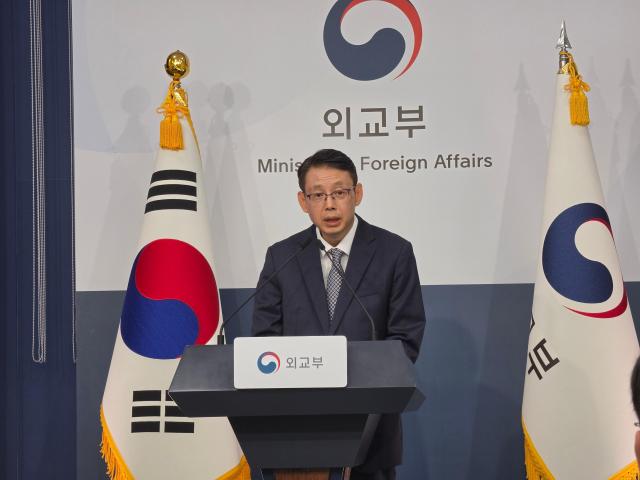
SEOUL, August 11 (AJP) - South Korea's Ministry of Foreign Affairs did not say Tuesday whether the government will hold a briefing that Republican members of the United States House Judiciary Committee have demanded by Aug. 20 on how a new law against false and manipulated information online will be enforced.
Asked at a regular briefing whether the government was discussing the request internally, Ministry of Foreign Affairs (MOFA) spokesperson Park Doo-soon said Seoul was fielding inquiries from the Judiciary Committee and other bodies. He did not say what it would do about this one.
"We are explaining our position on the ground, and we are working actively to raise their understanding of the intent behind the law," he said. "We are continuing to communicate."
He gave no indication of whether the briefing would happen, when it might be scheduled or which agency would deliver it. The deadline falls in nine days.
The demand did not go to MOFA. Four Republican lawmakers led by House Judiciary Committee Chairman Jim Jordan sent the letter on Aug. 6 to Kim Jong-cheol, chairman of the Korea Media and Communications Commission, the regulator that administers the law.
They asked him to arrange a briefing no later than 10 a.m. Eastern time on Aug. 20. Representatives Scott Fitzgerald, Darrell Issa and Michael Baumgartner co-signed.
The letter calls the amendment a major threat to online speech and expression, and says it would let the Korea Media and Communications Commission (KMCC) punish American companies and their users for exercising rights protected by the US Constitution.
The lawmakers wrote that the law does not define false information or set out how it will be enforced. That vagueness, they argued, could be used to censor politically disfavored opinions.
Park rejected the discrimination charge.
"The amendment contains no element that discriminates against domestic or foreign companies, and it respects freedom of expression under the Constitution," he said.
The law was written to address social harms that have come with changes in the digital environment and to strengthen protection for users, he added. The ministry has worked to convey the intent and content of the bill to the United States and other stakeholders, and will keep up the communication needed as the law takes effect.
The National Assembly passed the amendment on Dec. 24, 2025, by 170 votes to three, with four abstentions among the 177 members present. The main opposition People Power Party boycotted the vote after a filibuster was cut off. The law took effect on July 7.
It puts definitions of false information and manipulated information into statute for the first time. Distribution is banned only where the person knew the material was false, acted to harm someone or obtain unjust gain, and infringed another party's rights or the public interest.
Courts can award up to five times the damages proven, and up to 50 million won ($352,940) where damage is difficult to quantify.
The Judiciary Committee objects to the reach as much as the wording. Its letter says the law covers content publishers with more than 100,000 subscribers or a monthly average of 100,000 views, and platforms averaging more than a million daily users, thresholds met by Facebook, X, Instagram and YouTube.
Large platforms must set up complaint procedures, remove offending content, publish transparency reports and submit to government investigations. The KMCC can impose fines of up to 1 billion won, about $656,000.
The lawmakers noted that the regulator has said it will allow no grace period for compliance.
The letter places the law in a line the committee has been drawing since last year, arguing that South Korea is following the European Union in using disinformation rules to reach American speech. It quotes the ruling Democratic Party of Korea saying in September 2025 that it intended to build a Korean version of the Digital Services Act into the Network Act.
The same four lawmakers produced a committee report on July 1 accusing South Korea of discriminatory treatment of American-owned businesses, Coupang among them.
Ambassador to the United States Kang Kyung-wha was recalled to Seoul from July 15 to 19 on the instruction of Foreign Minister Cho Hyun for consultations on the state of the relationship.
Park described that recall Tuesday as a chance for Kang to exchange views repeatedly with the foreign minister, the National Security Office and other relevant agencies.
Pressed on why the letter arrived anyway, he said several pending issues underlie the friction between the two countries and that the government judged a more coordinated response necessary. "Those efforts have continued, and we are pushing them forward harder," he said.
Copies of the letter went to Secretary of State Marco Rubio and to the committee's three ranking Democrats, Jamie Raskin, Jerrold Nadler and Henry C. Johnson.
Copyright ⓒ Aju Press All rights reserved.