
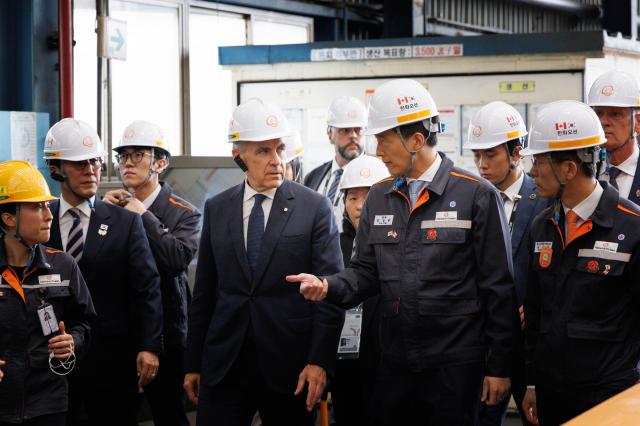
As the competition for Canada’s next-generation submarine program intensifies, both South Korea's Hanwha Ocean and Germany's ThyssenKrupp Marine Systems (TKMS) are finalizing their bids, drawing attention from Canadian media.
According to the Canadian Press on May 31, the federal government is currently evaluating final bids from Hanwha Ocean and TKMS for a major contract to supply up to 12 submarines to the Royal Canadian Navy.
This project is estimated to be worth billions of dollars and could become the largest military procurement in Canadian history. Steven Pure, Canada’s Minister of Procurement, stated on May 27 that a winner will be selected by the end of June, noting that Canada is completing the procurement process for submarines in less than a year, which is unusually fast compared to the typical five-year timeline for major naval vessel procurements.
Hanwha Emphasizes Quick Delivery and Economic Benefits
Hanwha Ocean is promoting its strengths in rapid delivery schedules and economic impacts within Canada. The company plans to deliver four submarines by 2034, utilizing its shipyard in Geoje, which heavily employs robotics, and will provide an additional submarine each year thereafter. Furthermore, the Dosan Ahn Chang-ho, the lead ship of the Changbogo-III Batch I class, arrived at the Esquimalt naval base in British Columbia on May 24, enhancing Hanwha's promotional efforts in the bidding process.
Hanwha claims that its recent bid reflects economic opportunities exceeding CAD 70 billion (approximately USD 52 billion) according to KPMG evaluation criteria, potentially creating around 500,000 jobs and generating about CAD 100 billion in GDP effects from 2026 to 2044.
Earlier this year, Hanwha invested up to CAD 345 million (approximately USD 258 million) in Algoma Steel, Canada’s largest steel producer, and secured a contract to use Algoma's steel for submarine construction. The company has also signed agreements with Canadian firms to support industries affected by tariffs and to promote liquefied natural gas (LNG) exports.
Glen Copeland, CEO of Hanwha Defense, expressed a desire for Hanwha to supply all equipment to the Canadian military, aiming to stand alongside well-known Korean brands like LG, Kia, and Hyundai in Canada. He noted, "While Hanwha is a well-known brand in Korea, it is not yet recognized as a tier-one defense contractor in North America. Building our brand here is essential for success."
TKMS Highlights NATO Interoperability
In contrast, TKMS is emphasizing interoperability with NATO allies. The company highlighted that the German and Norwegian fleets are jointly tracking Russian submarine movements, sharing knowledge, data, and equipment. TKMS has a strong tradition of supplying conventional submarines to NATO member countries.
Regarding collaboration with Canadian companies, TKMS is focusing on quality over quantity, carefully evaluating whether integration within the supply chain is feasible before selecting partners. Oliver Burkhardt, CEO of TKMS, stated during a recent visit to Ottawa for CANSEC, Canada’s largest defense exhibition, "The important thing is not the number of MOUs but their quality. We are collaborating with key players like CAE, Cohere, and Seaspan." CAE is a Canadian simulator company, Cohere is a Canadian AI firm, and Seaspan is a Canadian shipyard. Both CAE and Cohere are also collaborating with Hanwha Ocean.
Initially, TKMS proposed delivering Canada’s first submarine by 2034 but has recently strengthened its proposal to deliver four submarines by 2036, which includes delaying the delivery schedule for one submarine each from Germany and Norway. Additionally, TKMS has promised CAD 160 billion in economic activity, CAD 86 billion in GDP effects, and the creation of over 650,000 jobs throughout the project duration.
Burkhardt remarked, "It’s the third quarter of the game, and it’s still a tie. Let’s see who wins. We are ready."
However, the Canadian Press noted that both Hanwha and TKMS have largely focused on geopolitical partnerships and domestic economic impacts in their bids, with little mention of the actual performance capabilities of the submarines.
Canada is accelerating its submarine procurement due to the aging of its existing fleet. The four Victoria-class submarines are scheduled to be decommissioned by 2035, with reports indicating that only one is currently operational. Some of the remaining submarines may need to be decommissioned for parts.
While the next-generation submarine program requires significant funding, the companies involved have promised substantial economic cooperation, raising expectations for considerable economic benefits. Daniel Carey, head of the national automotive cluster at Deloitte, who has also participated in submarine projects in the UK, commented on the Canadian submarine program, saying it will be "eye-wateringly expensive" but will bring tremendous value to the Canadian economy.
* This article has been translated by AI.
Copyright ⓒ Aju Press All rights reserved.