SEOUL, August 11 (AJP) - Elections can get dirty, and even one of South Korea's oldest religious traditions is not immune to the rough edges of politics.
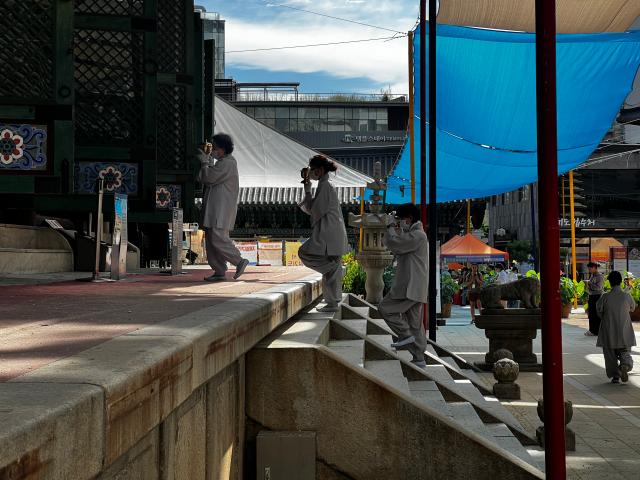
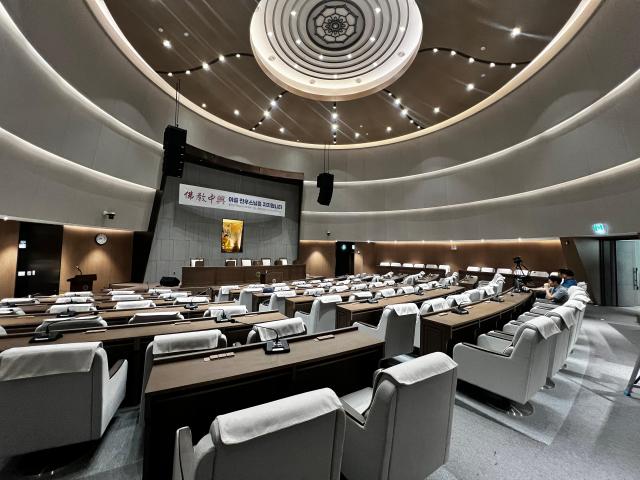
Inside Jogyesa Temple in downtown Seoul on Tuesday, 53 members of the Jogye Order's Central Assembly bowed before the Buddha and recited a declaration supporting incumbent chief administrator Ven. Jinwoo for another four-year term.
They praised his first term for making Buddhism more "friendly and warm" and said he was best positioned to lead the country's largest Buddhist order through secularization and generational decline.
But the headcount mattered almost as much as the ceremony.
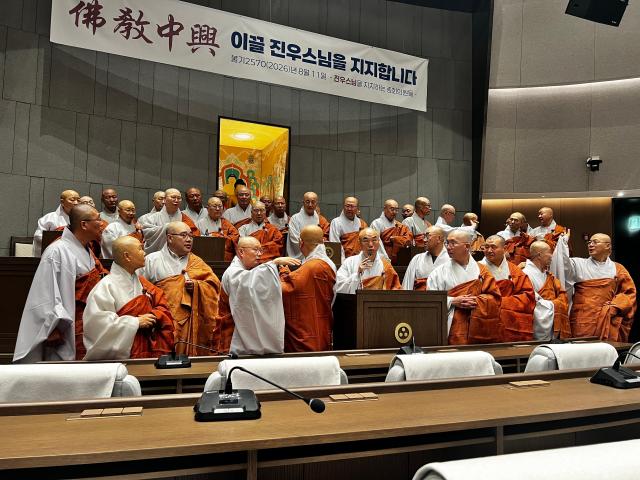
The 53 assembly members represent nearly two-thirds of the body's 81 seats, giving Jinwoo a formidable bloc of institutional support more than three weeks before the Sept. 3 election.
Still, it does not guarantee victory.
The Central Assembly accounts for only part of the 321-member electoral college. Another 240 electors — 10 from each of the order's 24 diocesan headquarters — will help decide whether Jinwoo wins a second term against Ven. Jeongnyeom and Ven. Gyeongu.
The biggest question is whether Jinwoo should be allowed to run at all.
Ven. Gakun, a former senior Jogye Order official, filed a lawsuit with the Seoul Central District Court earlier this month challenging Jinwoo's eligibility and separately filed a criminal complaint accusing him of obstruction of business through deception.
The allegations have not been established in court, and the Jogye Order rejects them.
Yet they have turned what might have been an election fought over Jinwoo's four-year record into a dispute reaching back nearly half a century into his early life as a monk.
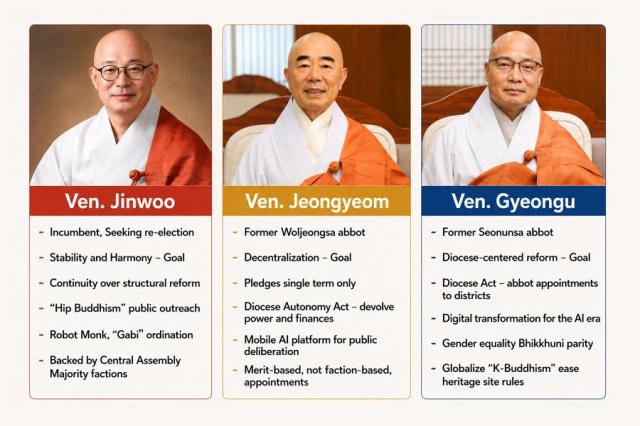
It credited Jinwoo with taking Buddhism beyond temple walls through the Buddhist Expo, temple-stay programs and meditation programs aimed at Koreans struggling with stress and burnout.
Buddhism has also gained visibility among younger Koreans through events mixing traditional Buddhist culture with DJs and rap, helping create the phenomenon sometimes described as "hip Buddhism."
His supporters also point to the opening of the order's first Buddhist nursing hospital, expanded welfare assistance for elderly monks and pension-contribution support covering about 2,600 registered clergy.
They credit his administration with removing admission fees at temple cultural heritage sites and providing electricity subsidies to roughly 300 temples.
The declaration closes with Jinwoo's practice of performing 108 prostrations every morning, portraying his record as the product of steady Buddhist discipline.
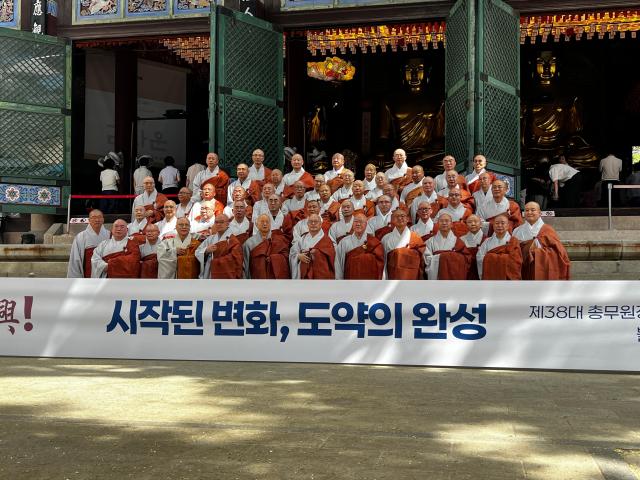
It says nothing about the dispute over his ordination.
Gakun's challenge centers on Jinwoo's officially recorded novice ordination at Bohyeonsa Temple in Gangneung in October 1978.
According to Gakun's complaint, no such ordination ceremony took place at Bohyeonsa that year and the monk recorded as presiding over it was staying at another temple at the time.
He also alleges that Jinwoo's recorded period of religious study overlaps with his military service from 1982 to 1984 and that Jinwoo lived outside the monastic community for several years between 1985 and 1988 without formally completing procedures to leave the order.
Jinwoo has not been found by a court to have falsified his record.
The Jogye Order says his registration was legitimately established and ultimately settled under a special law governing old monastic registration records, and that his eligibility has repeatedly been recognized through the order's own procedures.
What has kept the dispute alive are inconsistencies in Jinwoo's publicly available biographies.
A 2012 profile in a Jogye Order-affiliated Buddhist newspaper, published when Jinwoo was a candidate for abbot of Baegyangsa Temple, said he received novice ordination at Woljeongsa Temple in 1973 and full ordination at Beomeosa Temple in 1978.
His current official record is different.
It lists his novice ordination as taking place at Bohyeonsa Temple in 1978 and his full ordination at Tongdosa Temple in 1998 — the same chronology contained in a statement he submitted when becoming head of the order's education institute in 2019.
The conflicting biographies do not prove that his monastic registration is invalid.
They have nevertheless given his critics grounds to demand that the record be examined again.
The order's answer is that it already has been.
At the center of that argument is the Special Act on Monastic Registration, adopted during the administration of the late Ven. Jaseung, who served as chief administrator from 2009 to 2017.
The measure was intended to settle longstanding problems involving incomplete or disputed records from earlier decades by giving final effect to registrations recognized through the order's system.
That solved one problem while creating another argument.
Supporters regarded the law as a practical way to stop decades-old ordination disputes from repeatedly destabilizing the order. Critics argued that making registrations effectively final could shield questionable historical entries from renewed scrutiny.
Jaseung himself had faced questions over changes in his own monastic registration history.
That old argument is now playing out again around Jinwoo.
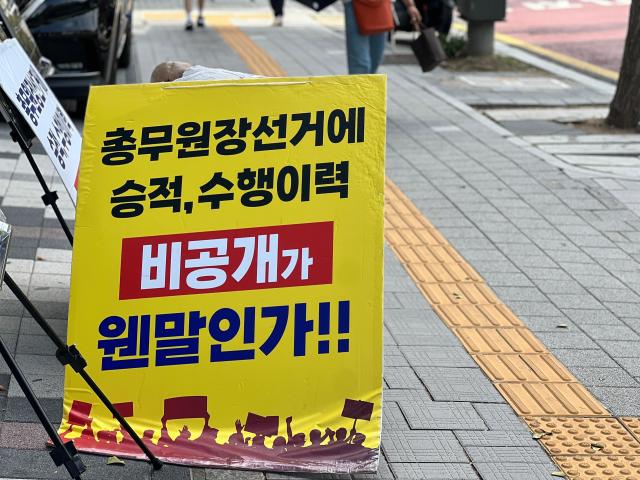
Outside Jogyesa on Tuesday, a protester opposing Jinwoo's re-election put much of the blame on the registration law.
"There are a lot of questions about his monastic history, including his ordination," the protester said. "Those are things he should explain."
The protester argued that the law made it easier for disputed records to escape scrutiny and traced the problem to Jaseung's years of influence over the order.
"This special law keeps creating these kinds of situations," the protester said. "It's a very bad law. It needs to be abolished."
The dispute has also spilled into the Jogye Order's disciplinary system.
Gakun says the order is seeking "myeolbin" against him, its most severe disciplinary sanction, which would strip him of his status as a monk, after he took his allegations to secular courts and investigative authorities.
That has opened another fault line in the election: not just whether Jinwoo's record deserves another examination, but how a religious order should treat monks who take internal disputes outside the Buddhist establishment.
For many ordinary Buddhists, however, the struggle inside the order can feel remote.
Kim Ji-soo, a 35-year-old Buddhist from Gunja in eastern Seoul, regularly visits Jogyesa because it is close to her workplace but said she knows relatively little about the election.
"Honestly, I don't know much about the election," Kim said. "Of course, as a Buddhist, I hope a good person is elected."
She hopes the next chief administrator will continue finding ways to bring Buddhism closer to younger people, including through events such as the Buddhist Expo.
"But it doesn't really feel like something that directly affects me," she said. "Maybe that's because I haven't studied Buddhism very deeply.
I just hope a good person is chosen."
That disconnect stands in contrast to the increasingly intense maneuvering among the monks who will decide the election.
Jinwoo, Jeongnyeom and Gyeongu registered Tuesday for the three-way race. Jinwoo's supporters are campaigning on his record in public outreach, meditation and monk welfare, while the challenge over his eligibility ensures that his monastic history will follow him through the campaign.
His endorsement by 53 Central Assembly members gives him a powerful base, but the decisive arithmetic will involve all 321 electors on Sept. 3.
For Seong Jeong-ja, an 84-year-old Buddhist from Bundang who has practiced the faith for decades and now attends Bongeunsa Temple, the arguments over registration, elections and institutional power matter less than what they appear to be doing to the Buddhist community itself.
"I think having an election for the chief administrator is a good thing, but of course a good person has to be chosen," Seong said.
"What makes me sad is that Buddhism seems to be becoming divided rather than coming together."
"As someone who has believed in Buddhism all my life," she said, "I would be very happy if people who follow the Buddha's teachings could come together."
Copyright ⓒ Aju Press All rights reserved.