
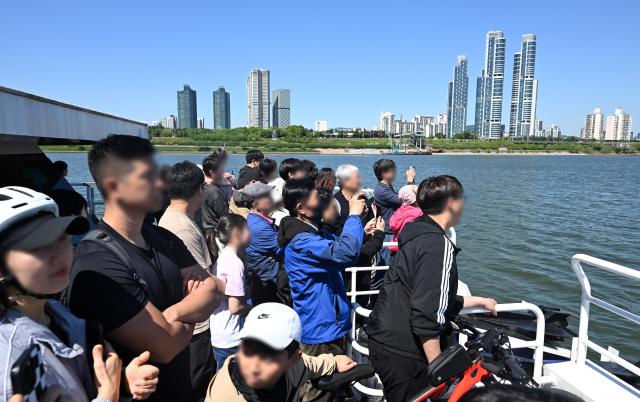
Since its official launch in September 2022, the Han River Bus service in Seoul has rapidly established itself as a popular mode of water transportation and tourism, showing a steady increase in ridership. Initial concerns about it being merely an experiential service have been alleviated by rising user numbers and high satisfaction ratings, indicating its potential as a unique tourism product for the city.
According to the Seoul city government, the total number of passengers on the Han River Bus in May reached 91,126, marking the highest monthly ridership since the service's inception. Following the resumption of full operations, ridership increased from 62,491 in March to 76,488 in April, and then to 91,126 in May, averaging an increase of about 15,000 passengers each month.
The growth trend is evident, with a 22% increase in ridership from March to April, and a nearly 19% increase from April to May. Daily average ridership also surged from 2,016 in March to 2,940 in May, nearly a 1.5-fold increase.
The service has proven particularly popular on weekends and holidays, with record ridership on May 1, when 5,584 passengers boarded, followed by 5,423 on Children's Day, May 5, and 5,494 on May 24. The experience of viewing the city skyline from the water has resonated well with both residents and tourists.
Even on weekdays, demand remains steady, with ridership consistently between 1,000 and 2,000, suggesting that the Han River Bus is evolving from a purely recreational service into a viable transportation option. It connects key areas such as Yeouido, Jamsil, and Magok, contributing to commuting and urban mobility.
User satisfaction is notably high. A survey conducted by the city in April among 3,115 Han River Bus passengers revealed that 96% expressed satisfaction with the service. Additionally, 94% indicated they would recommend it, and 89% stated they would use it again, indicating a strong likelihood of repeat ridership.
Cumulative ridership has also grown rapidly. From its launch in September 2022 until February 2023, the total number of passengers was 104,498. However, in the three months following the resumption of full operations from March to May 2023, an additional 230,105 passengers boarded, bringing the total to over 334,603.
Despite the increase in ridership, political debates surrounding the Han River Bus continue. Jung Won-oh, the Democratic Party's candidate for Seoul mayor, stated in a radio interview last month that he would halt the service if elected, citing safety concerns that he believes have not been adequately addressed. He suggested limiting operations to tourism if alternative solutions are available.
Conversely, voices within and outside the city argue that the rising ridership, high satisfaction rates, and willingness to return should prompt a reevaluation of the Han River Bus not merely as a political issue, but as a significant asset for Seoul's tourism competitiveness and future transportation framework. As major cities worldwide expand their tourism and transportation models utilizing rivers and waterfronts, advocates argue that Seoul should actively leverage the Han River as a global asset.
Starting in June, the city plans to launch operations at the Seoul Forest dock in conjunction with the Seoul International Garden Expo. This initiative aims to expand the waterway network connecting Seoul Forest, the Han River, and urban tourism, positioning the Han River Bus as a key infrastructure for transportation and leisure in the city.
Park Jin-young, head of the Future Han River Headquarters, stated, "The Han River Bus is quickly establishing itself as a new mode of water transportation, thanks to the high interest and support from citizens. We aim to enhance safety and convenience while expanding routes to make it a preferred means of travel along the Han River."
* This article has been translated by AI.
Copyright ⓒ Aju Press All rights reserved.