
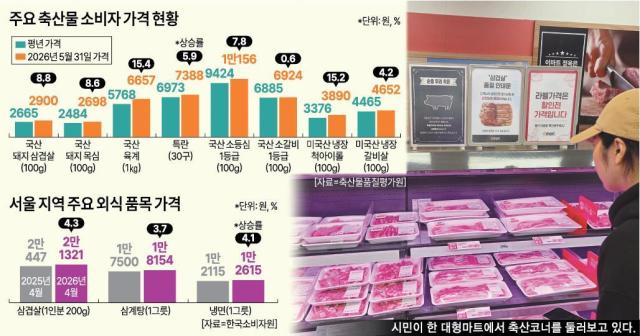
Pork belly, a staple for many households, has become a luxury item, with prices surpassing 2,900 won per 100 grams, marking the highest level since October of last year. The overall rise in livestock prices, including chicken, eggs, and beef, is increasingly burdening consumers.
According to the Korea Institute of Animal Products Quality Evaluation, the average price of domestic pork belly reached 2,900 won per 100 grams as of the previous day. This represents an 8.8% increase from the average price of 2,665 won, making it the highest price recorded this year. It is the first time since October 15 of last year that pork belly prices have exceeded the 2,900 won mark. On the same day, the price of domestic pork neck also rose to 2,698 won per 100 grams, up 8.6% from the average of 2,484 won, also setting a new high for the year.
The price of chicken has seen an even steeper increase. Domestic broiler chicken is now priced at 6,657 won per kilogram, a staggering 15.4% rise from the average of 5,768 won. The price of a dozen special eggs has also increased to 7,388 won, up 5.9% from the average of 6,973 won.
Beef prices are also climbing. The price of domestic Grade 1 sirloin has reached 10,156 won per 100 grams, a 7.8% increase from the average of 9,424 won. Domestic Grade 1 short ribs are priced at 6,924 won per 100 grams, slightly above the average of 6,885 won. Imported beef is not exempt from these price hikes either. The price of U.S. chilled chuck eye roll has surged to 3,890 won per 100 grams, a 15.2% increase from the average of 3,376 won, while U.S. chilled ribeye has risen to 4,652 won per 100 grams, up 4.2% from 4,465 won.
The rise in livestock prices is also impacting dining costs. According to the Korea Consumer Agency's price information portal, the average price for a serving of pork belly (200 grams) in Seoul was 21,321 won in April, a 4.3% increase from 20,447 won in the same month last year. Prices for popular summer dishes like samgyetang (chicken soup) and naengmyeon (cold noodles) are also on the rise. The price of samgyetang in Seoul increased from 17,500 won in April last year to 18,154 won this April, a 3.7% rise. Similarly, naengmyeon prices rose to 12,615 won this April, up 4.1% from 12,115 won a year earlier.
Key factors driving the surge in meat prices include supply shortages due to African swine fever (ASF) and avian influenza (AI), as well as rising fuel prices stemming from conflicts in the Middle East. The ongoing high exchange rate of the won against the dollar is also exacerbating production costs for livestock farmers, particularly given the heavy reliance on imports for key feed ingredients like corn and soybeans.
In response to rising consumer prices, the retail sector is launching discount events for livestock products. Lotte Mart plans to hold a major discount event from June 3 to 7, focusing on meat products. During this event, pork belly and pork neck (both 100g, chilled, imported) will be offered at a 50% discount for customers using event cards. Additionally, pork jowl and Australian Black Angus cuts will be available at a 40% discount.
E-Mart will offer domestic chilled pork belly and neck at a 40% discount for one day only on June 3, priced at 1,788 won per 100 grams for customers who accumulate Shinsegae points. From June 5 to 7, Grade 1 and 1+ Hanwoo sirloin will be available at a 50% discount for event card users, priced at 6,440 won and 7,790 won per 100 grams, respectively.
A retail industry official stated, "As we approach the peak vacation season and the dog days of summer, demand for key livestock products like pork belly and chicken is expected to rise, which may keep prices elevated for the time being. If supply conditions do not improve quickly, the rise in livestock prices could also drive up dining and processed food costs."
* This article has been translated by AI.
Copyright ⓒ Aju Press All rights reserved.