
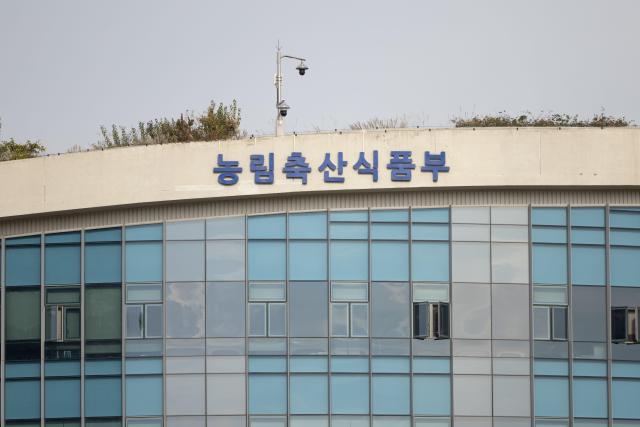
Ministry of Agriculture, Food and Rural Affairs in Sejong City. [Photo by Yu Dae-gil]
The South Korean government has downgraded its avian influenza (AI) alert level from 'caution' to 'concern' due to a decreased risk of outbreaks. No new cases have been reported in poultry farms since April 8.
According to the Ministry of Agriculture, Food and Rural Affairs, there have been 62 reported cases of AI in poultry farms nationwide this winter season, an increase of 13 cases compared to the same period last year, marking the highest number in three years since the winter of 2022.
This winter season is notable for the detection of three types of serotypes (H5N1, H5N6, and H5N9) for the first time in the country. Among these, the H5N1 virus has been found to be more than ten times more infectious than previous strains.
Despite the downgrade in the alert level, the ministry plans to continue surveillance inspections and biosecurity checks at poultry farms, traditional markets, and migratory bird habitats without interruption. Additionally, it aims to promptly address any issues identified during the biosecurity efforts.
To prepare for the next winter season, the ministry will conduct a comprehensive inspection of biosecurity measures at poultry farms and implement improvements before the start of the special biosecurity measures period. Customized biosecurity training by region and species will be conducted until September, with a particular focus on enhancing training for farms that experienced outbreaks last winter.
Park Jeong-hoon, head of the Food Policy Office at the Ministry of Agriculture, Food and Rural Affairs, urged poultry farmers to adhere strictly to basic biosecurity protocols, emphasizing that the potential for sporadic AI outbreaks still exists. "Farmers should take the mindset of 'I protect my farm' to ensure safety," he said.
According to the Ministry of Agriculture, Food and Rural Affairs, there have been 62 reported cases of AI in poultry farms nationwide this winter season, an increase of 13 cases compared to the same period last year, marking the highest number in three years since the winter of 2022.
This winter season is notable for the detection of three types of serotypes (H5N1, H5N6, and H5N9) for the first time in the country. Among these, the H5N1 virus has been found to be more than ten times more infectious than previous strains.
Despite the downgrade in the alert level, the ministry plans to continue surveillance inspections and biosecurity checks at poultry farms, traditional markets, and migratory bird habitats without interruption. Additionally, it aims to promptly address any issues identified during the biosecurity efforts.
To prepare for the next winter season, the ministry will conduct a comprehensive inspection of biosecurity measures at poultry farms and implement improvements before the start of the special biosecurity measures period. Customized biosecurity training by region and species will be conducted until September, with a particular focus on enhancing training for farms that experienced outbreaks last winter.
Park Jeong-hoon, head of the Food Policy Office at the Ministry of Agriculture, Food and Rural Affairs, urged poultry farmers to adhere strictly to basic biosecurity protocols, emphasizing that the potential for sporadic AI outbreaks still exists. "Farmers should take the mindset of 'I protect my farm' to ensure safety," he said.
* This article has been translated by AI.
Copyright ⓒ Aju Press All rights reserved.