
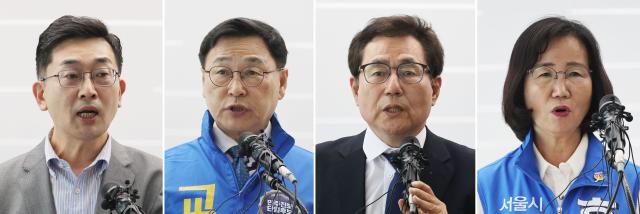
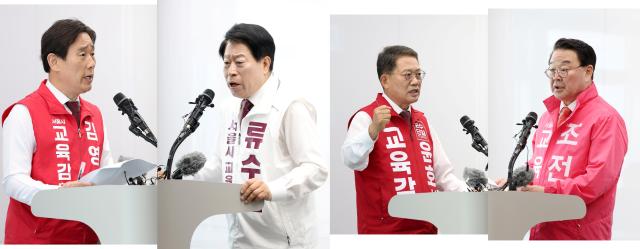
With just one day to go until the June 3 local elections, the race for the Seoul education superintendent is mired in legal disputes and personal attacks rather than policy discussions. Both progressive and conservative factions have failed to unify, resulting in eight candidates competing for the position. As the election devolves into ideological battles and negative campaigning, concerns are growing over the uncertainty surrounding education administration in Seoul.
According to reports from the education sector, tensions have escalated between conservative candidates Yoon Ho-sang and Jo Jeon-hyeok in the final stretch of the campaign. Yoon has called for Jo to withdraw from the race, citing Jo's past history of school violence, while Jo's camp has labeled this as a refusal to accept the primary results. Similarly, in the progressive camp, Jeong Geun-sik and Han Man-jung have filed mutual complaints over alleged violations of election laws, overshadowing any opportunity for policy comparisons among candidates.
Currently, there is a prevailing sentiment that the essence of education has been lost in the Seoul education superintendent election due to candidates' ideological biases and provocative issues. To attract voter attention in a multi-candidate race, some candidates have resorted to sensational slogans, such as opposing homosexuality, which are far removed from the core issues of education administration. As a result, critical macro-level challenges facing Seoul's education, such as enhancing public education infrastructure to respond to future industries and addressing educational disparities, have been sidelined amid the noise of the election.
The deepening apathy among voters and media regarding the election is also cited as a major factor contributing to the chaotic atmosphere. With an increasing number of households either not having children or having already raised them, the proportion of voters directly interested in educational issues has sharply declined. Major media outlets have also given less coverage to debates and policy verifications related to the education superintendent election compared to the mayoral race, exacerbating the situation of voters being unaware of candidates and their pledges, leading to a so-called "blind election."
This absence of policy focus could have significant economic repercussions, as it may disrupt the continuity of the Seoul education administration, which manages an annual budget of 11 trillion won. Analysts warn that if the election results lead to drastic shifts in educational policies, it could result in administrative chaos in schools and a decline in public trust in the entire education system. Historical trends indicate that when the consistency of public education is compromised, there is a tendency for consumers to shift towards private education, thereby increasing the financial burden on families.
Education experts point to a "system error" as the fundamental cause of the recurring mudslinging in education superintendent elections. They argue that applying existing election laws, designed for party-based politics, to elections without party nominations creates structural contradictions. The proposed running mate system, which has been suggested as an alternative, is criticized for potentially allowing political parties to exert direct influence over education, leading candidates to adopt more extreme ideological pledges or biased policies, which could negatively impact the future of education in South Korea.
Ultimately, to minimize the adverse effects of the election, a responsible citizenship from voters is essential. Park Nam-ki, an honorary professor at Gwangju National University of Education, stated, "The issue of the election being a blind one is not just the candidates' problem; voters and the media also bear significant responsibility for not even checking the election materials. Reading the election pamphlets delivered to each household carefully and actively verifying the sustainability of policies is the first step in changing the future of education in South Korea."
According to reports from the education sector, tensions have escalated between conservative candidates Yoon Ho-sang and Jo Jeon-hyeok in the final stretch of the campaign. Yoon has called for Jo to withdraw from the race, citing Jo's past history of school violence, while Jo's camp has labeled this as a refusal to accept the primary results. Similarly, in the progressive camp, Jeong Geun-sik and Han Man-jung have filed mutual complaints over alleged violations of election laws, overshadowing any opportunity for policy comparisons among candidates.
Currently, there is a prevailing sentiment that the essence of education has been lost in the Seoul education superintendent election due to candidates' ideological biases and provocative issues. To attract voter attention in a multi-candidate race, some candidates have resorted to sensational slogans, such as opposing homosexuality, which are far removed from the core issues of education administration. As a result, critical macro-level challenges facing Seoul's education, such as enhancing public education infrastructure to respond to future industries and addressing educational disparities, have been sidelined amid the noise of the election.
The deepening apathy among voters and media regarding the election is also cited as a major factor contributing to the chaotic atmosphere. With an increasing number of households either not having children or having already raised them, the proportion of voters directly interested in educational issues has sharply declined. Major media outlets have also given less coverage to debates and policy verifications related to the education superintendent election compared to the mayoral race, exacerbating the situation of voters being unaware of candidates and their pledges, leading to a so-called "blind election."
This absence of policy focus could have significant economic repercussions, as it may disrupt the continuity of the Seoul education administration, which manages an annual budget of 11 trillion won. Analysts warn that if the election results lead to drastic shifts in educational policies, it could result in administrative chaos in schools and a decline in public trust in the entire education system. Historical trends indicate that when the consistency of public education is compromised, there is a tendency for consumers to shift towards private education, thereby increasing the financial burden on families.
Education experts point to a "system error" as the fundamental cause of the recurring mudslinging in education superintendent elections. They argue that applying existing election laws, designed for party-based politics, to elections without party nominations creates structural contradictions. The proposed running mate system, which has been suggested as an alternative, is criticized for potentially allowing political parties to exert direct influence over education, leading candidates to adopt more extreme ideological pledges or biased policies, which could negatively impact the future of education in South Korea.
Ultimately, to minimize the adverse effects of the election, a responsible citizenship from voters is essential. Park Nam-ki, an honorary professor at Gwangju National University of Education, stated, "The issue of the election being a blind one is not just the candidates' problem; voters and the media also bear significant responsibility for not even checking the election materials. Reading the election pamphlets delivered to each household carefully and actively verifying the sustainability of policies is the first step in changing the future of education in South Korea."
* This article has been translated by AI.
Copyright ⓒ Aju Press All rights reserved.