
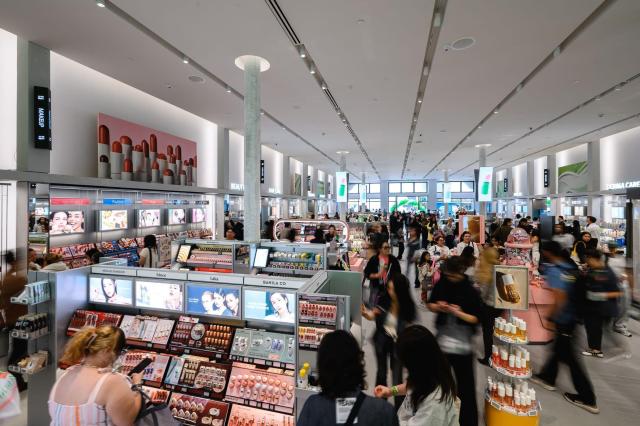
Local consumers visit the CJ Olive Young store in Pasadena, California, on its opening day, May 29, to explore K-Beauty products. [Photo: CJ Olive Young]
The strategy for K-Beauty's expansion into the U.S. market is evolving. Companies are moving away from reliance on online platforms and social media buzz, focusing instead on building local logistics and offline infrastructure or acquiring major distributors.
According to industry sources, CJ Olive Young opened its first U.S. store in Pasadena, California, on May 29. The company has also launched a dedicated online mall for the U.S. market and an integrated membership program called 'OY Members.' To support this initiative, it established a 36,000-square-foot logistics center in Bloomington, California, in March. This automated facility, which can expand to 50,000 square feet, will manage inventory for both the physical store and online deliveries.
The company is replicating its 27-year-old beauty retail model in the heart of the U.S. Olive Young plans to open its second store, 'Olive Young Century City,' in the Westfield Century City shopping mall in Los Angeles this month, with a goal of securing a total of five stores by mid-2024.
Gudai Global, which owns brands such as 'Chosun Beauty,' 'Tirtir,' and 'Skin Food,' has opted for an acquisition strategy to leverage existing local distribution networks. In January, Gudai Global acquired control of Hanseong USA, a K-Beauty-focused distributor in the U.S., for approximately 100 billion won. Hanseong USA is a key vendor supplying K-Beauty products to major retailers like Costco, Ulta Beauty, and Target. The company reported sales of about 170 billion won last year, more than doubling from the previous year.
This acquisition allows Gudai Global to expand its distribution network and complete its value chain, covering production, logistics, and distribution. It also enables the company to supply external K-Beauty indie brands such as 'Myeongji Factory,' 'Mediheal,' and 'VT' to major U.S. channels through Hanseong USA. Gudai Global aims to establish a global distribution hub through its Japanese subsidiary, 'Gudai Global Japan,' and Hanseong USA in North America.
Amorepacific and LG Household & Health Care have also pursued local brand acquisitions to strengthen their distribution channels. Amorepacific acquired the American beauty brand Tata Harper, which is present in over 800 stores including Sephora and Neiman Marcus, for 168.1 billion won in 2022. Similarly, LG Household & Health Care purchased The Cream Shop, which has channels in Ulta Beauty and Walmart, for 148.5 billion won in the same year, opting for a strategy that brings local distribution networks under their control.
The acceleration of K-Beauty companies in building local distribution networks is seen as a strategy to overcome structural limitations that have hindered long-term growth. Historically, reliance on local distributors or agents has weakened price control and complicated brand image management as the number of channels increased. There is also a calculation to reclaim distribution margins previously given to third parties to maximize profitability.
An industry insider noted, "We have seen K-Beauty trends come and go in the U.S. If we own the distribution network, we can control pricing and brand image, which is essential for establishing a lasting presence rather than a temporary trend."
* This article has been translated by AI.
Copyright ⓒ Aju Press All rights reserved.