
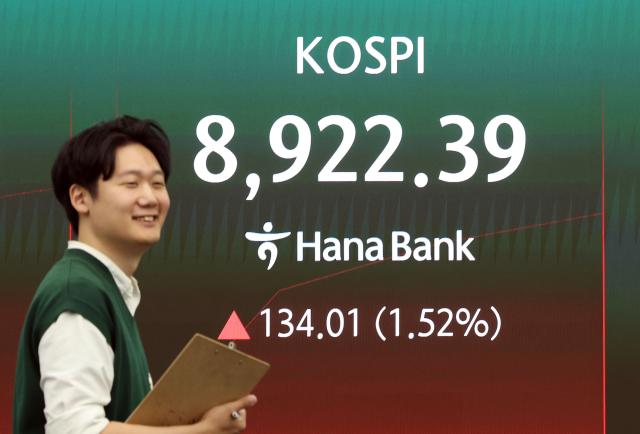
South Korea's stock market has surpassed India to become the sixth largest in the world, driven by a surge in shares of Samsung Electronics and SK Hynix amid a boom in artificial intelligence (AI) memory semiconductors.
According to Bloomberg, as of June 1, the market capitalization of South Korea's stock exchange stood at $5.42 trillion (approximately 7,550 trillion won), surpassing India's market capitalization of $4.84 trillion.
Bloomberg calculates market capitalization based on total outstanding shares, excluding exchange-traded funds (ETFs) and American depositary receipts (ADRs).
The South Korean stock market has experienced a sharp upward trend this year, steadily climbing the global rankings.
As of April 27, the market capitalization reached $4.04 trillion, moving past the United Kingdom ($3.99 trillion) to become the eighth largest globally. At that time, the KOSPI index broke the 6,600 mark for the first time, propelled by a rally in AI semiconductors led by Samsung and SK Hynix.
On May 6, the market capitalization increased to $4.59 trillion, allowing South Korea to surpass Canada ($4.05 trillion) and rise to seventh place. The KOSPI index also crossed the 7,000 mark for the first time based on closing figures.
The strong performance in semiconductors has continued, enabling South Korea to overtake India and secure the sixth position globally. This year, South Korea's stock market capitalization has increased by 86%, while India's has decreased by about 9%.
Both Samsung Electronics and SK Hynix have surpassed a market capitalization of $1 trillion this year, leading the KOSPI's upward trend and helping South Korea rise from eighth to sixth place in just over a month.
Currently, the only stock markets larger than South Korea's are those of the United States ($79.47 trillion), mainland China ($15.09 trillion), Japan ($8.63 trillion), Hong Kong ($7.24 trillion), and Taiwan ($5.15 trillion).
Bloomberg analysts attribute South Korea's rapid ascent to its critical role in the AI semiconductor supply chain.
Ross McGarry, a senior analyst at UK-based asset management firm Asset Value Investors, told Bloomberg, "The memory cycle has driven the rally, and the key question will be whether South Korea can sustain this revaluation through corporate governance reforms."
* This article has been translated by AI.
Copyright ⓒ Aju Press All rights reserved.