
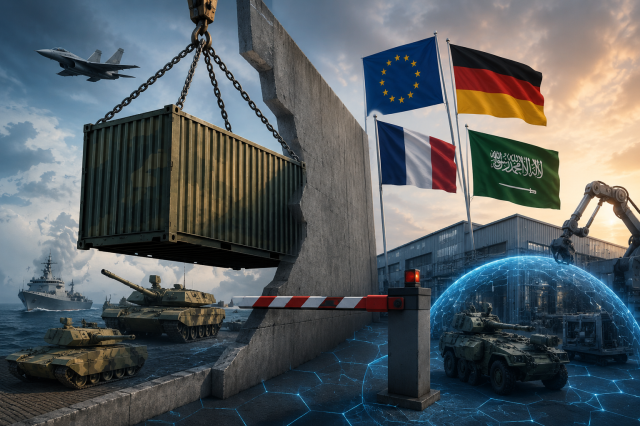
As countries accelerate their defense self-sufficiency, the export formula for K-Defense is facing significant challenges. The environment has become increasingly difficult, where quick delivery and price competitiveness alone may not guarantee large contracts. Experts suggest that securing new competitive advantages, such as local production and technology transfer, is essential.
Price and Localization Leave K-Defense Vulnerable to 'Buy European' Policies
According to industry sources, Hanwha Aerospace recently failed to secure a contract for Romania's next-generation infantry fighting vehicle (IFV) project. The Romanian Ministry of Defense announced on May 29 that it had selected Germany's Rheinmetall as the final contractor through the European Security Action (SAFE) program.
This project, aimed at replacing the aging infantry fighting vehicles currently in use by the Romanian military, has a total budget of €3.337 billion (approximately 5.9 trillion won). Hanwha Aerospace and Rheinmetall were in competition for the final contractor selection.
In terms of competitiveness, Hanwha Aerospace was not at a disadvantage. It proposed supplying 298 AS21 Redback vehicles for €2.8 billion, while Rheinmetall offered 232 KF41 Lynx vehicles for €2.59 billion. On a per-unit basis, the Redback (approximately €9.35 million) was cheaper than the Lynx (€11.16 million).
Hanwha Aerospace also met the Romanian government's requirement for 'complete localization,' proposing to increase local production from 80% to 90% in the long term. In contrast, Rheinmetall reportedly proposed a localization rate of around 40%. Despite this, the Romanian government chose Rheinmetall.
Industry analysts note that the European Union's policy to foster domestic defense industries may have influenced this decision. The growing 'Buy European' sentiment is raising the barriers for foreign companies seeking contracts.
In the Middle East, the trend of prioritizing domestic production is also intensifying. For instance, Saudi Arabia has committed to procuring over 50% of its defense spending through domestic defense companies as part of its Vision 2030 initiative.
As a result, local production and industrial cooperation are becoming key factors in major projects pursued by domestic defense firms, including Hanwha Aerospace's K9 self-propelled howitzer and Redback, Hyundai Rotem's K2 tank, and LIG Nex1's L-SAM.
K-Defense Must Revise Export Strategy
The increasing demands for local production and technology transfer in Europe and the Middle East stem from a heightened awareness of defense self-sufficiency following the Russia-Ukraine war. Initially, European countries relied on South Korean weapons due to a lack of production capacity. Quick delivery and reasonable pricing enabled K-Defense to penetrate the European market. However, as the war has prolonged, European nations have recognized the importance of expanding production facilities and establishing joint procurement systems, diminishing the 'gap-filler' role that South Korean defense had previously enjoyed.
Choi Gi-il, a professor at Sangji University, stated, "Just a few years ago, European defense companies lacked sufficient production capacity, allowing K-Defense to fill the gaps. However, with Germany and France rapidly recovering their production capabilities, the competitive landscape is changing."
Germany, a leading defense power in Europe, is increasing its total defense spending to €108.2 billion (approximately 170 trillion won) this year to enhance its domestic defense production capabilities. France is also expanding its defense investments and production capacity. Experts argue that K-Defense needs to find new breakthroughs to succeed in Europe and the Middle East, emphasizing the need for enhanced local cooperation and cross-industry collaborations.
Nam Myung-ryul, head of the K-Defense Center at Korea University, remarked, "We must go beyond merely selling weapons to establishing local production facilities and proposing industrial cooperation models. A package cooperation strategy that links defense with industries where Korea has strengths, such as energy, artificial intelligence, and information and communication technology, is essential."
* This article has been translated by AI.
Copyright ⓒ Aju Press All rights reserved.