
KOSDAQ-listed company Kespion, a manufacturer of wireless communication devices, has struggled with stagnant stock prices for years. On February 23, the company announced a 2-for-1 stock consolidation (from 500 won to 1,000 won per share). While the stated purpose was to stabilize stock prices and enhance corporate value by maintaining an appropriate number of circulating shares, the real motivation was to avoid the so-called "penny stock delisting" criteria announced by financial authorities in mid-February. After a trading suspension lasting over two months, trading resumed on May 4, but Kespion's stock closed at 751 won on June 1. The company's discussion forums are filled with anxious shareholders worried about delisting.
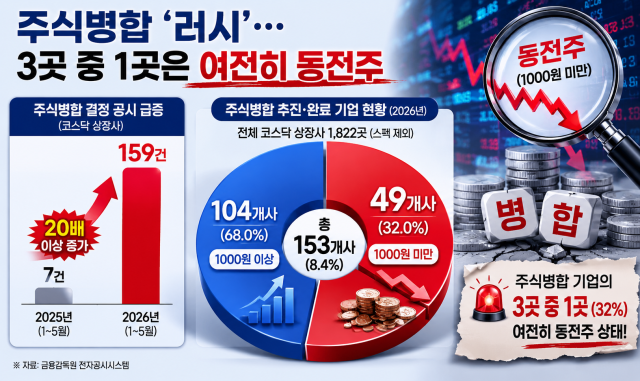
This year, the KOSDAQ market has seen a surge in stock consolidation announcements. Following the government's announcement of measures to eliminate penny stocks and reform delisting regulations in February, related disclosures have skyrocketed. The number of stock consolidation announcements from January to May has increased more than twenty-fold compared to the same period last year. This move is seen as a survival tactic to artificially inflate stock prices. However, the limitations are evident. It is estimated that one in three companies that decided to consolidate their stocks this year still remain penny stocks with prices below 1,000 won, putting them at risk of being listed on the "delisting blacklist."
According to the Financial Supervisory Service's electronic disclosure system, 159 KOSDAQ companies announced stock consolidation decisions from January to May this year. This marks an increase of over twenty times compared to just seven announcements during the same period last year. Excluding six companies that had their proposals rejected at shareholder meetings, a total of 153 companies are currently pursuing or have completed stock consolidations. This represents about 8.4% of the total 1,822 KOSDAQ-listed companies (excluding SPACs).
The urgency behind these consolidations stems from the impending delisting of penny stocks. According to revised KOSDAQ listing regulations, companies whose stock prices fall below 1,000 won for 30 consecutive trading days will be designated as management items. If they fail to exceed this threshold for 45 out of the next 90 trading days, they will face final delisting procedures.
The revisions also include measures to prevent circumvention. Companies that have conducted stock consolidations or reductions in the past year are prohibited from further consolidations or reductions for 90 trading days after being designated as management items. Additionally, any consolidation or reduction exceeding a 10-to-1 ratio is not allowed during this 90-day period. Violating these rules will result in immediate delisting.
The problem is that stock consolidation is not a fundamental solution for escaping penny stock status. Among the 153 companies that have pursued or completed stock consolidations, 49 (32.0%) still had stock prices below 1,000 won as of the end of last month. For instance, Wonpung Moolsan, which decided on a stock consolidation in March, had a closing price of just 524 won on June 1. Other KOSDAQ companies at risk of delisting due to two consecutive years of delisting criteria include Samyoung ENC and Tubesoft, both of which have market capitalizations below 20 billion won. Currently, Samyoung ENC has been granted a three-month improvement period, while Tubesoft is awaiting a decision on its delisting from the Corporate Review Committee.
A securities industry insider noted, "It is not easy for companies to improve their performance or financial structure in the short term, so many companies are likely to become candidates for delisting. Companies that cannot escape penny stock status through consolidation are at a significant crossroads for survival."
Market analysts caution against interpreting stock consolidation as a signal of improved corporate value. Stock consolidation merely reduces the number of circulating shares while increasing the price per share, without changing the market capitalization or actual value of the company. For example, Aptun, which resumed trading on May 8, saw its stock price surge close to the upper limit immediately after trading resumed, but it ultimately closed down 17.54% from the previous trading day due to profit-taking.
In addition to KOSDAQ, there are companies in the KOSPI market facing delisting risks. There are a significant number of potential risk companies in the KOSPI market as well. Currently, there are 99 companies with market capitalizations below 30 billion won and 39 penny stocks with prices below 1,000 won. Excluding duplicates, a total of 129 companies fall under at least one of these criteria.
Notably, the KOSPI market has also seen an increase in forced delisting cases this year. In the past three years (2023-2025), only five companies were delisted due to reasons such as rejection of audit opinions, but this year, five companies, including Daedong Electronics, Kukbo, Well Biotech, IHQ, and Philux, have already been delisted. Recently, the delisting of Geumyang, which has 240,000 shareholders, has caused a stir. Geumyang is currently seeking legal action against the Korea Exchange's delisting decision by filing for a suspension of the decision's effectiveness.
* This article has been translated by AI.
Copyright ⓒ Aju Press All rights reserved.