
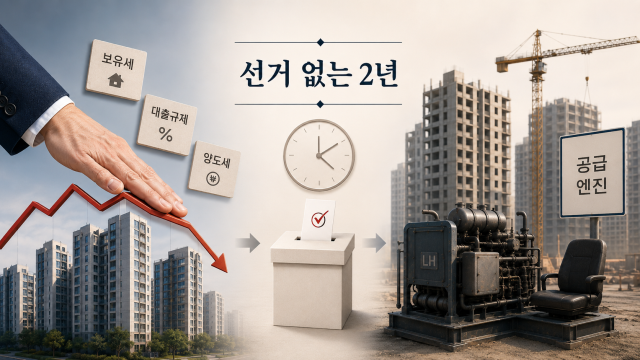
The local elections on June 3 have concluded. Regardless of the results, one fact is clear: there will be no nationwide elections for nearly two years. The next general election is scheduled for April 2028. The time for hiding real estate policies behind election schedules has passed.
The conditions are in place. The ruling Democratic Party holds 166 seats in the National Assembly, a majority on its own. The numerical conditions for processing general legislation do not disadvantage the ruling party. The president's approval rating has remained around 60% as he approaches his first anniversary in office. Therefore, the question is no longer whether they can act, but rather what actions they will take and how they will implement them. In a position where there is nothing left to hide, the government's true capabilities in real estate will be revealed.
The First Year Was a Time for Direction Change
In summary, the first year of the Yoon Suk Yeol administration can be described as a "change in direction." The initial declaration was to end the structure of profiting from real estate, followed by the implementation of policies.
The first measure was not a tax but a loan restriction. The limit on mortgage loans for homes in the metropolitan area and regulated zones was set at 600 million won, and loans for multiple homeowners were completely banned. The supply expansion plan was introduced, and measures were taken to designate all of Seoul and parts of Gyeonggi Province as regulated areas and land transaction permission zones. Extensions on loans for multiple homeowners in regulated areas were halted, and as of May 9, the suspension of the heavy taxation on capital gains for multiple homeowners also ended. During this time, the president sold his own home and instructed that non-resident owners of high-value properties be excluded from policy approval lines. At a recent cabinet meeting, he directly asked whether measures were being prepared as housing prices began to rise again. The direction was clear from the start.
The most powerful weapon was saved until the end. The comprehensive real estate tax, the fair market value ratio, and the long-term holding special deduction were all left unchanged. The reason became evident in April when discussions about modifying the long-term holding deduction emerged, prompting the ruling party to quickly draw a line. They indicated that such discussions would burden them in the local elections. While measures to suppress the market were implemented, those affecting voter sentiment were postponed. The elections effectively served as a brake on strengthening the holding tax.
With Elections Over, the Holding Tax Is the Closest Card
The brakes have been released. The line drawn by the president throughout the year has been to "support residents while suppressing non-residents," and this line can now be translated into tax rates and assessment values.
The lever is within reach. The core of the comprehensive real estate tax, the fair market value ratio, currently stands at 60%, but it can be raised to 80% with just a presidential decree, without needing parliamentary approval. Adjustments to the comprehensive real estate tax rate and the long-term holding special deduction will require legislative changes, but with a majority in the National Assembly, numerical obstacles are minimal. The market also provides justification. Since the suspension of the heavy taxation on capital gains ended on May 9, housing prices in Seoul have continued to rise. This is largely due to a lack of inventory and resilient asking prices rather than a sudden surge in demand. The supply is dwindling while asking prices continue to rise, indicating that the pressure on the market has not been effective, providing justification for stronger measures.
However, a deeper level of consideration is necessary. While changing direction requires willpower, sustaining the market demands skill. It is essential to calculate whether raising taxes will lead to an increase in inventory and how the costs will be passed on to rental prices when tightening regulations on non-resident owners. The real skill lies not in simply raising the holding tax but in carefully distinguishing between resident homeowners and non-resident multiple homeowners while designing mechanisms to prevent adverse effects. The ability to apply pressure was clearly demonstrated in the first year; the challenge lies in what comes next.
The Holding Tax Is a Policy for Suppression, Not for Filling
The real test lies beyond the reach of the holding tax. While taxes can suppress demand, they cannot revive a stagnant supply.
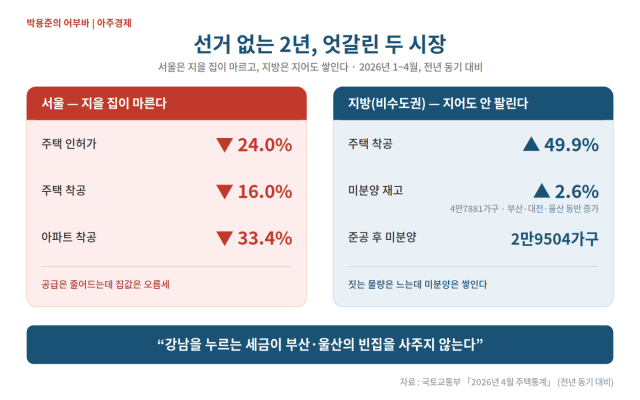
In particular, the leading indicators for supply in Seoul, the epicenter of market instability, are already declining. According to the Ministry of Land, Infrastructure and Transport, housing permits in Seoul from January to April this year totaled 12,760 units, a 24% decrease from the previous year, while construction starts fell by 16% to 7,023 units. When looking specifically at apartments in Seoul, permits dropped by 32.6% and construction starts by 33.4%. While suppressing housing prices, a reduction in new housing construction only postpones the problem by two to three years. Raising the holding tax will not reverse the decline in construction starts.
In contrast, non-metropolitan areas are experiencing the opposite issue. Although construction starts are increasing outside the capital, the number of unsold units in April rose by 2.6% from the previous month to 47,881 units. Cities like Busan, Daejeon, and Ulsan all saw increases. The number of unsold units classified as problematic stands at 29,504 nationwide. While supply indicators in Seoul are declining, prices are rising, and in the provinces, new constructions are not selling. One area needs to be suppressed while the other needs to be revived. Taxes aimed at suppressing Gangnam will not help sell vacant homes in Busan and Ulsan.
Rental markets are shifting towards monthly leases. The cumulative proportion of monthly rental transactions from January to April reached 68.5%, an increase of 8.1 percentage points from the previous year. Pressuring non-resident owners may reduce the availability of jeonse (long-term lease) units, shifting the burden to monthly rents and deposits. If policies aimed at capturing multiple homeowners end up reflected in tenants' monthly rent bills, that would signify failure, not success.
The Yoon Suk Yeol Administration's Competence Is Not Solely Dependent on the Holding Tax
In reality, the challenges of filling the market are even more pressing. The public housing plan under the Yoon administration remains caught between conceptualization and institutional design. Many names have been floated since the introduction of basic housing, but how to fund it and what legal and project structures will support it remain unclear. The executing body is also lacking. The president has repeatedly emphasized "direct supply by LH (Korea Land and Housing Corporation)," yet the position of CEO at LH was vacant until just before the elections.
In the meantime, LH's immediate action can only involve purchasing existing homes and unsold units in the provinces for rental purposes. However, this approach merely relocates existing homes rather than creating new ones. The blueprint is still being drawn, and the hands needed to turn that blueprint into reality are still absent. Even if they are filled late, it will be difficult to make up for lost time. The direction has been proclaimed, but the preparations to fill the market are still insufficient.
Deciding whether to raise the holding tax is merely the first test. The real challenge lies ahead: reconnecting interrupted construction starts, reducing vacant homes in the provinces, and retaining tenants who are being pushed into the monthly rental market. In the two years without elections, the government's real estate competence will be judged not by the ability to apply pressure but by the ability to fill the market. And the engine for that filling is still not fully warmed up.
* This article has been translated by AI.
Copyright ⓒ Aju Press All rights reserved.