
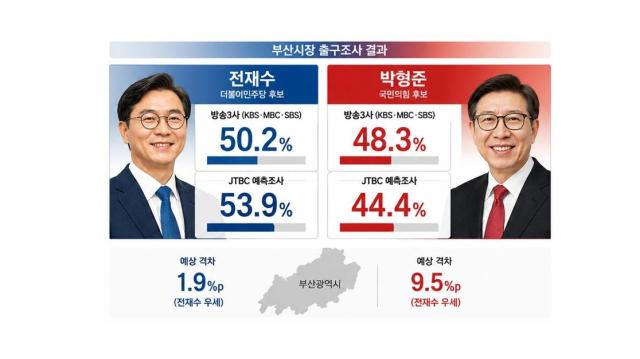
In one of the most competitive races of the local elections, Jeon Jae-soo of the Democratic Party appears to have a lead in the Busan mayoral election. However, there is a significant discrepancy between the exit polls conducted by three major broadcasters and the predictions from JTBC, leading to heightened interest in the actual vote count.
According to the joint exit poll by KBS, MBC, and SBS, Jeon is projected to receive 50.2% of the vote, slightly ahead of Park Hyung-jun of the People Power Party, who is forecasted to get 48.3%. This indicates a very close race, essentially within the margin of error.
In contrast, JTBC's prediction shows Jeon with 53.9% and Park at 44.4%, a difference of 9.5 percentage points, suggesting a much larger lead for Jeon compared to the broadcasters' poll.
Both polls predict a victory for Jeon, but their interpretations of the election dynamics differ significantly. If the broadcasters' results hold true, the race could remain too close to call until the end of the counting process. Conversely, if JTBC's figures are accurate, it would indicate a relatively stable win for the Democratic Party in Busan.
The Busan mayoral election is considered one of the most symbolic contests in this local election cycle.
Traditionally, Busan has been classified as a conservative stronghold, but recent shifts in the political landscape have been notable. In the 2018 local elections, the Democratic Party won the mayoral seat, but the People Power Party regained control in subsequent by-elections and local elections.
Initially, Park, leveraging the advantages of incumbency and organizational strength, seemed to have the upper hand. However, as the campaign progressed, Jeon gained momentum, narrowing the gap significantly.
The competition over local issues such as the redevelopment of Busan North Port, the relocation of the Industrial Bank, the construction of Gadeokdo New Airport, and urban regeneration has intensified, leading to fluctuating voter sentiments right up to the election.
Busan is also seen as a barometer for the overall political landscape in this local election.
If Jeon secures a victory, it could signal that the Democratic Party has expanded its influence beyond the capital region into the PK area. Notably, Democratic candidates have also performed well in Ulsan and South Gyeongsang Province, raising the possibility of renewed discussions about shifts in the political dynamics of the Yeongnam region.
On the other hand, if Park manages to turn the tide, it would represent a significant victory for the People Power Party, reinforcing its foothold in Busan and countering the narrative of a nationwide Democratic Party landslide.
With the exit polls showing conflicting results, political circles are exercising caution.
The Democratic Party is noting that both polls predict a lead for Jeon, while the People Power Party emphasizes the narrow 1.9 percentage point margin in the broadcasters' poll, suggesting that the outcome could still be reversed during the counting process.
Throughout the campaign, the Busan mayoral race has been characterized by shifting poll results, making it a challenging contest to predict. Some surveys indicated Park was ahead, while others showed Jeon in the lead. In the final stretch, several polls reported a close contest within the margin of error.
* This article has been translated by AI.
Copyright ⓒ Aju Press All rights reserved.