
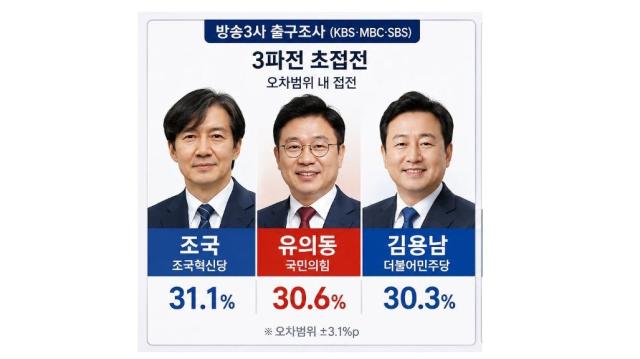
The by-election for the National Assembly seat in Pyeongtaek, held alongside the local elections on June 3, is proving to be a closely contested race. Results from exit polls conducted by the three major broadcasters (KBS, MBC, SBS) and predictions from JTBC show conflicting outcomes, indicating that the final result may not be clear until the end of the vote counting process.
According to the exit polls from the three broadcasters, Cho Kuk of the Justice Party leads with 31.1%, followed closely by Yoo Yi-dong of the People Power Party at 30.6% and Kim Yong-nam of the Democratic Party at 30.3%. The candidates are effectively within the margin of error, highlighting the tight nature of the race.
In contrast, JTBC's predictive survey places Kim Yong-nam in the lead with around 34%, followed by Cho Kuk. This divergence in results has made Pyeongtaek one of the most unpredictable constituencies in the national by-elections.
Political analysts have characterized this election as a 'three-way structure' rather than a simple contest between the ruling and opposition parties.
Yoo Yi-dong, a local native and a three-term lawmaker, has built a strong regional base. Kim Yong-nam is leveraging the advantages of being from the ruling party and its organizational strength to close the gap. Cho Kuk is banking on his national recognition and the support of the Justice Party to make a significant impact. As the election nears its conclusion, no candidate can confidently claim an advantage.
Public sentiment in Pyeongtaek appears to be influenced more by party affiliation, political symbolism, and local ties than by individual candidates. While the younger and progressive voter base has increased around the Godeok New Town area, traditional communities such as Paengseong-eup and Anjung-eup still show strong support for Yoo Yi-dong.
The simultaneous competition between the Democratic Party and the Justice Party has also been identified as a major variable in this election, leading to a fragmentation of the progressive vote. The exit polls indicating all three candidates hovering around 30% reflect this phenomenon.
The Pyeongtaek by-election carries significance beyond just a local contest. If Cho Kuk wins, the Justice Party will expand its presence in the National Assembly and gain momentum for future political agendas. Conversely, a victory for the Democratic Party would symbolize a strengthening of governmental authority early in its term. For the People Power Party, a win for Yoo Yi-dong would mean retaining a foothold in the metropolitan area.
Political observers describe the current situation as a "de facto three-way tie," with no candidate able to guarantee victory. The differing results from the exit polls and the minimal gaps between candidates suggest that the final outcome will only become clear once a significant portion of the votes has been counted.
Pyeongtaek is likely to be the final battleground in the June 3 by-elections.
* This article has been translated by AI.
Copyright ⓒ Aju Press All rights reserved.