
[Photo: Generated image by ChatGPT]
The Jeonbuk gubernatorial election is shaping up to be a much tighter contest than expected. Joint exit polls from three major broadcasters (KBS, MBC, SBS) and predictions from JTBC indicate that Lee Won-taek of the Democratic Party is leading, but Kim Kwan-young is mounting a strong challenge.
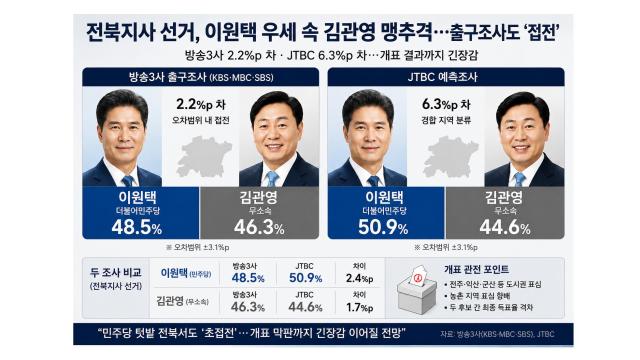
According to the joint exit poll from the three broadcasters, Lee Won-taek garnered 48.5% of the vote, leading Kim Kwan-young, who received 46.3%, by a narrow margin of 2.2 percentage points. The close gap suggests that the outcome could still change as votes are counted.
JTBC's prediction also shows Lee Won-taek ahead with 50.9% compared to Kim Kwan-young's 44.6%. However, JTBC classified the Jeonbuk gubernatorial race as competitive, making it difficult to predict the final results.
Initially, the Jeonbuk gubernatorial election did not attract much attention due to its reputation as a stronghold for the Democratic Party. However, as the election progressed, it has drawn national interest due to the unexpectedly close race.
In particular, the contest in Jeonbuk, traditionally a Democratic stronghold, is characterized by the incumbent's advantages, organizational strength, and regional development issues, leading to a split in voter preferences.
While both the three broadcasters and JTBC predict Lee Won-taek's lead, they differ in the extent of that lead. The broadcasters assess the race as effectively within the margin of error, while JTBC indicates a slightly larger gap.
Political analysts view the Jeonbuk gubernatorial election as a potential indicator of changes in the region's political landscape. It will reveal whether the Democratic Party's traditional support base remains strong or if the political dynamics in the area are shifting.
Nationally, the Democratic Party appears to be winning in Seoul, Gyeonggi, Incheon, as well as Busan, Ulsan, and Gyeongnam, but the competitive nature of the race in Jeonbuk stands out.
In the exit polls, the results from Seoul show candidate Jeong Won-o leading Oh Se-hoon by 5.4 percentage points, while in Gyeonggi, candidate Choo Mi-ae leads by 26.3 percentage points, and in Incheon, candidate Park Chan-dae has an 8.2 percentage point advantage. In contrast, Jeonbuk's margin is only 2.2 percentage points.
As the vote counting begins, attention is focused on the major urban areas of Jeonju, Iksan, and Gunsan, as well as rural regions. The final outcome is likely to hinge on how urban and rural voters cast their ballots.
Based on the exit polls so far, Lee Won-taek appears to have a slight edge in winning. However, the narrow margin and differing figures from polling organizations suggest that tension will continue until the final vote count is completed.
Ultimately, the decision on who will lead Jeonbuk's next administration will be made when the ballots are officially counted.
* This article has been translated by AI.
Copyright ⓒ Aju Press All rights reserved.