
The nation chose the Democratic Party, but Seoul opted for Oh Se-hoon.
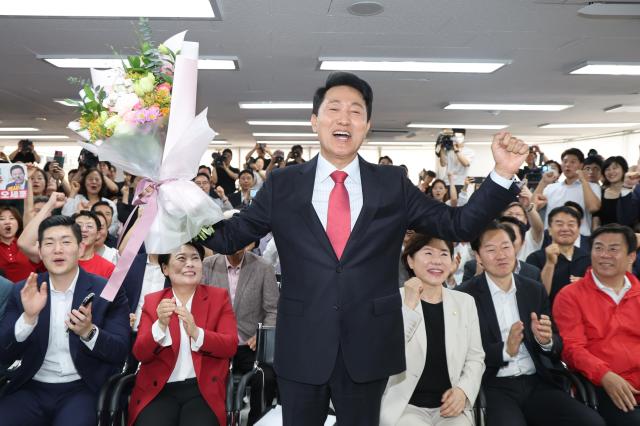
This local election marked the first nationwide political assessment since the inauguration of the Lee Jae-myung administration. While the Democratic Party triumphed in most regions, Seoul took a different path. The citizens of Seoul prioritized the city over party affiliation and competitiveness over politics. This choice reflects both the evaluation and expectations surrounding Mayor Oh, who has been managing the city for several years.
However, the significance of his re-election extends beyond merely serving another term. Mayor Oh now faces a crucial question in Seoul's history: What will the city grow into in the future? Will it be through reconstruction, Han River development, or expanding transportation networks? While all these aspects are important, they are not sufficient on their own.
AI has emerged as a pivotal factor in determining national and urban competitiveness, transcending its status as just an industry. During the election, Mayor Oh proposed key pledges such as making Seoul an 'AI-leading city' and establishing a 'youth AI ladder.' Additionally, the city has already announced its vision of becoming a 'Physical AI-leading city,' aiming to transform the entire city into a testing ground for AI.
Seoul must now aspire to be more than just the capital of South Korea; it should aim to become the global capital of AI. This is the real challenge presented to Mayor Oh by this election.
The 'Miracle on the Han River' has ended. Now, we must create a miracle with AI.
Seoul symbolizes the development of South Korea. It was the center of industrialization in the 1960s and gained global recognition through the Olympics in the 1980s. In the 1990s, it grew into a hub for finance and services, and since the 2000s, it has established itself as a center for the digital economy. Almost every scene of South Korea's economic growth has been tied to Seoul.
However, past successes do not guarantee future prosperity.
The world has entered a new era of competition. In the past industrial revolution, steel and automobiles were the keys to competitiveness. During the internet age, platforms and communication networks held that role. Now, in the AI era, data, talent, algorithms, and innovation ecosystems are the new competitive factors.
The issue is that Seoul remains anchored to the formulas of past successes.
The city still allocates a significant portion of its administrative capacity to housing, transportation, and urban development issues. While these are essential for improving citizens' quality of life, they alone will not suffice to survive in the global urban competition.
Seoul's competitors include New York, London, Tokyo, and Singapore. These cities have already adopted AI as a core strategy for future growth. They are attracting AI research institutes, nurturing AI startups, and competing for AI talent.
Seoul can no longer rest on its laurels as the top city in the country.
Earlier this year, Mayor Oh announced his vision for a 'Physical AI-leading city.' This plan aims to apply technologies that allow AI to make decisions and act in real-world spaces throughout the city, opening Seoul as a testing ground for technology. This is not merely an industrial policy; it is a declaration to transform the entire city into an innovation platform.
What Seoul must do is clear.
It should become a city where AI operates most effectively, rather than just a city that supports AI. Tourists should come to Seoul to experience AI-based transportation systems, businesses should come to experience AI administration, and entrepreneurs should come to engage with the AI ecosystem.
If the Miracle on the Han River was created by manufacturing, then the future of Seoul must be built on the miracle of AI.
The city's competitiveness lies not in its buildings but in its talent.
In the AI era, the key resource is not oil but talent.
The power driving the global AI competition in Silicon Valley ultimately comes from people. Companies like NVIDIA, OpenAI, and Google are the results of exceptional talent coming together.
Seoul already possesses excellent assets.
Top universities such as Seoul National University, Korea University, Yonsei University, Hanyang University, and Sungkyunkwan University are concentrated in the city. The best hospitals, financial institutions, and research organizations in South Korea are also located in Seoul.
However, these assets are not yet connected into a cohesive ecosystem. Universities conduct research, businesses operate, investors provide funding, and the administration offers support, but they all function separately.
For Seoul to become the global AI capital, these elements must be unified.
Research from Seoul National University should directly lead to startups, capital from Yeouido should invest in these startups, and the city should provide opportunities for practical testing, creating a virtuous cycle.
During the election, Oh proposed the 'Youth AI Ladder' initiative, which aims to establish AI-utilizing environments in public libraries and youth centers, providing opportunities for young people to engage with generative AI. This approach views AI not as a technology exclusive to certain companies or experts but as a fundamental capability for citizens.
This direction is correct.
In the AI era, it is not those who cannot code who will be left behind, but those who cannot utilize AI.
Seoul must become a city where all citizens can harness AI.
When citizens utilize AI, businesses will grow. When businesses grow, investment will increase. When investment increases, talent will be attracted back. Ultimately, the competitiveness of the city hinges on the strength of its talent ecosystem.
Seoul should become the headquarters of South Korea's AI strategy.
South Korea has set the goal of becoming an AI G3 nation. The government is investing substantial budgets to foster the AI industry, and global companies are paying attention to the Korean market. Recently, Google announced plans to establish the world's first AI campus in Seoul, raising expectations for the domestic AI ecosystem.
However, national strategy alone is insufficient.
The competition in AI ultimately takes place at the city level. The center of AI competitiveness in the U.S. is not Washington, D.C., but Silicon Valley. In China, it is Beijing and Shenzhen. In the U.K., it is London. South Korea must also center its efforts in Seoul.
Seoul is not merely an administrative capital.
It is where the most talent, capital, and information in South Korea converge.
In the AI era, Seoul's role will only become more critical.
Yongsan should become a global AI hub, Yeouido should be the center of AI finance, Gangnam should lead in AI startups, and Hongneung should be a base for AI bio-innovation. A massive AI innovation belt must connect all these areas.
What the city needs to do is not build more buildings but connect people to people, technology to markets, and universities to businesses.
On this network, new industries and companies can emerge.
The legacy that Mayor Oh should leave lies here.
Han River development can be continued by the next mayor. Reconstruction can also be pursued by future leaders.
However, making Seoul the global AI capital is an opportunity that must be seized now, or it may be lost.
If Seoul becomes the AI capital, South Korea will become a powerhouse in AI. If Seoul falls behind, South Korea will inevitably lag as well.
This election has given Mayor Oh another opportunity. Now, he must transform that opportunity into a future.
:SWOT Analysis:
Strengths:
Mayor Oh Se-hoon's greatest strength is his proven administrative experience, having served as mayor for over a decade. He understands the city's organization and policy mechanisms better than anyone. Additionally, Seoul is home to the country's top universities, research institutions, startups, and financial organizations. The recently announced Physical AI-leading city strategy and Youth AI Ladder policy are significant as they elevate AI to a core agenda for urban growth.
Weaknesses:
Seoul still has an administrative structure that overly concentrates on real estate and transportation issues. There is a risk that the AI strategy may be treated as just one of many policies rather than a core agenda. Furthermore, the connection between Seoul's strong research capabilities and entrepreneurship remains weak, with universities, businesses, and the investment ecosystem operating in a fragmented manner.
Opportunities:
Now is the optimal time for Seoul to challenge for the title of global AI capital. The government is pursuing an AI G3 strategy, and global companies are focusing on the Korean AI market. AI is reshaping the industrial structure centered on manufacturing, redefining urban competitiveness. With the right strategy, Seoul has ample potential to become a leading AI hub in Asia, given its existing talent, capital, and infrastructure.
Threats:
Seoul's greatest threat is global competition. Cities like Singapore, Tokyo, and Shanghai are also making substantial investments to build AI hubs. Additionally, there is a serious issue of talent outflow, with skilled individuals migrating to the U.S. and China. If Seoul fails to leverage AI as a new growth engine, it risks stagnation in urban competitiveness amid aging and low growth.
* This article has been translated by AI.
Copyright ⓒ Aju Press All rights reserved.