
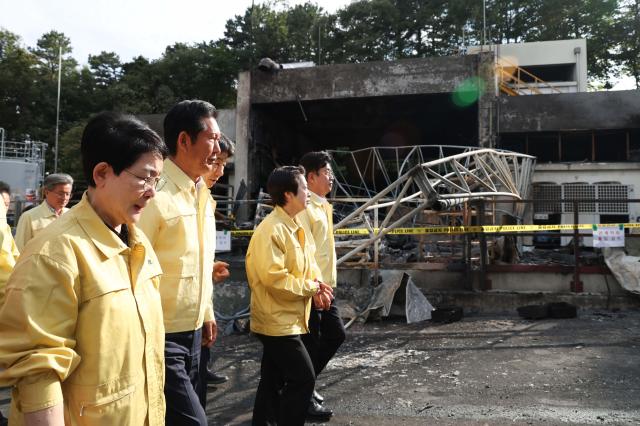
The Ministry of Employment and Labor raided Hanwha Aerospace’s headquarters in Seoul and its Daejeon plant on Thursday in connection with the fatal explosion.
The Ministry of Employment and Labor raided Hanwha Aerospace's headquarters in Seoul and its Daejeon plant on Thursday following the fatal explosion.
Hanwha Aerospace said it would suspend production lines at its domestic sites for two days from Thursday to conduct safety inspections and training, saying "safety comes before production."
The measure applies to nine sites nationwide, including plants in Daejeon, Boeun in North Chungcheong Province and Yeosu in South Jeolla Province, which produce propellants and charges, as well as its Changwon plants in South Gyeongsang Province, which manufacture K9 self-propelled howitzers, armored vehicles and aircraft engines. R&D campuses in Daejeon, Pangyo and Asan are also included. Hanwha Aerospace has a total of 11 domestic business sites.
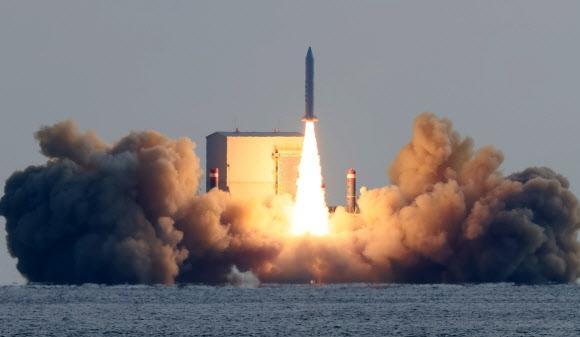
The Daejeon plant, where the explosion occurred, is known as a key site that produces defense and space-related products, including propellants. Hanwha Aerospace had been working with the Agency for Defense Development to conduct the fourth launch of a solid-fuel space rocket from waters near the Jeju naval base on May 30, but the launch was postponed due to bad weather.
"It is difficult to link the two because rockets and weapons are matters involving the military and the government," a Hanwha official told AJP by phone. "For details, you would need to check with DAPA, the military or other state agencies."
The official also said the report linking the accident directly to the launch schedule appeared to be "highly speculative," adding, "It is not accurate to make that connection."
The Defense Ministry's spokesperson's office also said the delay was so far understood to be related to weather conditions and that no confirmed link had been made to the accident.
"As of now, there has been no discussion related to that," an official at the ministry's spokesperson told AJP by phone. "So far, it has been about the weather."
The official added that "various conditions" could still be considered, but said no new launch date had been fixed.
The Agency for Defense Development succeeded in the third test launch of South Korea's indigenous solid-fuel rocket from waters off Jungmun, Jeju, in December 2023 to verify its capability to place a small satellite into orbit.
The upcoming launch would be the fourth test. Hanwha Aerospace is responsible for the launch vehicle, Hanwha Systems for the reconnaissance satellite and Hanwha Ocean for the offshore launch platform.
The accident has also raised questions about why an explosion occurred in a process the company had not considered highly dangerous. During a joint briefing on the day of the accident, a Hanwha Aerospace official said, "The process involved in today's accident had not been recognized as highly dangerous."
The explosion reportedly occurred in a cleaning room in Building 56, where tools used in the production of solid propellant for rocket launch vehicles were washed with water and detergent.
A chemistry expert said fine aluminum particles used in propellants are vulnerable to static electricity, making explosions possible when residues are removed or handled with various materials. However, the expert said the risk of an explosion may have been considered significantly lower because the accident occurred in a room where water was used for cleaning.
Choi Gi-il, a professor of military studies at Sangji University, said the explosion may have been caused by sparks generated by friction, external impact or other minor factors during the cleaning of equipment contaminated with explosives.
"There is a high possibility that sparks occurred during the cleaning of tools or mixing containers contaminated with explosives, due to friction, external impact or other small factors, leading to a chain explosion," Choi said.
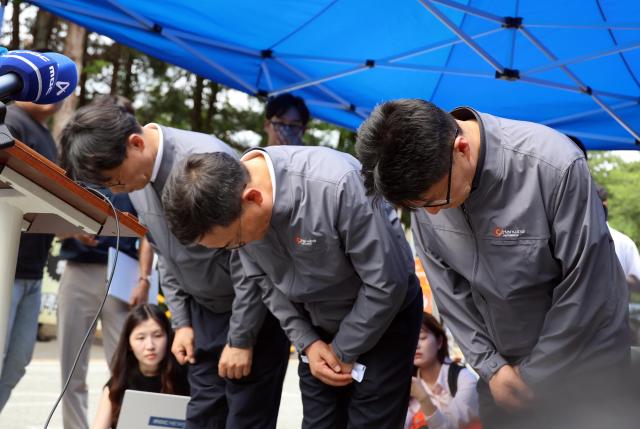
The previous accidents also prompted criticism over the company's safety management. After the 2018 accident, the Labor Ministry found 486 violations during an inspection in the field of occupational safety and health, with 126 cases referred for legal action. At the time, the Daejeon plant's process safety management, or PSM, rating was downgraded to M-, the lowest level.
The latest accident could therefore go beyond a single process failure and raise broader questions over whether safety management has been properly carried out at defense and space facilities that handle high-risk materials, especially given the limited transparency surrounding defense contractors.

Copyright ⓒ Aju Press All rights reserved.
