
Xi Jinping, General Secretary of the Communist Party of China and President of China, will make a state visit to North Korea from June 8 to 9 at the invitation of Kim Jong Un, General Secretary of the Workers' Party of Korea and Chairman of the State Affairs Commission. This marks Xi's second visit to North Korea as the top Chinese leader since June 2019. It is also the first time a Chinese leader has made two state visits to North Korea.
The significance of this visit is underscored by its formal nature. Previous visits by former Presidents Jiang Zemin in 2001 and Hu Jintao in 2005 were categorized as 'official friendly visits.' In contrast, both Xi's 2019 visit and this upcoming visit are classified as 'state visits,' indicating that North Korea will welcome the Chinese leader with the highest level of national protocol. Although the visit is brief, lasting just two days, its diplomatic weight is substantial.
However, the approach to creating a favorable atmosphere differs from 2019. During Xi's 2019 visit, Song Tao, head of the International Liaison Department of the Communist Party, and Luo Zhaohui, Deputy Minister of Foreign Affairs, provided detailed briefings to the press about the significance and key agenda of the visit. They notably announced the itinerary for visiting the China-North Korea Friendship Tower, emphasizing the historical and friendly ties on the 70th anniversary of diplomatic relations. This time, the announcement has been limited to a spokesperson from the International Liaison Department, suggesting that the current state of North Korea-China relations is at a different stage compared to the close interactions seen in 2018 and 2019, when Kim and Xi met five times within 15 months.
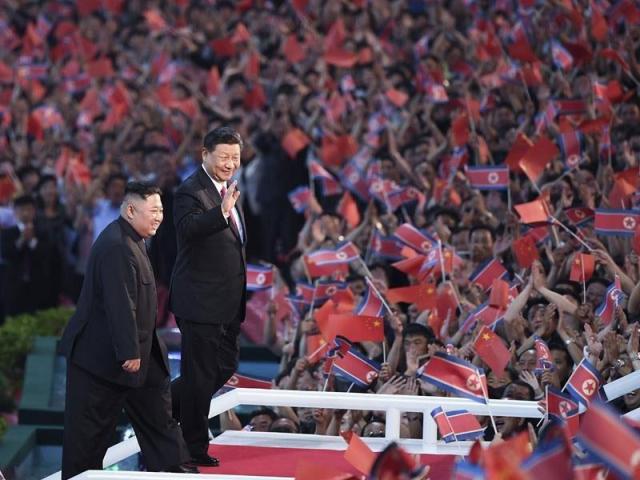
Xi's 2019 visit was meticulously staged, with the Rodong Sinmun publishing an op-ed by Xi on its front page the day before his arrival—an unusual occurrence for a foreign leader. North Korea welcomed Xi at the Kim Il Sung Square in front of the Kumsusan Palace of the Sun, marking the first time this space was opened for a foreign leader. The Kumsusan Guesthouse, where Xi stayed, was also revealed for the first time during that visit.
Another noteworthy moment was the group photo taken in front of the Workers' Party headquarters. Kim invited Xi and his wife to the headquarters, where they posed for a commemorative photo with 32 members of the Politburo. This unprecedented invitation for a foreign leader into a core power space, accompanied by the entire party leadership, was significant. During this upcoming visit, it will be crucial to observe which spaces North Korea opens and what kind of protocol is displayed.
This visit also holds significance as Xi's first overseas trip of the year. In 2019, after Kim made four visits to China, Xi traveled to Pyongyang. This time, Xi's visit comes relatively quickly after Kim's trip to Beijing last September, indicating that North Korea's strategic value has risen again in China's view. It also serves to bolster Kim's diplomatic standing.
The international context surrounding this visit is also important. Xi's 2019 trip occurred just before the G20 summit in Osaka, Japan, where he utilized the Pyongyang card amid complex U.S.-China tensions and North Korean nuclear diplomacy. This visit follows recent U.S.-China and China-Russia summits, suggesting a different character. While it may outwardly emphasize North Korea-China friendship and strategic cooperation, it appears to have a stronger focus on China's 'management' of North Korea.
China cannot completely push North Korea toward Russia, nor can it ignore North Korea's unpredictable actions. Following the Ukraine war, North Korea has strengthened military and economic cooperation with Russia, increasing its leverage. In this context, China needs to realign its relationship with Kim by visiting Pyongyang. This visit can be seen not merely as a friendly gesture but as a diplomatic effort to keep North Korea within China's strategic orbit.
For South Korea, this is a development that cannot be taken lightly. The North Korea-China summit will impact security on the Korean Peninsula, the North Korean nuclear issue, North Korea-China-Russia relations, U.S.-China competition, and inter-Korean relations. Particularly, as North Korea seeks to solidify its status as a nuclear power, the messages China conveys will be crucial. Key points of observation will include how often the term 'denuclearization' is mentioned and the extent to which phrases like 'strategic cooperation' and 'joint response' are emphasized during the talks.
Ultimately, Xi's second state visit to North Korea carries three significant meanings: first, North Korea's strategic value is rising again; second, China aims to manage and coordinate with North Korea; and third, the Korean Peninsula issue is once again at the intersection of U.S.-China competition and North Korea-China-Russia cooperation. While the 2019 visit symbolized the restoration of North Korea-China relations, this upcoming visit serves as a test of how China will handle North Korea amid a rapidly changing international order.
* This article has been translated by AI.

Copyright ⓒ Aju Press All rights reserved.