
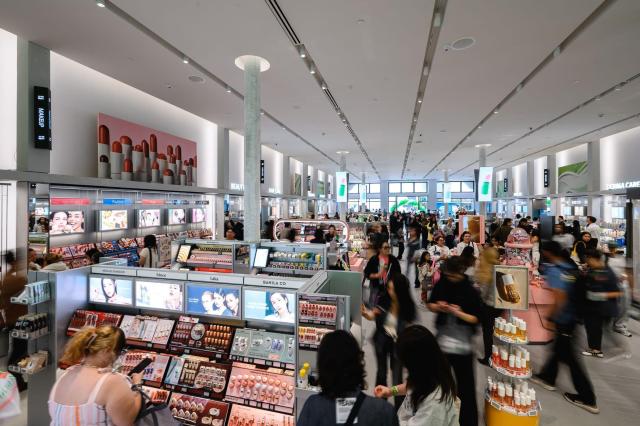
The influence of the Korean Wave is reshaping the status of Korean consumer goods globally, with cosmetics standing out as a leading sector. K-Beauty has evolved beyond a fleeting trend or cultural phenomenon, establishing itself as a key export industry that showcases Korea's technological prowess and brand competitiveness in the global market.
According to the Ministry of Trade, Industry and Energy, cosmetic exports reached $1.18 billion in May, marking the highest figure for that month on record. Cumulative exports from January to May exceeded $5.6 billion, reflecting a more than 20% increase compared to the same period last year. Notably, cosmetics have surpassed agricultural and fishery products, which have long been the mainstay of domestic consumer goods exports, becoming the top export item. This shift indicates that the Korean economy is diversifying its export structure, moving away from a reliance on semiconductors and automobiles towards consumer goods and cultural content as new growth drivers.
A significant change in the export market is noteworthy. Previously, K-Beauty was heavily reliant on the Chinese market, experiencing rapid growth fueled by Chinese consumer preferences. However, this dependence also exposed structural vulnerabilities, leading to significant fluctuations in performance due to changes in the Chinese market. Recently, exports to the U.S. and European markets have surged, demonstrating successful market diversification. Exports to the U.S. increased by over 40%, while countries like the UK, Netherlands, and Germany recorded triple-digit growth rates. Mexico also saw a remarkable 116% growth compared to the previous year. This trend of reducing reliance on specific countries and expanding into the global market is a positive development.
The success of K-Beauty is no coincidence. It results from a combination of high quality, reasonable pricing, rapid product development, and the global spread of the Korean Wave, particularly through K-pop and K-dramas. Additionally, continuous innovation from small and medium-sized cosmetic companies and effective global marketing strategies utilizing online platforms have played a crucial role. Whereas the industry once followed foreign brands, it is now the global market that looks to Korean cosmetic trends.
However, complacency with current achievements is not an option. The global market can become fiercely competitive at any moment. Chinese companies are already pursuing price competitiveness, and global corporations are studying K-Beauty's successful model. Today's success does not guarantee tomorrow's victories.
As the government has recently emphasized, K-Beauty is evolving into a future industry intertwined with artificial intelligence (AI), big data, biotechnology, and digital healthcare. Technologies that analyze skin conditions, personalized cosmetics, and smart beauty devices are becoming a reality. There is significant potential for K-Beauty to develop into a high-value industry that connects manufacturing, services, and tourism.
To achieve this, the government's role is crucial. Systematic support is needed for research and development, assistance with overseas certifications and regulatory compliance, expansion of export financing, and nurturing beauty tech startups. In particular, enhancing smart manufacturing infrastructure, as demanded by companies, is essential for securing global competitiveness. Reducing regulatory uncertainties and creating an environment conducive to the growth of new industries is also a responsibility of the government.
While semiconductors and automobiles have been the main drivers of Korea's economic growth, K-Beauty has the potential to become a new key industry responsible for the future. To ensure that K-Beauty does not remain a temporary trend but instead establishes itself as a leading industry in the global market, both private innovation and government support must work in tandem. A more strategic and consistent effort is required to cultivate K-Beauty as a national strategic industry, ensuring that products made in Korea continue to set global trends.
* This article has been translated by AI.
Copyright ⓒ Aju Press All rights reserved.