
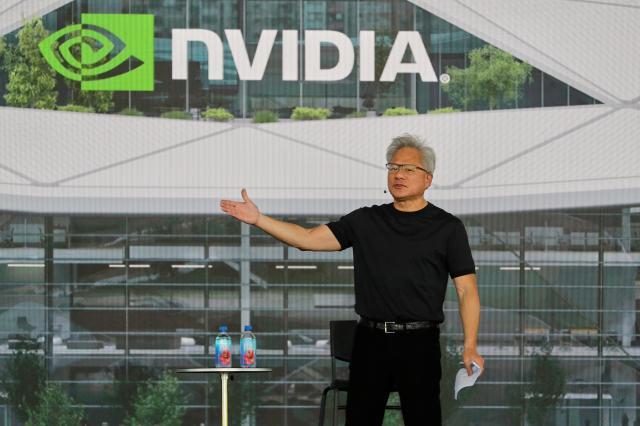
On June 7, the WSJ reported that Nvidia topped the '2026 Best Companies for the Future' ranking, which evaluated S&P 500 companies. Alphabet, Microsoft, Meta Platforms, and Cisco Systems secured the second to fifth positions, respectively.
The ranking was compiled by Venderblabs at the request of the WSJ Leadership Institute. It assessed companies across six categories: AI readiness, innovation, talent competitiveness, financial health, supply chain stability, and organizational agility. AI readiness measures how well a company is prepared for an AI-driven environment, while organizational agility evaluates how quickly a company can respond to changes. The analysis utilized 30 metrics from 20 data providers.
The top ranks were dominated by technology companies, with one-third of the top 100 being tech manufacturing and service firms. Among the top 25, 18 were classified as technology companies or identified as such in the market. Among non-tech firms, Mastercard ranked seventh, S&P Global was 13th, and Visa came in 15th. Johnson & Johnson placed 20th, while Eli Lilly was 22nd.
AI readiness was a key evaluation criterion. Venderblabs analyzed how AI is integrated into business operations and the extent of employees' AI-related skills and experience. The presence of AI-related terms in board explanations and executive biographies was also considered in the assessment. Companies that had high AI utilization prior to the rise of generative AI scored relatively well in this ranking.
Among semiconductor companies, AMD ranked 16th overall, making it the second-highest ranked semiconductor firm after Nvidia. AMD received high scores for organizational agility, innovation, and AI readiness. Broadcom ranked 110th, performing well in innovation and financial health but scoring lower in AI readiness, talent competitiveness, and supply chain stability.
Apple placed 12th overall, but its AI evaluation ranked it 56th. This was the lowest position among the 'Magnificent Seven' big tech firms in the U.S. Apple received low scores in AI adoption, investment, mergers and acquisitions, and strategic indicators. Venderblabs noted that Apple's cautious approach to public disclosures may have influenced its evaluation based on public filings.
The WSJ clarified that this ranking is not a predictor of future stock prices. Rick Wurtsman, co-founder of Venderblabs, described the ranking as a "diagnostic tool, not a predictive tool."
* This article has been translated by AI.
Copyright ⓒ Aju Press All rights reserved.