
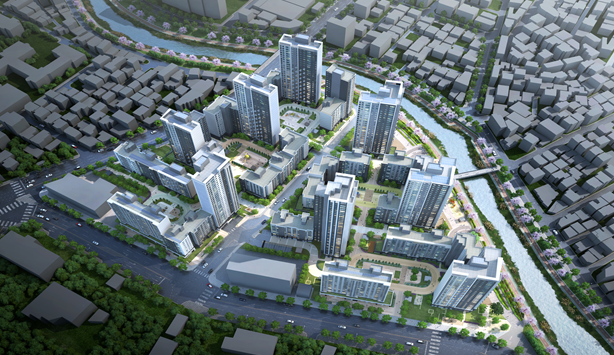
Oh Se-hoon, the mayor of Seoul, has successfully secured a fifth term in the June 3 local elections, raising expectations for continuity in the city's urban renewal policies. Mayor Oh is expected to continue the private-led urban renewal initiatives, including the rapid integrated planning and Moa Town projects, aiming to start construction on 310,000 housing units by 2031.
According to industry sources on June 8, mid-sized construction companies are expanding their foothold in Moa Town projects, focusing on aging low-rise residential areas in districts such as Gangbuk, Jungnang, Guro, and Geumcheon. While the scale of contracts for these projects is smaller than large-scale redevelopment efforts, the limited availability of new supply sites in Seoul makes securing stable order backlogs attractive.
Moa Town is a specialized initiative by the Seoul government that aims to revitalize aging low-rise residential areas by consolidating them into units of less than 100,000 square meters. Individual projects are pursued as small-scale urban renewal efforts, such as street housing maintenance projects, but if adjacent areas are secured consecutively, it is possible to create brand towns with hundreds to thousands of housing units.
Key players gaining traction in the Moa Town bidding process include Kolon Global, DL Construction, Dongbu Construction, Ssangyong Construction, and BS Hanyang. These companies are not only focusing on single project bids but are also adopting strategies to enhance brand recognition by bundling adjacent areas.
Kolon Global is recognized as an active player in the Seoul Moa Town market. The company has secured projects in the Bondon area of Gangbuk-gu, one of the initial Moa Town sites, and is reportedly pursuing related urban renewal projects in areas like Myeonmok-dong in Jungnang-gu and Cheonho-dong in Gangdong-gu.
DL Construction has been winning consecutive bids for street housing maintenance projects related to Moa Town in Myeonmok-dong and Seongbuk-gu's Seokgwan-dong, aiming to create a brand town under the 'e-Pyeonhansaeng' label. According to DL Construction, the Myeonmok Station Zone 6 project will consist of 253 units, and plans are in place to supply 792 units by combining Zones 2, 4, and 6. Following this, the Myeonmok Station Zone 1, with 435 units, has also been confirmed for construction, aiming for a continuous order effect in the Myeonmok-dong area.
Dongbu Construction is also establishing its presence in the Moa Town-related street housing maintenance project in Guro-gu's Gocheok-dong. DL Construction had previously secured the construction rights for the Gocheok-dong street housing maintenance project in 2022, indicating a growing competitive atmosphere among mid-sized construction companies focusing on aging low-rise residential areas in Guro, Jungnang, and Seongbuk.
Ssangyong Construction has achieved success in the Moa Town project in the Shiheung-dong area of Geumcheon-gu. This area is known for its concentration of aging low-rise residential buildings, highlighting significant demand for residential environment improvements through Moa Town initiatives. Ssangyong Construction expects to enhance its brand recognition in the southwestern part of Seoul through this project.
BS Hanyang has reportedly secured contracts in small-scale urban renewal projects in Myeonmok-dong, which is a focal point for multiple Moa Town initiatives attracting the interest of mid-sized construction companies. BS Hanyang is leveraging its 'Sujin' brand to expand its presence in Seoul's urban renewal market.
Industry insiders believe that Moa Town could become a significant entry point for mid-sized construction companies into Seoul's urban renewal market. Competing in the large-scale reconstruction and redevelopment market against major construction firms is challenging, but Moa Town projects are relatively smaller in scale, allowing for brand town effects through consecutive orders in specific regions.
An industry source stated, "In a situation where new supply sites in Seoul are scarce, Moa Town provides a market where mid-sized construction companies can securely establish their order backlogs. With Mayor Oh's fifth term ensuring policy continuity, competition for orders will likely intensify, particularly in aging low-rise residential areas outside Gangnam."
* This article has been translated by AI.
Copyright ⓒ Aju Press All rights reserved.