
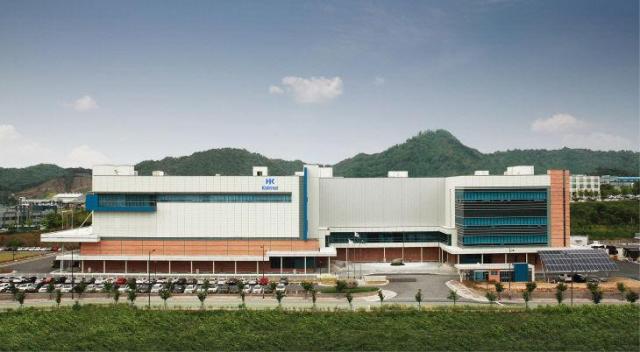
Overview of Korea Kolmar's Sejong factory [Photo=Korea Kolmar]
The global K-beauty boom has prompted the domestic cosmetics manufacturing industry, particularly Original Design Manufacturers (ODM), to enter a fierce competition for production capacity. Companies are making aggressive investments in digital supply chains and expanding factories worth hundreds of millions of dollars to establish a foundation for long-term growth.
According to the Ministry of Trade, Industry and Energy, cumulative cosmetic exports from January to May this year surpassed $5.6 billion, significantly exceeding the approximately $4.6 billion recorded during the same period last year. Cosmetics have become the top export item among five promising consumer goods categories, which include agricultural and fishery products, fashion apparel, household goods, and pharmaceuticals. Notably, cosmetic exports in May alone reached $1.18 billion, marking a 24.2% increase compared to the same month last year, setting a record for May exports.
Cosmetic exports are projected to reach $10.2 billion in 2024, marking the first time surpassing the $10 billion mark, following last year's record of $11.4 billion. The upward trend is expected to continue this year, with forecasts suggesting that annual exports could reach an all-time high.
While exports to China, the largest market for Korean cosmetics, have slowed, growth has been observed in Europe and the Americas, contributing to overall increases. Statistics from the Korea International Trade Association indicate that from January to April, exports to the U.S. rose by 40.5% year-on-year to $880 million, the highest among all markets. In contrast, exports to China fell by 14% to $650 million.
Exports to the U.K. reached $160 million, and to the Netherlands, $110 million, reflecting increases of 172.2% and 231.0%, respectively, compared to last year. Germany (122.6%), Estonia (225.1%), and Mexico (116.8%) also reported triple-digit growth rates.
In response to the surging demand for K-beauty, ODM companies are moving quickly. Cosmecca Korea announced on June 5 that it has decided to acquire land and a factory in Cheongju worth 64 billion won. This acquisition amounts to 10.13% of its total assets of 631.8 billion won as of the end of last year. The company aims to increase its annual production capacity, currently at 1.3 billion units, to meet diverse orders from global clients, including skincare, hydrogel masks, and sun care products.
On the same day, Cosmax revamped its collaboration platform, 'eBiz,' to diversify its supply chain. The new system allows any raw material company worldwide to easily propose new ingredients through an English page, lowering entry barriers that previously required intermediaries.
Korea Kolmar plans to end operations at its Beijing factory by the end of the first half of this year and invest approximately 170 billion won to expand its Sejong factory. Production will be centralized at its Wuxi factory in China, significantly boosting domestic production capacity. Additionally, Korea Kolmar has been operating its second factory in the U.S. since last year, establishing a foothold for exports to the North American market.
CNC International is also constructing a large new factory in Cheongju Central Valley with an investment of 79 billion won. The new facility will occupy over 60,000 square meters, more than six times larger than its existing factories in Hwaseong and Yongin, and is expected to increase annual production capacity by 1.4 billion units to a total of 1.45 billion units upon completion in September next year.
An industry insider stated, "As K-beauty exports expand beyond China to North America and Europe, the role of ODM companies is becoming increasingly important. How proactively they respond in terms of facility expansion, raw material sourcing, research and development, and local supply chain establishment will determine their market dominance in the future."
* This article has been translated by AI.
Copyright ⓒ Aju Press All rights reserved.