

The Illusion That Technology Will Save Humanity=Adam Becker, translated by Park Joo-yong, East Asia.
The author, an astrophysicist and science journalist, critiques the prevailing Silicon Valley ideology that new technologies must be developed as quickly as possible for the benefit of humanity. He questions whether a technology-driven future is based on scientific evidence or merely serves to perpetuate the wealth and power of a few Silicon Valley billionaires.
The book centers on interviews with key thinkers from Silicon Valley and Oxford, such as Eliezer Yudkowsky and Anders Sandberg, who view the emergence of artificial general intelligence (AGI) as inevitable. Through these interviews, scientific validation of original papers, and extensive field research, the author traces how the grand worldview of 'techno-salvation' has been formed while revealing the contradictions within this ideological framework.
He critically examines how concepts like effective altruism, the singularity, AI alignment issues, and technological accelerationism have risen to prominence. Notably, he analyzes how effective altruism prioritizes the urgent issue of future space colonization over current problems like poverty, climate crises, and war. Yudkowsky's apocalyptic warning that humanity faces a high likelihood of extinction upon the advent of AGI is highlighted as a distraction from real issues such as bias in AI, job displacement, and energy consumption, providing a pretext for the tech industry to evade regulation.
The author warns that major visions lack scientific grounding and could lead to disaster for humanity even if realized. He also argues that concentrated technological monopolies could become tools of oppression against humanity.
The book emphasizes that the fears articulated by Silicon Valley are not new and prompts readers to consider whether the narrative of salvation promised by technology truly serves all of humanity. "Fear of the apocalypse, fear of death. But these are already familiar to humanity. Fearing death is natural, and immortality has been humanity's oldest fantasy."
“Human history—especially the history of the 20th century—is filled with examples of utopian movements that ended violently. In 1990, British philosopher Isaiah Berlin asked, ‘What price would we not pay if we could make humanity forever just, happy, creative, and harmonious?’ He remarked that if such an omelet exists, we should break all the eggs to make it. This was the belief of Lenin, Trotsky, and Mao Zedong. Yudkowsky’s advice to world leaders to risk nuclear war to achieve their goals indicates that such extreme utopian ideologies have already taken root among rationalists.” (p. 287)
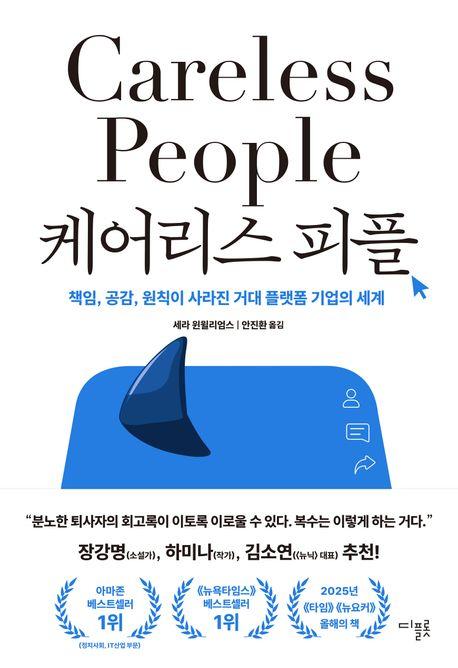
Careless People=Sarah Winfield, translated by Ahn Jin-hwan, Deflot.
The author shares her experiences as the Director of Public Policy at Facebook (now Meta) for seven years, working closely with founder Mark Zuckerberg. Joining the company during its rapid growth as a global social media platform, she initially believed that Facebook's technology would save the world. However, she later testified before the U.S. Senate Judiciary Committee in 2025 regarding Meta's relationship with China, user privacy issues, and attempts at internal retaliation and silencing.
The book details labor exploitation, workplace harassment, sexual assault, election interference via the platform, algorithm manipulation targeting youth, and repeated diplomatic blunders that the author either experienced or witnessed. While Facebook promotes the hopeful slogan of making the world a more open and connected place, she criticizes the reality that it destroys community trust and threatens democracy. Her central argument is that while the company has changed the world, the changes have been more negative than positive.
She particularly points to Zuckerberg's autocratic leadership style, effectively running the company as a one-man rule. The organizational culture is also problematic; for instance, she was discouraged from discussing her role as a mother.
Additionally, the author claims that Facebook has allowed the spread of fake news and hate and racist content, failing to respond actively even as the platform has been exploited as a tool for inciting violence by extremist groups. During the election process, when Donald Trump misled voters with fake news on Facebook, the company's leadership did not take the situation seriously, citing that Trump spent more on advertising than Hillary Clinton.
Novelist Jang Gang-myung remarked, “What happens when great power ignores great responsibility? It decays from within and destroys the world outside. This book is a vivid indictment of how irresponsibly a colossal force in our era has acted and how rotten it has become inside.”
“Like Mao Zedong's Little Red Book, Facebook's own Little Red Book is filled with the words, images, and core principles of its supreme leader. In this case, the leader is not Mao but Mark. Another ‘MZ’ is expressing a peculiar form of Maoist fervor. The first page reads, ‘Facebook was created to achieve a social mission. To make the world a more open and connected place.’” (p. 75)
* This article has been translated by AI.
Copyright ⓒ Aju Press All rights reserved.