
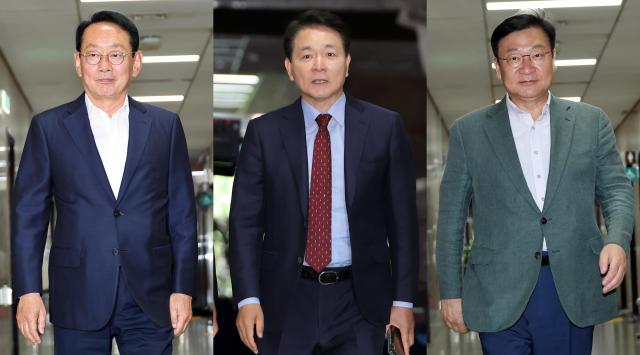
Candidates for the People Power Party's National Assembly Leader election: Kim Do-eup, Seong Il-jong, and Jeong Jeom-sik [Photo=Yonhap News]
The election for the National Assembly Leader of the People Power Party is evolving into a preliminary round for the next party leadership competition. This shift follows former leader Han Dong-hoon's election as an independent in a by-election, prompting pro-Han lawmakers to work on expanding their influence within the party. Analysts suggest that this election could trigger a butterfly effect that reshapes the broader conservative political landscape in South Korea.
According to the People Power Party, a mobile voting system will be implemented for the National Assembly Leader election scheduled for June 10, allowing lawmakers who cannot attend the general assembly to participate. This marks the first time mobile voting will be used in this election. Party members who are unable to attend due to overseas trips or other commitments will still be able to cast their votes for their preferred candidates.
A debate featuring the candidates will take place the day before the vote. Organized by junior lawmakers, the event will include opening statements from each candidate, four common questions, and a session for free questions from lawmakers, concluding with final remarks. Although not an official debate hosted by the party's election committee, all candidates—Kim Do-eup, Jeong Jeom-sik, and Seong Il-jong—are expected to participate.
The party had previously decided to postpone the election by one day to ensure sufficient campaigning time, responding to concerns raised about the election timeline. With the introduction of mobile voting and the organization of a candidate-led debate, the party appears to be gearing up for a successful election.
The timing of the election, occurring shortly after the June 3 local elections, is significant as it is closely tied to the upcoming leadership competition. The outcome of the National Assembly Leader election could greatly influence the future dynamics of the party and the conservative political landscape. The next leader is expected to play a crucial role in determining the fate of the 'Han Dong-hoon regime.'
A key issue in this election is whether Han Dong-hoon will be allowed to rejoin the party. Lawmakers aligned with Han are advocating for his reinstatement, and the candidates' positions on this matter could significantly impact the election. Han is currently expelled from the People Power Party, and his reinstatement would require the cancellation of his expulsion. While the National Assembly Leader does not have the authority to revoke expulsions, they can exert pressure on the party leadership to address the issue.
In a related statement, Kim Do-eup appeared on CBS Radio's 'Park Seong-tae's News Show' and emphasized the need for a united conservative front to achieve a successful government formation, stating, "To create a government, the conservative forces must unite in a chemical bond to release energy. If we are to assume a grand perspective of government formation, Han's reinstatement is necessary."
This election is also linked to discussions about accountability for the local election results. Within the party, there is ongoing debate about who bears responsibility for the anticipated losses. If Jeong Jeom-sik, the former policy committee chair, is elected, it could alleviate some of the accountability concerns for the current leadership under Han Dong-hoon. Conversely, if another candidate wins, it may be interpreted as an acknowledgment of the leadership's significant responsibility for the local election losses.
The newly elected National Assembly Leader will need to engage in negotiations with the Democratic Party regarding the formation of the National Assembly. Given the contentious nature of the legislative committee discussions, particularly concerning the Legal Affairs and Judiciary Committee, these negotiations are expected to be challenging. Although the People Power Party has increased its seat count through the recent by-elections, it still holds only 110 seats, limiting its negotiating power.
According to the People Power Party, a mobile voting system will be implemented for the National Assembly Leader election scheduled for June 10, allowing lawmakers who cannot attend the general assembly to participate. This marks the first time mobile voting will be used in this election. Party members who are unable to attend due to overseas trips or other commitments will still be able to cast their votes for their preferred candidates.
A debate featuring the candidates will take place the day before the vote. Organized by junior lawmakers, the event will include opening statements from each candidate, four common questions, and a session for free questions from lawmakers, concluding with final remarks. Although not an official debate hosted by the party's election committee, all candidates—Kim Do-eup, Jeong Jeom-sik, and Seong Il-jong—are expected to participate.
The party had previously decided to postpone the election by one day to ensure sufficient campaigning time, responding to concerns raised about the election timeline. With the introduction of mobile voting and the organization of a candidate-led debate, the party appears to be gearing up for a successful election.
The timing of the election, occurring shortly after the June 3 local elections, is significant as it is closely tied to the upcoming leadership competition. The outcome of the National Assembly Leader election could greatly influence the future dynamics of the party and the conservative political landscape. The next leader is expected to play a crucial role in determining the fate of the 'Han Dong-hoon regime.'
A key issue in this election is whether Han Dong-hoon will be allowed to rejoin the party. Lawmakers aligned with Han are advocating for his reinstatement, and the candidates' positions on this matter could significantly impact the election. Han is currently expelled from the People Power Party, and his reinstatement would require the cancellation of his expulsion. While the National Assembly Leader does not have the authority to revoke expulsions, they can exert pressure on the party leadership to address the issue.
In a related statement, Kim Do-eup appeared on CBS Radio's 'Park Seong-tae's News Show' and emphasized the need for a united conservative front to achieve a successful government formation, stating, "To create a government, the conservative forces must unite in a chemical bond to release energy. If we are to assume a grand perspective of government formation, Han's reinstatement is necessary."
This election is also linked to discussions about accountability for the local election results. Within the party, there is ongoing debate about who bears responsibility for the anticipated losses. If Jeong Jeom-sik, the former policy committee chair, is elected, it could alleviate some of the accountability concerns for the current leadership under Han Dong-hoon. Conversely, if another candidate wins, it may be interpreted as an acknowledgment of the leadership's significant responsibility for the local election losses.
The newly elected National Assembly Leader will need to engage in negotiations with the Democratic Party regarding the formation of the National Assembly. Given the contentious nature of the legislative committee discussions, particularly concerning the Legal Affairs and Judiciary Committee, these negotiations are expected to be challenging. Although the People Power Party has increased its seat count through the recent by-elections, it still holds only 110 seats, limiting its negotiating power.
* This article has been translated by AI.
Copyright ⓒ Aju Press All rights reserved.