
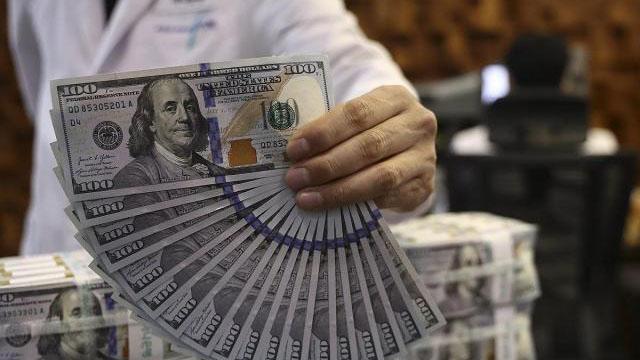
[Photo by Yonhap News]
The won-dollar exchange rate has surged to levels reminiscent of the global financial crisis, yet the supply of dollars in the foreign exchange market remains limited. Analysts suggest that dollars earned from exports are not entering the market but are instead being held in deposits, which is constraining any potential decline in the exchange rate.
According to the Bank of Korea, as of April, domestic companies held $80.04 billion in dollar deposits, a 10.1% increase from the previous month’s $72.71 billion.
Corporate dollar deposits have remained high, starting at $81.92 billion at the end of last year, slightly increasing to $81.93 billion in January and then decreasing to $81.62 billion in February. In March, expectations of a rising exchange rate led to increased profit-taking, dropping the total to $72.71 billion, but by April, it had rebounded above $80 billion.
The increase in foreign currency deposits is impacting the supply and demand dynamics of the foreign exchange market. When export companies bring dollars earned overseas back to Korea and convert them to won, it increases the supply of dollars in the market. Conversely, if companies choose to hold dollars in foreign currency deposits or use them for overseas investments, the supply of dollars decreases. In a situation where demand for dollars is high and supply is dwindling, it becomes difficult for the exchange rate to fall.
Recent analyses indicate that companies have little incentive to convert dollars to won. Ongoing U.S. trade pressures and demands for increased investment in the U.S. have led companies to prefer using dollars earned from exports for expanding U.S. factories, investing in local subsidiaries, and procuring raw materials and components rather than bringing them back to Korea.
Moon Da-un, a researcher at Korea Investment & Securities, stated, "Expectations of a rising exchange rate are driving a concentration of dollar purchases, creating a self-fulfilling cycle of supply and demand imbalance that pushes the exchange rate higher. Events such as the potential announcement of additional tariffs, the May Consumer Price Index (CPI), and the hawkish stance expected from the Federal Open Market Committee (FOMC) meeting continue to exert downward pressure on the won."
Given that the foreign currency deposit statistics are based on April data, the situation may have worsened recently. Since May, the won-dollar exchange rate has continued to rise due to Middle Eastern risks and foreign capital outflows, recently soaring to around 1,560 won. As the exchange rate increases, companies are more inclined to hold onto their dollars rather than sell them quickly.
The government is also aware that companies' dollar holdings can impact the supply and demand in the foreign exchange market. When the won-dollar exchange rate threatened to breach the 1,500 won mark at the end of last year, the presidential office requested major export companies to cooperate in supplying dollars. The rationale was that converting dollars held by export companies into won and supplying them to the market could help alleviate upward pressure on the exchange rate.
Foreign exchange authorities are paying close attention to how corporate foreign exchange transactions affect market supply and demand. On July 7, they announced that they would focus on monitoring excessive delays in the collection of export proceeds or premature payments for imports during the rising exchange rate phase.
Lee Hyung-ryeol, director of the International Finance Bureau at the Ministry of Finance, and Yoon Kyung-soo, director of the International Department at the Bank of Korea, stated, "We will not tolerate excessive volatility and one-sided trends compared to fundamentals and will respond strongly," indicating a verbal intervention in the market.
According to the Bank of Korea, as of April, domestic companies held $80.04 billion in dollar deposits, a 10.1% increase from the previous month’s $72.71 billion.
Corporate dollar deposits have remained high, starting at $81.92 billion at the end of last year, slightly increasing to $81.93 billion in January and then decreasing to $81.62 billion in February. In March, expectations of a rising exchange rate led to increased profit-taking, dropping the total to $72.71 billion, but by April, it had rebounded above $80 billion.
The increase in foreign currency deposits is impacting the supply and demand dynamics of the foreign exchange market. When export companies bring dollars earned overseas back to Korea and convert them to won, it increases the supply of dollars in the market. Conversely, if companies choose to hold dollars in foreign currency deposits or use them for overseas investments, the supply of dollars decreases. In a situation where demand for dollars is high and supply is dwindling, it becomes difficult for the exchange rate to fall.
Recent analyses indicate that companies have little incentive to convert dollars to won. Ongoing U.S. trade pressures and demands for increased investment in the U.S. have led companies to prefer using dollars earned from exports for expanding U.S. factories, investing in local subsidiaries, and procuring raw materials and components rather than bringing them back to Korea.
Moon Da-un, a researcher at Korea Investment & Securities, stated, "Expectations of a rising exchange rate are driving a concentration of dollar purchases, creating a self-fulfilling cycle of supply and demand imbalance that pushes the exchange rate higher. Events such as the potential announcement of additional tariffs, the May Consumer Price Index (CPI), and the hawkish stance expected from the Federal Open Market Committee (FOMC) meeting continue to exert downward pressure on the won."
Given that the foreign currency deposit statistics are based on April data, the situation may have worsened recently. Since May, the won-dollar exchange rate has continued to rise due to Middle Eastern risks and foreign capital outflows, recently soaring to around 1,560 won. As the exchange rate increases, companies are more inclined to hold onto their dollars rather than sell them quickly.
The government is also aware that companies' dollar holdings can impact the supply and demand in the foreign exchange market. When the won-dollar exchange rate threatened to breach the 1,500 won mark at the end of last year, the presidential office requested major export companies to cooperate in supplying dollars. The rationale was that converting dollars held by export companies into won and supplying them to the market could help alleviate upward pressure on the exchange rate.
Foreign exchange authorities are paying close attention to how corporate foreign exchange transactions affect market supply and demand. On July 7, they announced that they would focus on monitoring excessive delays in the collection of export proceeds or premature payments for imports during the rising exchange rate phase.
Lee Hyung-ryeol, director of the International Finance Bureau at the Ministry of Finance, and Yoon Kyung-soo, director of the International Department at the Bank of Korea, stated, "We will not tolerate excessive volatility and one-sided trends compared to fundamentals and will respond strongly," indicating a verbal intervention in the market.
* This article has been translated by AI.
Copyright ⓒ Aju Press All rights reserved.