
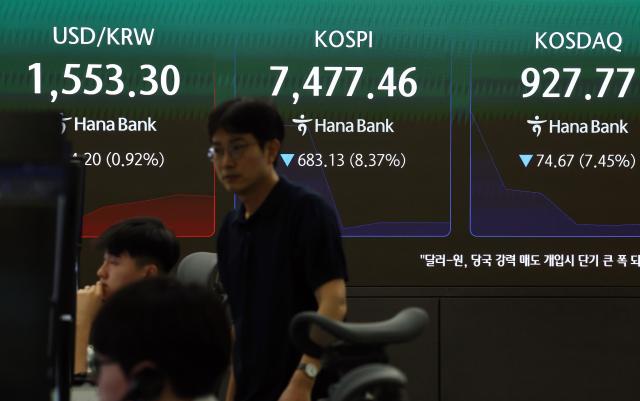
The won-dollar exchange rate has surged past 1,500 won, creating mixed outcomes across various sectors. Companies with a high export ratio are anticipating improved profitability from the rising exchange rate, while those heavily reliant on imported raw materials and energy are concerned about increasing cost pressures. Consumers are also expected to face higher living expenses due to rising import prices.
According to the Bank of Korea, the average won-dollar exchange rate from June 1 to June 5 was recorded at 1,522.4 won. The monthly average exchange rate jumped from 1,448.4 won in February to 1,492.5 won in March, slightly decreased to 1,485.0 won in April, but rose again to 1,491.3 won last month, indicating volatility at high levels.
Typically, a rising exchange rate benefits export companies, as they can secure more revenue when converting dollars earned abroad into won. Industries such as semiconductors, automobiles, and shipbuilding, which have high export ratios, are seen as primary beneficiaries. Companies with production facilities concentrated in South Korea tend to experience a more significant improvement in performance due to the rising exchange rate.
Conversely, sectors with high dependence on imported raw materials and energy face increased burdens. Since payments for crude oil, natural gas, and grains are made in dollars, a rising exchange rate directly translates to higher cost pressures. The refining, aviation, and food industries are notable examples. Increased import costs are likely to lead to upward pressure on product prices.
Recent analyses suggest that the benefits of improved export competitiveness due to high exchange rates are not as significant as in the past. As companies increasingly process imported intermediate goods for export, the positive effects of rising exports may be offset by rising costs. Particularly, materials such as semiconductors, crude oil, and battery components are difficult to substitute, necessitating continued imports even as exchange rates rise. This creates a structure where rising exchange rates lead to increased procurement costs.
The impact of high exchange rates also extends to households. A decline in the value of the won raises import prices, affecting costs for fuel, food, and public utilities. The costs of international travel and overseas purchases are also expected to rise. Recently, concerns have emerged that rising international oil prices could further increase cost pressures for companies and inflationary pressures.
The Korea Institute for Industrial Economics and Trade (KIET) noted that during the global financial crisis of 2008-2009, a sharp drop in international oil prices significantly alleviated energy import costs, cushioning the shock. However, the current situation is characterized by both high exchange rates and soaring oil prices, leaving no buffer against rising energy costs.
Kim Tae-hoon, a senior researcher at KIET, stated, "The rise in exchange rates simultaneously increases import costs and improves export price competitiveness. In an economy like South Korea's, which heavily relies on imported intermediate goods, the benefits of improved export competitiveness due to rising exchange rates can be largely offset by rising cost pressures." He added, "The net effect of exchange rates varies depending on the import structure and dependence on intermediate goods by industry, making it difficult to view high exchange rates solely as a boon for exports."
* This article has been translated by AI.
Copyright ⓒ Aju Press All rights reserved.