
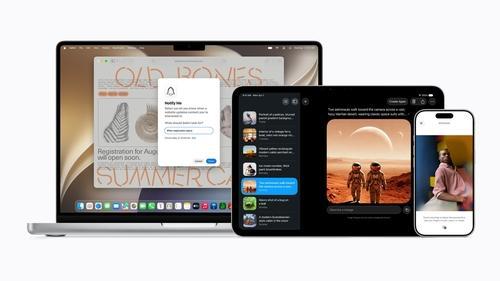
On June 8, during the Worldwide Developers Conference (WWDC) held at its headquarters in Cupertino, California, Apple announced the new Siri AI and plans to expand Apple Intelligence. The revamped Siri is designed to engage in natural conversations, recognize content displayed on screens, and reference previous dialogues to provide responses.
Key features include personalization and contextual understanding. Siri AI can process user requests based on information within messages or apps. For instance, if an address not saved in contacts appears in a message, Siri can incorporate it into scheduling, navigation, or response drafting. The capabilities for web information access and image comprehension have also been enhanced.
The upgrade incorporates the Google Gemini model. Apple aims to maintain privacy standards by processing AI functions through its own devices and private cloud computing, rather than relying solely on its models. This strategy combines external AI models to enhance Siri's performance.
Initially, Siri AI will be available in English, first on iPhones and iPads, and as a standalone app on Macs. Apple is also optimizing it for the Apple Watch. However, it will not be released initially in the European Union or the Chinese market.
Market reactions have been lukewarm. On the day of the announcement, Apple’s stock fell by 1.9%. Investors were hoping for strong signals that Apple was catching up in the AI race, but the announcement remained within expected parameters.
Long-term revenue potential remains. Bank of America estimates that if the revamped Siri succeeds, Apple could generate an additional $15 billion to $30 billion in revenue by 2030. The AI assistant could create new revenue streams within the iPhone ecosystem by connecting to search, app execution, scheduling, payments, and e-commerce.
This announcement signals a strategic shift for Apple, as it seeks to enhance Siri's competitiveness by integrating external AI models. Although Apple had previously indicated improvements to Siri starting in 2024, delays have led to perceptions that it is lagging behind competitors like OpenAI, Google, and Microsoft. Actual evaluations will likely depend on the functionality and user experience following the launch, as well as the speed of service expansion in various regions.
* This article has been translated by AI.
Copyright ⓒ Aju Press All rights reserved.