
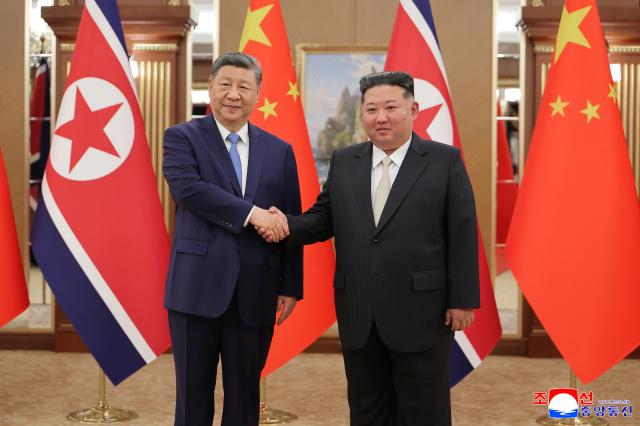
North Korean state media reported that Xi Jinping, President of China, and Kim Jong Un, Chairman of the Workers' Party of Korea, agreed to expand and develop cooperation across various fields during their summit in Pyongyang. Kim reaffirmed his support for the 'One China' principle.
The Korean Central News Agency (KCNA) reported on June 9 that during the summit held at the Kumsusan Palace of the Sun, the two leaders agreed to enhance strategic communication through high-level exchanges between their parties and countries, and to further expand cooperation in politics, economics, culture, and other areas, thereby opening a new chapter in North Korea-China relations.
The leaders also agreed to hold commemorative events next month to mark the 65th anniversary of the North Korea-China Friendship and Cooperation Treaty, which is set to take place on July 11.
Additionally, Kim and Xi exchanged views on international and regional issues, achieving a consensus on strengthening strategic coordination and cooperation, firmly safeguarding the sovereignty, security, and developmental interests of both countries, and jointly maintaining peace and development in the region and the world.
Kim stated, "Regardless of how the situation changes, our party and government will fully support and uphold the policies and positions of the Chinese party and government to protect core interests based on the 'One China' principle." He added that he would continue to regard North Korea-China friendship as the most significant strategic endeavor, vowing to strengthen and develop the relationship into a unique, genuine, and solid strategic partnership that serves as a model for relations between socialist countries.
Xi emphasized that the Chinese party and government's firm stance on valuing traditional China-North Korea friendship will not change, asserting that their determination to safeguard mutual interests and a favorable strategic environment remains steadfast.
While Chinese media reported extensively on Xi's remarks about enhancing exchanges in diplomacy and law enforcement, including military cooperation, the KCNA did not mention these statements. Furthermore, the KCNA did not reference the 'Four Global Initiatives' that Xi highlighted in his recent contributions to the Rodong Sinmun and during the summit.
Professor Lim Eul-chul from Kyungnam University’s Institute for Far Eastern Studies noted that North Korea emphasized regime dignity and its 'special relationship,' while China focused on inter-state 'pragmatic cooperation' and its leadership in the 'international order,' indicating a clear divergence in perspectives. He analyzed that China is urging North Korea to actively participate in its economic and security bloc, while North Korea desires economic cooperation but is wary of becoming dependent on China's economic model or global supply chain system.
The Korean Central News Agency (KCNA) reported on June 9 that during the summit held at the Kumsusan Palace of the Sun, the two leaders agreed to enhance strategic communication through high-level exchanges between their parties and countries, and to further expand cooperation in politics, economics, culture, and other areas, thereby opening a new chapter in North Korea-China relations.
The leaders also agreed to hold commemorative events next month to mark the 65th anniversary of the North Korea-China Friendship and Cooperation Treaty, which is set to take place on July 11.
Additionally, Kim and Xi exchanged views on international and regional issues, achieving a consensus on strengthening strategic coordination and cooperation, firmly safeguarding the sovereignty, security, and developmental interests of both countries, and jointly maintaining peace and development in the region and the world.
Kim stated, "Regardless of how the situation changes, our party and government will fully support and uphold the policies and positions of the Chinese party and government to protect core interests based on the 'One China' principle." He added that he would continue to regard North Korea-China friendship as the most significant strategic endeavor, vowing to strengthen and develop the relationship into a unique, genuine, and solid strategic partnership that serves as a model for relations between socialist countries.
Xi emphasized that the Chinese party and government's firm stance on valuing traditional China-North Korea friendship will not change, asserting that their determination to safeguard mutual interests and a favorable strategic environment remains steadfast.
While Chinese media reported extensively on Xi's remarks about enhancing exchanges in diplomacy and law enforcement, including military cooperation, the KCNA did not mention these statements. Furthermore, the KCNA did not reference the 'Four Global Initiatives' that Xi highlighted in his recent contributions to the Rodong Sinmun and during the summit.
Professor Lim Eul-chul from Kyungnam University’s Institute for Far Eastern Studies noted that North Korea emphasized regime dignity and its 'special relationship,' while China focused on inter-state 'pragmatic cooperation' and its leadership in the 'international order,' indicating a clear divergence in perspectives. He analyzed that China is urging North Korea to actively participate in its economic and security bloc, while North Korea desires economic cooperation but is wary of becoming dependent on China's economic model or global supply chain system.
* This article has been translated by AI.
Copyright ⓒ Aju Press All rights reserved.