
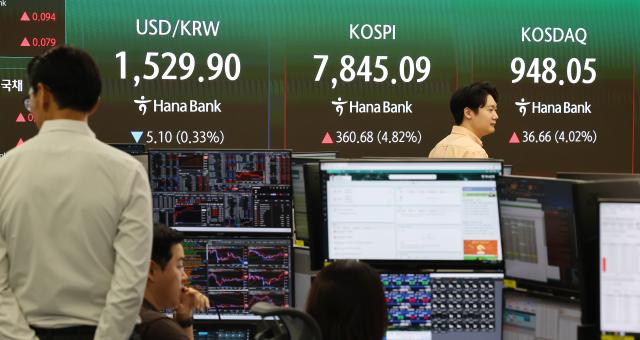
The won-dollar exchange rate is declining due to active intervention by foreign exchange authorities.
As of 9:17 a.m. on June 9, the exchange rate in the Seoul foreign exchange market is 1,531.3 won per dollar. The rate opened at 1,529.4 won, down 5.6 won from the previous session.
This decline is interpreted as a result of the authorities' strengthened commitment to managing the exchange rate. On June 7, they held an emergency meeting to address market conditions and stated they would respond strictly to speculative trading.
Following a spike in the exchange rate to the 1,550 won range the previous day, the Ministry of Economy and Finance and the Bank of Korea issued verbal interventions, asserting they would not tolerate excessive volatility and one-sided movements compared to fundamentals.
The National Pension Service, a major player in the foreign exchange market, has also resumed currency hedging, contributing to the decline in the exchange rate. Reports of the National Pension Service restarting its halted forward foreign exchange sales since the beginning of the year led to a widening drop in the exchange rate during overnight trading.
In overnight trading, U.S. stocks rebounded, particularly in technology and semiconductor sectors. The Dow Jones Industrial Average closed down 80.77 points (0.16%) at 50,786.01.
The S&P 500 index rose 21.99 points (0.30%) to finish at 7,405.73, while the Nasdaq Composite gained 220.23 points (0.86%) to close at 25,929.66.
International oil prices moderated their gains, with Brent crude for August delivery closing up 1.25% at $94.25 per barrel, and West Texas Intermediate (WTI) for July delivery rising 0.84% to $91.30.
Investor sentiment improved slightly following news that Israel and Iran agreed to halt further attacks after recent exchanges of fire over the weekend.
Min Kyung-won, an economist at Woori Bank, stated, "Today, the won-dollar exchange rate is expected to decline as the conflict in the Middle East subsides and the dollar weakens. The authorities' stabilization measures are also likely to suppress the expansion of offshore long positions, supporting the drop in the exchange rate."
* This article has been translated by AI.
Copyright ⓒ Aju Press All rights reserved.